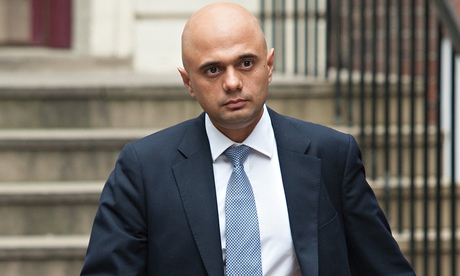
The culture secretary has warned that the entire system of funding the BBC would be up for debate if the Conservatives win the next election.
In comments that reveal the extent of the battle faced by the BBC in the runup to the renewal of its charter in 2016, Savid Javid said: “We need to take a fresh look at how to fund the BBC for the long term ... There are various funding models out there. Charter review should rule nothing out or rule anything in.”
Asked what alternatives there are to the current model of an annual flat-rate licence fee, Javid said he “hasn’t made any decision” before going on to mention a subscription model such as that funding commercial rivals such as Sky, and a “state-owned commercially funded model” similar to Channel 4.
The minister indicated that the charter review process will start in earnest next June once the election is over and a review of licence fee enforcement is complete. Such a review will give the government and the BBC just 18 months to hammer out a deal, whereas the last review process took three years.
Just before his appearance before the Commons select committee on media, culture and sport, the government announced that David Perry QC, a leading criminal law barrister who has worked on several high-profile cases including the prosecution of Abu Hamza and the cash for honours scandal, would lead its independent review into whether non-payment of the BBC licence fee should be decriminalised.
Javid was the final figure giving evidence to the select committee’s inquiry into the future of the BBC. In her first appearance before the committee since her appointment as chair of the BBC Trust two weeks ago, Rona Fairhead appeared to back the BBC’s controversial decision to close the BBC3 TV channel before the trust had even received final details of the proposal.
Talking of the challenges of producing for an online-only world, Fairhead said: “The idea of moving BBC3 and making it online in and of itself is good,” before going on to add “We haven’t done our final review of BBC3. It’s a really difficult challenge. [Younger viewers] are certainly watching very differently, typically they watch on the go”.
Tory MP Philip Davies accused Fairhead of having “gone native in record time” as she seemed to think that everything at the BBC was wonderful. Fairhead, the former FT group executive, replied, “ I don’t think I have gone native, I don’t ever intend to go native.”
Outgoing trustee David Liddiment, who is standing down after eight years, said there was a “widespread view that the trust was not fit for purpose” and admitted there was a “faultline in the way that the trust was set up”.
He also raised eyebrows among committee members by suggesting that “few licence fee payers had heard of the trust”.
Having brought forward his review into decriminalisation last month, Javid repeated his opinion that the cost of the licence fee was too high for some people, with cases of non-payment taking up 10% of the time in magistrates’ courts. “I do think £145.50 a year for some families is a lot of money,” he said.
To other questions including those from committee chair John Whittingdale about the TV licensing authorities using powers under Ripa to chase people over non-payment of licence fee, Javid said he had no answers but added that asking such questions “suggests there will always be a licence fee”.
As well taking aim at the licence fee, Javid said the much-criticised BBC Trust model of governance should be reviewed.
“I think there definitely needs to be a fresh look at what the governance structure should be in the charter review process. Some people have said should there be one board. Other ideas out there are should [media regulator] Ofcom have a role. Another idea I’ve heard about is should there be a BBC Trust-type structure but independent from the BBC, for example not funded by the BBC. These are good questions. I don’t have an answer at this point.”
In comments that recognised controversy over executive pay, the Jimmy Savile scandal and more Javid said: “The trust has had to deal with significant challenges and they have made some mistakes which has been well recognised over the last few years and part of that is down to governance ... There’s a bit of a question-mark over how accountable BBC has been to licence fee payers.”
However, he seemed less keen on scrapping the idea of a charter altogether, saying, “The current structure of the royal charter is still relevant today. Anything that has big impact on the independence of the BBC should be treated very carefully. Notwithstanding that parliament’s role is very important in holding BBC to account. What I would absolutely expect and certainly happen if I was secretary of state at the time [of charter review] is once government puts forward a proposal for charter it should be debated in the house and MPs given an opportunity to share their views.”
Among other issues Javid suggested would have to be part of the charter review process were spinning off BBC Worldwide, the BBC’s commercial arm, as well as the full privatisation of the BBC TV production operation.
Of the latter, he said: “This comes back to whole issue of the size of the BBC and does it need to be doing everything does. These are good legitimate questions. Yes, it would form part of charter review.”