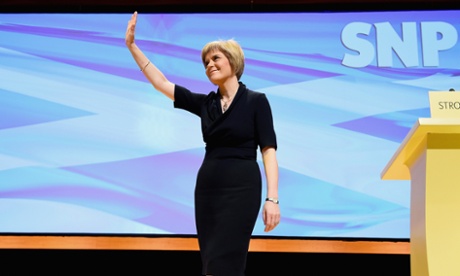
The Scottish National Party may hold the balance of power in Westminster after the May general election, but the BBC’s rules on election broadcasts mean the majority of voters outside of Scotland are unlikely to see the party’s direct pitch to voters.
The BBC Trust said it would risk discrediting the broadcasts if the SNP’s party election programmes were shown in parts of the UK where viewers were unable to vote for it, even though polls have shown that it could end up as the third biggest party after the 7 May election.
In a further sign of how broadcasters are struggling to keep up with the breakdown of traditional three-party politics, the trust has announced that its eligibility criteria for party election broadcasts will be unchanged from the last election in 2010.
It means the SNP’s political broadcasts will only be broadcast in Scotland.
Nevertheless, SNP leader Nicola Sturgeon was invited to take part in the revised proposals for party leader debates, put forward by the BBC, ITV, Channel 4 and Sky, along with Ukip leader Nigel Farage, Green leader Natalie Bennett, Plaid Cymru’s Leanne Wood and the leaders of the three main parties.
The BBC and ITV debates, which feature all seven leaders, would be broadcast across the UK. The the Channel 4/Sky News debate would feature a head to head between David Cameron and Ed Miliband.
A three-month consultation by the trust concluded that parties would be eligible for an election broadcast in each constituent nation of the UK in the run-up to the 7 May poll if they field 89 candidates in England, 10 in Scotland, seven in Wales or three in Northern Ireland.
The SNP will not meet the criteria for a UK-wide broadcast because it does not plan to field any candidates outside of Scotland, let alone the 89 that would be required in England.
Trustees said they acknowledged the argument that parties including the SNP might hold the balance of power in a hung parliament, but it said airing election broadcasts for parties which people could not vote for would “risk discrediting” the broadcasts and “create viewer and listener indifference”.
In the case of the SNP, they said viewers in England “would not be interested” and “would be frustrated”.
The BBC executive agreed, arguing that it could “undermine the principles” of the broadcast to “provide a direct appeal to those who can vote for that party”.
It is not yet known exactly how many candidates each party will put forward – nominations are due by 9 April.
But if they stand in a similar number of seats as in 2010, the British National Party and English Democrats would pass the threshold for a broadcast alongside larger parties.
According to the criteria published by the trust on Wednesday, to qualify for more than one election broadcast, parties may have to “demonstrate substantial levels of past and/or current electoral support in that nation”.
Even if they are not broadcast nationwide, members of the trust said viewers would be able to access election broadcasts online and through social media, as well as watching them via country-specific BBC channels on digital TV.
Following the increasing fragmentation across the British political landscape, the trust opened its consultation in November to ask if the “proposed party election broadcast allocation criteria seems appropriate”.
During the consultation, the BBC Trust received a number of responses, including one from Mebyon Kernow, or the Party for Cornwall, which said it was “disappointed” that it would have to field candidates outside Cornwall to make it eligible for a broadcast.
It pointed out that the party was featured in BBC2 satire W1A and said, “it did seem strange to us that, at the same time as the BBC had failed to allow [Mebyon Kernow] fair access to the media, it should sanction a satirical programme which featured the issue as a vehicle for humour.”
• To contact the MediaGuardian news desk email editor@mediaguardian.co.uk or phone 020 3353 3857. For all other inquiries please call the main Guardian switchboard on 020 3353 2000. If you are writing a comment for publication, please mark clearly “for publication”.
• To get the latest media news to your desktop or mobile, follow MediaGuardian onTwitter and Facebook.