Summary - Who won?
Conventional wisdom has it that election debates favour the outsiders, the insurgent parties.
But this evening that did not happen. It was the mainstream, establishment parties that emerged with substantial gains. And the two figures who have most cause to feel disappointed were the challengers.
Whether or not David Cameron gained more than Ed Miliband is not entirely clear. But they both secured some advantage from the proceedings.
Ed Miliband came away looking plausible and authoritative, and the CCHQ claim that he is a third-rate liability continues to look ever more shaky. He can claim to have “won” the debate on the polling evidence (even if the methodology looks a bit odd - see 11.59pm) and he got a platform to taunt Cameron for not daring to debate him head-to-head on primetime TV. This won’t necessarily win him the election, but he took a risk deciding to take part, and it did not go wrong.
David Cameron’s refusal to turn up was demeaning, but he is probably right in thinking that most voters won’t bother with such media processology and he has managed to get the media talking, yet again, about the prospect of Labour governing with the support of the SNP. Even though Miliband faced Sturgeon down on this about as robustly as he could, the prospect of Labour governing with SNP votes does seem to alarm some English voters, which is why the Tories are campaigning on this so strongly. Tonight’s debate will enable Cameron to keep the scare running.
In Westminster Nicola Sturgeon is perceived as an insurgent, but her party is in power in Edinburgh and she has been a minister since 2007, making her more experienced in government than Cameron. She is also a remarkably good debater, and it showed again tonight. But, having made such a big impression last time, she made less of an impact tonight, and probably came off worse in her final showdown with Miliband. (See 9.41pm.)
Natalie Bennett came top on one Twitter sentiment analysis, and performed quite strongly overall, and yet she failed to make the impact some might have expected when the Greens were polling at their peak a few months ago. Why? Because there were three alternative, anti-austerity, anti-nuclear leftish progressive women, and she was not the most dominant. She was outshone by Sturgeon. Much the same could be said for Leanne Wood, although she does not need to make a splash UK-wise, and will probably get a deservedly good write-up in Wales.
And Nigel Farage has had better nights. When he debated Nick Clegg last year, he was exciting and reasonably plausible. But now his determination to pick fights seems contrived, he has given up on moderate opinion, and he seems to have retreated into Ukip core-vote appeasment. Like Bennett, he did not do badly, by any means. But he may have gone home thinking the debate did not give him quite the boost he was expecting.
That’s all from me for tonight. Thanks for the comments.
Updated
Earlier I was speculating why the Survation poll found that Ed Miliband won the debate, even though the respondents said Nicola Sturgeon performed the best. (See 11.16pm.) But Sam Freedman has explained it.
When respondents were asked about who performed the best, the question started: “Putting aside your own party preference and basing your answer on what you saw or heard during the programme ...”
But Survation did not use this preamble for the first question, which was simply: “Who do you think ‘won’ the debate”?
Freedman has posted a link to the tables on Twitter.
It is not clear why the questions were not asked in a consistent way, but I have asked.
@AndrewSparrow no - they only asked it on the "best" Q not on the "who won" Q. Don't know why. http://t.co/w78J3T5rHT
— Sam Freedman (@Samfr) April 16, 2015
UPDATE: I’ve had this reply from Survation.
@AndrewSparrow @DamianSurvation Hi Andrew, I think that's implied given the format. We also have 2010 vote to analyse.
— Survation. (@Survation) April 16, 2015
Updated
The Times and the Telegraph have got Nicola Sturgeon’s offer to prop up a Labour government as their main story, as have we.
Friday's Times front page: Join me or you’ll pay, Sturgeon tells Labour #tomorrowspaperstoday #bbcpapers #BBCDebate pic.twitter.com/U1lIQYl8Ed
— Nick Sutton (@suttonnick) April 16, 2015
Friday's Telegraph front page: Sturgeon offer to Miliband: I'll make you PM #tomorrowspaperstoday #bbcpapers #GE2015 pic.twitter.com/1TKOGLWZoc
— Nick Sutton (@suttonnick) April 16, 2015
As James Forsyth pointed out, that’s the line Number 10 was hoping would emerge as the dominant story. (See 11.35pm.)
Rachel Sylvester at the Times (paywall) says the David Cameron may regret not turning up.
There was one question tonight: would Ed Miliband be the representative of the Westminster establishment, attacked on all sides by the insurgents, or would he look like the only statesman on the stage?
On balance, I thought he looked prime ministerial while still having a bit of Opposition zeal ...
The crucial moment came when Ms Sturgeon challenged Mr Miliband to join forces with her to defeat the Tories. “I can help Labour be bolder”, she declared, a dream for Conservative spin-doctors. But the Labour man came back immediately with a “no” telling her: “I have fundamental disagreements with you, Nicola,” and insisting: “I’ve fought Tories all my life.”
His straight to camera invitation to the prime minister in the closing statement – “debate me and let the people decide” – only reinforced the impression of confidence.
At one point Mr Miliband slipped into saying “when I’m Prime Minister I will…” It was presumably a deliberate attempt to make the voters imagine him in Number 10.
I wonder whether David Cameron now regrets not turning up.
But James Forsyth at Coffee House says the night may have worked out to Cameron’s advantage.
But the last question was about hung parliaments and it is this which caused Miliband some problems. He stuck to his line about Labour wanting an overall majority and warned about the risks of voting SNP. But Sturgeon took the opportunity to set out how she and the other progressive parties would make Labour ‘better’. I suspect that as we speak CCHQ is cutting the footage into a new attack video. The BBC News at Ten led with this part of the debate and if the BBC news machine decides this is the main story of the night then it could become a problem for Labour and would justify Cameron’s decision to avoid this debate.
Here's one of the sketches from Adam Dant - the official 2015 election artist - from the #bbcdebate pic.twitter.com/98WwMOK5Je
— JamesClayton (@JamesClayton5) April 16, 2015
Here’s the Rupert Murdoch verdict.
No show Cameron only winner in UK debate as Scot Sturgeon clobbers Miliband and Farage stumbles.
— Rupert Murdoch (@rupertmurdoch) April 16, 2015
Survation findings in full - Miliband wins debate, but Sturgeon 'performed best'
Here are the full Survation figures.
The @Survation #BBCDebate poll in full: pic.twitter.com/dioPrJfRZK
— Alberto Nardelli (@AlbertoNardelli) April 16, 2015
They are rather confusing. When people were asked who “won” the debate, Ed Miliband came out on top. But, when they were asked who “performed the best”, Nicola Sturgeon won. She was on 35%, ahead of Miliband on 29% and Farage on 26%.
How do we make sense of that? Because, when asked who performed best, you may be making an objective judgment about technical debating skills (see 8.29pm) while, when asked who “won”, you may be making a more subjective judgment about the leader you favoured the most.
This would explain why the Survation panel also thought Miliband would make the best prime minister (43%, ahead of Farage on 26% and Sturgeon on 25%) and why they also thought he had the most convincing arguments (31%, joint equal with Farage, ahead of Sturgeon on 24%).
But the Survation findings will reinforce Lewis Baston’s belief that post-debate polling is a waste of time.
If you missed the debate, here are the clips that we think you should watch:
Updated
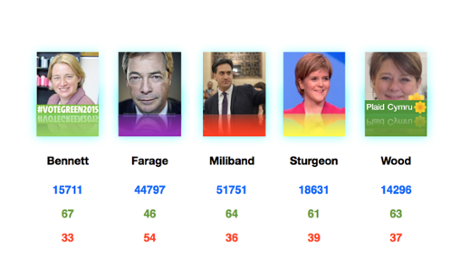
Here’s yet another Twitter sentiment analysis. This one’s from TheySay.
According to their figures, Natalie Bennett, the Green party leader “won”, in the sense of having the highest net ratings (proportion of positive tweets minus negative tweets). Ed Miliband generated a much higher volume of positive tweets, but the volume of negative tweets meant his net score was lower than Bennett’s.
The blue figures show total number of tweets, the green number shows the percentage that were positive, and the red the percentage that were negative.
Updated
And this is Deborah Mattinson’s report of the event:
Fewer of our panellists tuned in tonight, and several of those who did confessed that they would not have done so had we not asked them to – and that it was, well, a little dull. One said he’d rather be watching Double Decker Driving School on ITV. Quite a few did not stay the distance...
Those who did persist concluded that Nicola Sturgeon was the ‘winner’: with Ed Miliband the closest runner-up. Sturgeon continued to impress with her passion and verve: her attacks on Farage drew particular praise, and prompting one panelist from Taunton Deane to complain that ‘voting Nicola’ was not possible. Miliband walked a fine line between seeming the establishment figure drawing fire that might have belonged more naturally to Cameron, and talking what one panelist described as ‘real politics’. For the first time in the campaign several voters described his as ‘Prime Ministerial’.
Farage found less support than in the previous debate, although a minority praised his determination to ‘speak the truth’. Few commented on Wood and Bennett who seemed more out shadowed than they had when there were seven players on the stage.
Although our panelists often enjoyed the spats, some likened it to PMQs with poor behaviour from politicians and audience alike.
The Guardian is working with the pollsters BritainThinks to conduct focus groups throughout the election with 60 voters in five key marginals. Each has an app to feedback what they are noticing in the campaign in real time. Here’s their reaction to the debate:
Updated
Deborah Mattinson is writing a piece for us which will be up soon about what her focus groups are saying about the debate. But she’s revealed the key point on Twitter.
Most striking finding from @BritainThinks @guardian panel tonight was @Ed_Miliband described by some as 'starting to look Prime Ministerial'
— Deborah Mattinson (@debmattinson) April 16, 2015
According to Labour, the Survation poll shows that, amongst those who watched the debate, Ed Miliband is preferred as prime minister to David Cameron by 45% to 40%.
Here is more analysis from the Twitter sentiment analysis carried out by Demos and others. (See 9.59pm.) This is from their post-debate summary.
In terms of ratio, the biggest winner was Nicola Sturgeon (80% cheers), followed by Ed Miliband (74% cheers). The biggest loser was Cameron’s empty chair (69% boos). Farage was the only leader to have more boos than cheers, but still had more cheers than any other leader (7,359).
The biggest Tweet (by far) was for “David Cameron has decided not to attend tonight’s debate. If you’re applying for the job of PM, you should turn up to the job interview” [3245 retweets: tweeted by Ed Miliband]
David Cameron has decided not to attend tonight’s debate. If you're applying for the job of PM, you should turn up to the job interview.
— Ed Miliband (@Ed_Miliband) April 16, 2015
Farage is receiving a huge amount of the Twitter traffic. As of writing, he’s received more traffic than all of the other contestants combined, peaking when he was booed by the audience when he said he was talking to the ‘real audience’ at home. The audience on Twitter didn’t like that all.
In contrast, the biggest moments for both Sturgeon and Miliband were when challenging Farage on immigration, the clapping from the studio echoed across the Twittersphere. Miliband’s only time with more boos than cheers was also under challenge from Sturgeon not to miss the opportunity to keep the Tories out of government.
Cameron couldn’t escape the debate, his biggest moment coming as both Sturgeon and Miliband criticized his no show early on.
On Nicola Sturgeon...
Nicola Sturgeon certainly played a blinder. Her game is a tricky one – to make Labour look like the only alternative to the Conservatives in England, while reminding Scotland that it, of course, doesn’t have to put up with the brand of Labour that Westminster serves up to the rest of the country. She’d do anything to “kick the Tories out” – anything except sacrifice her own party in an election it can never win.

That she manages such a feat is testament to her brilliance as a politician. She got in big digs against the Tories. She thought it a “disgrace” that David Cameron wasn’t taking part in the debate. She thought the Conservative right-to-buy social housing notion was “one of the worst ideas I’ve ever heard.” But she also made Miliband look like the lucky guy who could bask in her charisma if only he’d stop being such a boring, ole PM in waiting.
Sturgeon, above all, reminds voters in England that if you’re still thinking of a left-wing protest vote, then you’re out of luck. She’s got that business all sewn up. Stray from Labour in England and you really will let the Tories in, because Scotland isn’t going to be there to make up the Labour safe-seat numbers. For sure.
Updated
On Leanne Wood...
An opposition that promises more of the same is no opposition at all,” said Leanne Wood, underlining her conviction that she will not prop up a Labour government “hell-bent on implementing Tory cuts.” Her final speech ended with the words “diolch yn fawr” (thank you in Welsh), reflecting her insistence on speaking directly to Wales – a strategy which was apparent from the start despite having led to criticism after the ITV debates.
“Plaid Cymru will not apologise for speaking up for Wales at every opportunity”, she said. And rightly so. As a minority party committed to civic nationalism, Plaid has never claimed to be in a position to pursue the interests of English voters. To viewers Welsh and English alike, however, Wood attempted to prove that there exists an alternative to the “grey, stale politics as usual,” and I think she achieved that.

Calm, though occasionally slightly hesitant, Wood spoke with great feeling, underlining Plaid’s commitment to a post-austerity Wales, her passionate belief in the importance of the welfare state, and her obvious distain for the divisive anti-immigration politics of Farage, or “her friend on the far right,” as she scathingly put it (I cheered). “You abuse immigrants & those with HIV and then complain UKIP is being abused,” she told him, with fire in her voice. Like Sturgeon, she did not shake his hand before walking off stage.
Obviously popular, Wood’s statements were met with frequent applause, though her attempts to challenge Miliband fell rather flat, not least because he didn’t care to answer any of her questions.
Updated
Reporting from the spin room:
Despite the absence of David Cameron from Thursday night’s debate, the Conservative party had a full spin operation in force, with three Tory ministers and the party’s head of communications Craig Oliver in attendance at the screening for members of the press.
Health secretary Jeremy Hunt, former leader of the house of commons William Hague and environment secretary Liz Truss were all in what is dubbed ‘the spin room’ to give their verdict on the evening’s events.
Hunt took the line – central to the Tory election campaign – that the debate had been evidence of the “coalition of chaos” that would await the British people if Ed Miliband became the next prime minister.
“[Nicola] Sturgeon” clearly got the better of [Ed Miliband],” said Liz Truss. “There was a big contrast in the debate where the prime minister was there. He was clearly in control of the situation.”
“It looked like the start of negotiations,” she said.
A spokesperson for the party described the run-ins between Miliband and Sturgeon as “brilliant”, adding that if the two parties were to do a deal after the election, “we know who the stronger negotiator would be and it wouldn’t be Ed Miliband”.
“Do you think we saw the real David Cameron tonight?” asked one journalist. “I think we saw the reality of what a chaotic coalition would look like,” said Truss.
“At the end of the debate we really saw it descend into chaos and I think that’s a picture of what the next five years would look like without having a majority Conservative government”
Updated
On Natalie Bennett...
OH, to have been a fly on the Green MP Caroline Lucas’s wall last night. Received wisdom had it that Ed Miliband would be horribly squeezed in this third debate, a lone establishment stooge overrun by insurgents. But if anyone was drowned out, it was the Greens’ Natalie Bennett. With three party leaders – Nicola Sturgeon, Leanne Wood and Bennett herself - selling a similar anti-establishment, anti-austerity message there was only really room for one to capture the imagination and the blunt truth is that it wasn’t Bennett. When she paid generous tributes to her predecessor Lucas, who went on to be the party’s sole MP, you wondered what would have happened had it been Lucas on the podium.

It wasn’t all bad. When the inevitable immigration question arose, Australian-born Bennett had powerful things to say in defence of free movement – even if they felt a little rehearsed compared to Sturgeon’s off-the-cuff savaging of Nigel Farage. She had a deft bedside manner with audience members and since English viewers hankering for a leftwing alternative can’t vote SNP perhaps it doesn’t matter that their leader outshone her. Committed Greens will be happy enough. But let’s just say an outbreak of Bennettmania feels unlikely.
Updated
Miliband won, says Survation poll
Here are the Survation figures. Ed Miliband won
Survation for @dailymirror #bbcdebate Who do you think ‘won’ the debate? Miliband 35% Sturgeon 31% Farage 27% Bennett 5% Wood - 2%
— Survation. (@Survation) April 16, 2015
Our picture editor for the night Joanna Ruck has been watching for the body language in the debate:


Updated
Where was Nick Clegg? Faisal Islam says he knows.
Nick Clegg is apparently in the pub in Sheffield right now after spending the night out canvassing, I am told, exclusively. #ge2015
— Faisal Islam (@faisalislam) April 16, 2015
Here’s a rare tweet from David Axelrod, the American election strategist hired to help the Labour campaign.
Strong, confident debate for @Ed_Miliband-the only plausible alternative to 5 more years of top down, Tory economics. And where WAS Cameron?
— David Axelrod (@davidaxelrod) April 16, 2015
Nick Clegg wants to do a one-to-one debate with Ed Miliband.
I'll debate with you @Ed_Miliband, even if @David_Cameron won't. Any time, any place, anywhere. #BBCDebate pic.twitter.com/GWc6JGBVYk
— Nick Clegg (@nick_clegg) April 16, 2015
Twitter is already imagining what this looks like:
Sliding into your debate like..... #BBCDebate #LibDem pic.twitter.com/ojUkWJ7VzA
— General Boles (@GeneralBoles) April 16, 2015
Updated
I’ve seen three Twitter sentiment analyses from the debate so far. All three suggest Nicola Sturgeon was the most popular leader.
But, according to the Press Association, Nigel Farage was the most talked about person on Twitter.
Ukip leader Nigel Farage proved yet again to be the big talking point on social media during the BBC election debate this evening, as his comments on immigration saw Twitter chatter spike.
The five leaders were mentioned in total more than 250,000 times on Twitter during the course of the 90-minute programme.
Farage was the most discussed leader, with more than 112,000 mentions on Twitter during the broadcast.
The Ukip leader saw a peak in discussions when he clashed with SNP leader Nicola Sturgeon over immigration and accused the studio audience of being biased.
At that point Mr Farage was being mentioned more than 4,600 times per minute on the social network.
Ed Miliband and SNP leader Nicola Sturgeon were the second two most discussed leaders, with more than 65,000 and 58,000 mentions respectively.
The Labour leader wishes he was part of the group hug …
when u try to talk to girls in the club but they're with their squad pic.twitter.com/Mk3Lr8JJno
— Tom Phillips (@flashboy) April 16, 2015
On Ed Miliband...
What a risk he took. They warned Ed Miliband was making a grave error to join a line-up of the second division. Instead he stood there as the only prime minister in the room – and one the great loser was the man who wasn’t there. Attack after attack rained down on the Tories, but their leader had run from the field. Killer punch line, addressed to Cameron - “If you think this election is about leadership come and debate me – Let the people decide.”

Calm, relaxed, even laughing sometimes, he hit all the buttons. He attacked failed markets, rogue employers and landlords, defusing attacks by frankly admitting Labour didn’t build enough housing and shouldn’t have followed the US into Iraq, reminding viewers it was he who prevented Cameron’s Syrian adventure. He stood by his deficit plans against the attractive anti-austerians. Best under attack, he walloped a comeback against Farage’s attack on Labour’s immigration record: “You want to exploit people’s fears instead of addressing them”.
His deadly opponent was Nicola Surgeon. He could have been easy meat for her deft jibes, but with a powerful defence of the union he more than survived: he might even have retrieved some Scottish votes.
Miliband’s team will be rightly delighted. At every outing he grows in strength and confidence. Once he thought presentation didn’t matter – now he knows better.
Updated
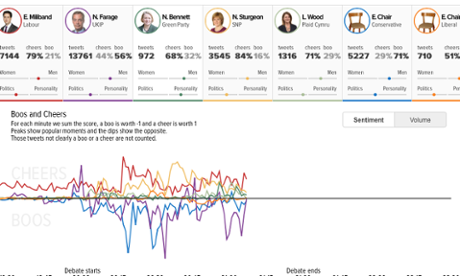
And here is some more Twitter sentiment analysis. It was conducted around half time, and it is from Demos, Qlik, the University of Sussex, and Ipsos MORI.
It suggests that Nicola Sturgeon and Ed Miliband are the winners.
Here are the net approval ratings - cheers (positive tweets) minus boos (negative ones).
Sturgeon: +68
Miliband: +58
Wood: +42
Bennett: +36
Farage: -12
For what it’s worth, this survey also looked at the two empty chairs: the Tories and the Lib Dems.
The Lib Dems were on +2.
But the Tories were on -42.
On Nigel Farage...
Nigel Farage began with the swagger of a man who had just seen his party’s coffers replenished with a million pounds from Express publisher Richard Desmond. Only Ukip will talk straight. We’ll stand up to corporate giants, he promised. He didn’t say whether Richard Desmond would one of them. Farage arrived once more as the insurgent. He huffed, he scoffed, framing himself as an adult among children. But these days opponents see him coming. Name one cut you would make, he demanded of Miliband. Miliband named three. You’re lying, he spat at Miliband when the Labour man accused him of seeking a privately funded NHS. Miliband read his original quote back to him.
Thus, within half an hour, the swagger had dissipated. His citation of immigration as root difficulty in housing and health failed to rouse the audience. He reacted by complaining that the event had been politically rigged, and was slapped down by David Dimbleby. My opponents are abusing me, he said, moments after he himself had abused the audience, and soon his contradictions seemed obvious to everyone in the vicinity. On a poor night, perhaps they were obvious to him. Still, he carried on regardless. “The real audience is sitting at home,” he said. Which was true enough. But Richard Desmond will want more for his bucks than this.
Updated
Sky has also got some Twitter sentiment analysis pointing to a Twitter win.
(But, remember, if Twitter was a reliable guide to public opinion, Scotland would be independent.)
25% of tweets about Nicola Sturgeon have been positive today, much higher than any other leader of top five parties pic.twitter.com/F2ToZV2G4D
— Sky News (@SkyNews) April 16, 2015
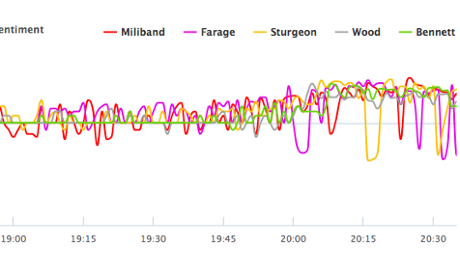
According to Twitter sentiment analysis for the Sun, Nicola Sturgeon won.
The Sun Twitter Worm verdict on #BBCDebate: the women won it - 1. Sturgeon 2. Bennett 3. Wood 4. Miliband, 5. Farage http://t.co/7kCwOQiCsw
— Tom Newton Dunn (@tnewtondunn) April 16, 2015
But, looking at the chart, it actually looks as if Bennett did best on this measure.
Updated
Here’s the video clip of Nicola Sturgeon talking down Nigel Farage over immigration:
Hung parliament question and closing statements - Snap verdict
Hung parliament question and closing statements - Snap verdict: The final section saw another raw exchange, as Ed Miliband and Nicola Sturgeon engaged in their first proper coalition negotiations. The arguments that Miliband and Sturgeon were deploying were much the same as those that Jim Murphy and Sturgeon used in the three Scottish leaders’ debates that have been held, but it was much more interesting to see the two principals thrash it out. On the BBC now William Hague is claiming that Sturgeon would be “in the driving seat”, but actually what the exchange revealed, I think, is how weak the SNP’s negotiating position actually is. The SNP has said that it would not form a coalition with Labour, or agree a confidence and supply deal, without a deal on Trident, and Labour has said that is not on offer. That means that, effectively, all the SNP could do is support Labour on a confidence motion and then deal with everything else on a case by case basis. And if the SNP are not prepared to let in the Tories, they have to support Labour on a confidence motion. There was a hint of pleading in Sturgeon’s pitch at the end, and Miliband seemed to be in the stronger position.
Miliband also made the most of his closing statement, with his “come and debate me” challenge. It sounded a bit cheesy, but people will remember it, and his point is a robust one. Hague told the BBC just now that it was the broadcasters who decided not to invite Cameron. That is disingenuous; Cameron was not invited because he said he would refuse point-blank to come.
Farage says the gap between the political class and ordinary people has never been wider. That has been shown tonight. People may not agree with him. But they know that he believes it. He will fight the takeover from the giant corporate companies. He will fight for the little man, he says.
And that’s it.

Updated
Bennett says we don’t have to take any more of this. Labour is not challenging the Tories. They are just offering a lighter version of the Conservatives. And where does that leave us? The Lib Dems? People will not be voting for them again. If you want real change, you have to vote for it.
Miliband says there is a fundamental choice at the election. Do we carry on as we are? Or do we try a different plan? Cameron refused to come and debate tonight. But he has a message for Cameron.
David, if you think this election is about leadership, then debate me one one one.
Closing statements

Sturgeon says none of us can afford more austerity. Ordinary people would pay the price. We have seen that Labour will not be bold enough. A big team of SNP MPs can force the pace of progressive alternatives. The SNP would help to deliver real change for everyone in the UK.

Wood says Miliband said tonight he would not reverse Tory spending cuts. An opposition that does not offer an alternative is not a real opposition. If you like what Plaid has to say, vote for Plaid, the party of Wales.
Updated
Dimbleby says people have just four days left to register to vote.
Bennett asks Miliband what he thought about Rachel Reeves saying Labour was not there to represent people on benefits.
She is quotes Reeves out of context.
context of @rachelreevesmp comment here - one line in 45 min summary of Labour welfare policy http://t.co/zcwCjTg0bk pic.twitter.com/Yaa1AJaTJ3
— amelia gentleman (@ameliagentleman) March 18, 2015
Andy Burnham is having fun.
"Dave, I'm here in the spin room but no-one's talking to me. Not sure why. Will keep trying. Best, Jeremy" pic.twitter.com/Fe3Rg2oDnA
— Andy Burnham (@andyburnhammp) April 16, 2015
Updated
Farage says Ukip could have done a deal with the Tories if they had backed a referendum earlier. Ukip will press for an honest one, he says.
Question 5 - Hung parliament
Q: What would you do in a hung parliament?

Miliband says he wants a majority.
Sturgeon says if Labour is prepared to be better than the Tories, the SNP will work with them.
Miliband says Sturgeon has said she wants another referendum. Labour cannot support that. He will not accept coalition with them.
Sturgeon says she can help Miliband be bolder. Don’t turn your back on that, Ed.
Oh no, Nicola, says Miliband. She has a strange approach. She says she wants a Labour government. But she is telling people to vote anyone but Labour. That means people will be left with Cameron, perhaps with Farage thrown in.
Sturgeon says the SNP and Labour can lock the Tories out. People will think he wants to keep the Tories in.
Miliband says he has fought the Tories all his life. But the SNP worked with them in Edinburgh, and their vote in 1979 let Thatcher in.
Sturgeon say she was only very young then. She is talking about now.
Updated
Immigration question - Snap verdict
Immigration question - Snap verdict: Immigration is Farage’s best topic, but I felt he was weaker on this than he has been on previous occasions (although that is not to say that a sizeable number of people won’t agree with him). Wood’s best moment in the last debate came when she took on Farage, and she performed a mini encore. Bennett was very effective this this section too. But it really came to live, though, when they got onto the NHS. Again, Farage barged into a stand-up row, but Miliband had the better of him.
Ed Miliband says he’s “coming after the gang-masters”. Cue gang-masters all around the country spitting out their coffee, checking the windows, barricading the door unholstering their Uzis. It has been a strange second half, the three women in the middle largely agreeing with one another, dismissing Farage, attacking Miliband. Miliband will be pleased though. He’s becoming even sadder, wiser, floating on his cloud above the fray.
Updated
Farage says Labour was the party that brought PFI into the NHS, and saw the growth of MRSA. Will Miliband run a national health service, or an international one?
Miliband says there are rules in place. They need to be enforced.
But Farage does not want an NHS, he says. Farage wants a private insurance system.
Stop lying, says Farage.
You are lying and lying to millions and millions of people and you keep on doing it.
Bennett says Miliband is comfortable with 5% of the NHS being privatised.
Miliband quotes what Farage said in the past about not wanting the NHS.
What Nigel Farage really thinks about the NHS - Guardian scoop by @rowenamason - http://t.co/IvzMElPcTM
— Dan Sabbagh (@dansabbagh) April 16, 2015
From Frances Perraudin in the spin room:
Spotted in the spin room so far...
For Labour – Rachel Reeves (shadow secretary of state for Work and Pensions), Kezia Dugdale (deputy leader of the Scottish Labour party), Caroline Flint (shadow secretary of state for energy and climate change.)
For the Liberal Democrats – Tom Brake (MP for Carshalton and Wallington)
For the Conservative party – Liz Truss (secretary of state for environment, food and rural affairs), Jeremy Hunt (health secretary)
For Ukip – Mark Reckless (MP for Rochester and Strood)
For the SNP - Humza Yousaf, minister for Europe and International Development and a Scottish National Party Member of the Scottish Parliament for Glasgow.
Updated
Miliband says he has a plan to improve the NHS in Wales.
Wood says Labour is running the NHS in Wales. It is not good there.
Miliband says Farage wants to exploit people’s fears, not address them. He says Farage wanted to end discrimination laws. And one of his MEPs made a disgraceful slur on a Scottish MSP.
Farage says he accepts that immigration has undermined services.

Bennett says migration rules need to be fair and reasonable. But one in four doctors are foreign born. And 40% of NHS staff are foreign born.
Sturgeon says we need strong immigration controls. But we needs appropriate to our rules. The government took away the post-study work visa system. That means students educated here cannot stay on to work. We lose out. As a Glasgow politician, she knows about the pressure on services. But immigrants should be treated fairly. We should be pragmatic. But she fears Farage is driving decisions instead.
Farage says the fact that there are some good foreign doctors is not the point. But it begs the question why we cannot train staff ourselves. And health tourism costs too much money. He says most British people want it to be a national health service.
Updated
Here are the most asked questions on Google during debate:
- What is austerity?
- Why is David Cameron not at the debate?
- Who should I vote for?
- Where is Natalie Bennett from?
- What is a brownfield site?
- How old is Ed Miliband?
- How old is Nicola Sturgeon?
- Who is Caroline Lucas?
- What is the deficit?
- What does Plaid Cymru mean?
Updated
Question 4 - Immigration
Q: Are immigrants putting too much pressure on public services?

Bennett says it is a mistake to say immigrants are to blame for putting pressure on public services. As an immigrant herself, she believes they have a valuable contribution to make.
Sturgeon says Ukip are wrong to scapgoat migrants.
Miliband says people are right to be concerned about immigration. He wants to stop people being exploited.
Farage says, when people are losing the argument, they turn to abuse. Immigration is too high. There are not enough school places, for example.
Wood says Farage abuses immigrants, and then turns around and complains about being abused himself. That gets a round of applause.
Updated
Defence question - Snap verdict
Defence question - Snap verdict: Labour HQ are heavily spinning the line that Miliband is looking like a future PM. The other are asking him the question, because he is the one who matters, they tell me by text. And this section has made that at least plausible. Miliband was credible. It was also notable how Sturgeon made a point of defending him over the Michael Fallon attacks. She is making an effort to keep relations with him cordial.
Farage says defence spending is like paying a premium on a home insurance.
Spending just 2% of GDP on defence is not enough, he says.
Bennett says the Green support the current levels of defence spending.
Wood says we already spend 6% of the budget on defence. That could be spend more wisely. She does not support Trident. Troops should be properly equipped, and looked after when they return to civilian life. Too many end up in jail.
She says Plaid do not support the 2% defence target.
Sturgeon says the SNP wanted an independent Scotland to become a member of Nato.
She says she and Miliband do not agree on Trident, although some of his MPs do. But the Tory attack on Miliband last week was a disgrace.
The world is not made safer by nuclear weapons, she says.
Miliband says Britain cannot solve the problems of the world on its own just with the US.
Wood asks if the problems of Islamic State can be solved by Trident.
No, says Miliband.
He says he says no when Cameron wanted to bomb Syria.
Question 3 - Trident and defence
Q: Would you keep Trident, and should defence spending be above 2% of GDP?

Farage challenges Miliband on the EU. Would you sign up to a European army?
No, says Miliband.
But there will be one, Farage say.
No there won’t, says Miliband.
Updated
Nick Clegg has been tweeting.
For clarity, I was not invited to #BBCDebate. I would have happily taken part and proudly defended our strong @LibDems record in government.
— Nick Clegg (@nick_clegg) April 16, 2015
That is true, but Clegg did not protest very hard about being excluded. There are suspicions that the Lib Dems went along with this in return for Clegg being invited to the three-leader Question Time sessions a fortnight today.
Housing question - Snap verdict
Housing question - Snap verdict: This format is working. The leaders are engaging with each other more than they did in the last one, and in this section they had a proper, sparky debate that took them beyond pre-rehearsed soundbites. The highlight was Sturgeon’s Farage put-down - she is the most experience on the panel, and it is showing - but Miliband was forceful and impressive on market failure in housing, and Bennett was good too. It was odd to see Farage arguing with the ref so early in the debate, and it is hard to know how this will go down with viewers.
Quarter-time report:
Miliband is doing pretty well halfway through. He seems to have adopted a long-suffering manner, talking very slowly like a sad wise saintly dying aunt. It’s not exactly prime ministerial. More like the deputy head master taking late detention. He’s lucky though. Nicola Sturgeon is a more nimble speaker but she keeps getting bundled in with all the other voices. Don’t fancy Farage much at this stage. Going after the audience was never a good move. Sturgeon’s jumped all over him on his immigrant obsession. She’s got him in a headlock. Standing count for Farage from Dimbleby. Roars from the crowd.
Updated
The order for the most searched for leaders on Google so far:
1. Ed Miliband
2. Natalie Bennett
3. Nigel Farage
4. Nicola Sturgeon
5. Leanne Wood
Updated
Wood says not enough housing has been built. Thatcher’s right to buy policy was to blame.
Bennett says she wants to talk about the market issue. The market does not work in housing. People are using them for investment.
We need to get back to houses as homes, not financial assets.
Miliband says Farage said something revealing. He said you cannot buck the market. That is what Thatcher used to say. But the market does not work in housing, he says. Large developers do not build enough. We are letting down our young people, and Labour will get to grip with this.
Farage says he accepts that there is a problem with developers.
But net migration makes the problem worse.
Miliband says we do need to get net migration down. But Ukip wants to get out of the EU. That would harm the country.
Planning permission is granted locally. But buy-to-let landlords lock out local buyers.
Farage says the audience is biased. Even by BBC standards, this is unusual.
Dimbleby says it is not. It was chosen by a polling company.
Farage says the audience do not understand markets. And the panel do not accept that immigration has contributed to the housing crisis.
Sturgeon says Farage cannot blame everything on immigrants.
Farage is obviously on a “win friends and influence people mission”, she says.
She says she does not accept that immigrants are to blame. They make a net contribution to the country, she says.
Twitter’s photoshop mavericks have some theories as to what David Cameron could be doing instead of being at the leaders’ debate:
You watchin? Yeah you? Yeah rubbish innit? Yeah. #BBCDebate pic.twitter.com/kqVpzsUWEJ
— General Boles (@GeneralBoles) April 16, 2015
Sit down, Nick! It's starting! pic.twitter.com/lgW08nO5ia
— Fudgey (@fudgecrumpet) April 16, 2015
Cameron couldn't be at the #BBCDebate because he's watching it for #Gogglebox pic.twitter.com/Kx08HBdAIf
— General Boles (@GeneralBoles) April 16, 2015
Dimbleby asks Miliband if he would cap rents.
Miliband says Labour would introduce three year tenancies in the private sector. Within those tenancies, rents would be capped. And Labour would also stop letting agencies charge fees to landlords and tenants.
Question 2 - Housing
Q: As a single parent, I’d like to know about your plans for social housing, and to tackle the housing crisis?
Sturgeon says the Tory plan to sell off housing association homes is one of the worst ideas she has heard.
Wood says much the same. Council house sales are not allowed in Wales, she says.
Miliband says Labour supports the right to buy, but the Tory plan does not add up. There is no money for it. And so the social housing stock will be watered down.
Opening statement and debt question - Snap verdict
Opening statement and debt question - Snap verdict: Sturgeon, Miliband and Farage are dominant, but none of them gained a decisive advantage in this section. It was interesting to hear the audience applaud when Sturgeon said Cameron should have been there, and it is possible that his no-show could work against him more than he thought. Miliband is having to fight on two fronts, against Ukip and the anti-austerity nationalist/Green troika, but he sounds measured and confident, and was persuasive when politely dismissed the idea that he was the same as Cameron. But Sturgeon’s response - you are different, but not by enough - was incisive. As a technical debater, she probably has the edge.
Nicola Sturgeon's opening statement
The SNP have sent me Nicola Sturgeon’s opening statement.

(I would post the others, but I have not been sent them.)
To those watching in Scotland tonight, my promise is this.
If you vote SNP, we will make Scotland’s voice heard. We will always stand up for Scotland’s best interests.
And my promise to everyone is that the SNP will work constructively to deliver progressive change for ordinary people right across the UK.
For as long as Scotland is part of the Westminster system, we have a shared interest in making it work better - for the many, not the few.
The truth is that no one party looks likely to win an outright majority at this election.
That means we will have to build bridges between different parties if we want to deliver real change for you.
The SNP will work with others of like mind to bring about an end to austerity, a higher minimum wage, more jobs, real protection for our NHS and action to lift children out of poverty.
An SNP vote will be a vote to make Scotland’s voice heard - loudly and clearly.
But ours will also be a voice for a new, better and more progressive politics at Westminster - for everyone.
Updated
The Guardian is working with the pollsters BritainThinks to conduct focus groups throughout the election with 60 voters in five key marginals. Each has an app to feedback what they are noticing in the campaign in real time. This is what some are saying about David Cameron’s absence:
Updated
Miliband says the IFS says Sturgeon’s plans will leave a £7.6bn hole in Scotland’s finances.
He does not want to break up the country.
He says you can come along and deny the need for difficult decisions; but that will not fool anyone.
Sturgeon says the IFS said people would not know what they were voting for under Labour. How big would Labour cuts be?
Miliband says he has admitted that there will be cuts.
How much, Sturgeon asks.
It depends how much growth there is.
Farage says the questioner will be paying for this lot for a very long time.
Sturgeon says she shares a desire with Ed to see the back of the Tories. But they don’t want to see the Tories replaced with “Tory lite”.
Wood asks Miliband if he would have an emergency budget, as prime minister, to reverse cuts.
Miliband says his first budget would include a mansion tax, would abolish the bedroom tax, and would have a bankers’ bonus tax.
He says those on the state should not pretend there is no difference between him and Cameron.
Sturgeon says she is not saying there is no difference between Miliband and Cameron; she is saying the difference is not big enough.

Sturgeon says it is a disgrace that Cameron is not here tonight to defend his record.
That gets a round of applause.
Miliband talks about cuts to unprotected areas, she says. That means cuts to social care. It is time not for “a pretend alternative to austerity”. It is time for “a real alternative to austerity”. The SNP will make Labour bolder.
Bennett says Sturgeon is “absolutely right”.
Updated
Dimbleby opens it up.

To Miliband, he asks if Farage is right.
No, says Miliband. Farage wants to cut the top rate of income tax even more than Cameron. The idea that you just help the rich, and wait for it to trickle down, does not work. Think about balance and fairness as you cast your vote.
Farage says Ukip plans have been verified by a thinktank. He says Ed has obviously not read the manifesto; Ukip is not proposing to cut the top rate now. Our national debt is £1.5tr. He says he has not heard a single cut from Miliband.
Miliband says that is wrong. He would take winter fuel payments from the rich. And save money from local government. For the NHS, Ukip’s plans are dangerous.
Updated
Leanne Wood says Plaid does want to tackle the deficit, but not at any cost. The welfare state was built when there was no money available. Continuing on the path of austerity will deliver an uncertain future.
Updated
Natalie Bennett says Charlotte, the questioner, is right to worry about debt. Students are leaving university with huge debts. She wants to invest money in new homes and renewable energy. That will be good for everyone.
Nigel Farage the questioner is right. National debt has doubled under David Cameron. Listening to the promises of those here, and the “other two”, they are going to drive us into bankruptcy. Only Ukip would stop this. It has a plan to save £32bn a year.
Question 1 - Debt
Q: As someone about to enter the job market, is it fair to spend more money so you leave my generation with more debt?
Nicola Sturgeon says there is no point in austerity if it holds growth back. Under SNP plans, it would take two years longer to pay off the deficit. But it would be worth it because of increased growth.
Ed Miliband says the questioner is right to worry about the deficit. Labour would get rid of it. But it would do it in a fair way. By raising living standards, we can raise tax revenues and help to get the deficit down.
Natalie Bennett says people should elect Green MPs like Caroline Lucas. We must ensure everyone has food on the table, and a proper home to live in.
The Greens are the real challengers. Challenge the establishment, and vote Green.
Ed Mililband says Cameron has not come here to defend his record. Labour has a plan, and it does not involve extra borrowing. As prime minister, he would always put working families first.
Nicola Sturgeon starts off by addressing those in Scotland. To them, she says the SNP will always put their interests first. And, to everyone else, she says the SNP will work for progressive policies across the UK.
No one party is likely to win the election. That is why parties have to work together.
Leanne Wood makes her opening statement. She says people across the UK want an alternative to austerity.
(At the last debate she talked mostly from the perspective of Wales.)
Cuts are a choice, she says. Austerity and the old politcs are not inevitable. Plaid will speak up for Wales, and cooperate with others for the good of all.
Nigel Farage says this election has become farcical. Parties are trying to bribe you with borrowed money. But Ukip has shown a proper way to save money. It would cut EU donations, and take on the corporate giants too. Ukip will tell it as it is.
I have a feeling that I am the only person here saying what a lot of you at home are thinking.
Opening statements
Dimbleby is introducing the five leaders.

The questions are from the audience, and from emails and tweets, he says.
He says the hashtag for the debate is #BBCDebate.
Updated
BBC election debate
David Dimbleby is opening the programme.
.@NicolaSturgeon on her way to the #BBCDebate set. 2 mins to go #voteSNP #GE15 pic.twitter.com/6bI4yqG52a
— Ria Robertson (@RiaDRobertson) April 16, 2015
As with the leaders’ debate we will be keeping an eye out on what people are searching on Google during tonight’s challengers’ debate. Two weeks ago Britain wanted to know if it could vote for the SNP in England? What will the nation ask tonight?
Meanwhile, Google Trends has exclusively provided the Guardian with the most search election-related questions on Google this month:
1. Who will win the 2015 general election?
2. Who can I vote for in the general election?
3. How do I vote in the 2015 general election?
4. How many seats will Conservatives win in 2015?
5. When will the next general election be?
6. Will UKip win the 2015 general election?
7. Why should I vote Labour
8. Who should I vote for as a teacher?
9. What planes are being used in the 2015 general election?
10. What ward do I live in?
11. What voting constituency am I in?
12. Are our finances worse than in 2010?
13. Who is in the government in the UK?
14. What is the population per MP UK?
15. What if hung parliament?
16. Why should I not vote Ukip?
Labour is fond of this “job interview” line. (See 6.50pm.)
Have you ever gone for a job and not turned up for the interview? That's what David Cameron's doing tonight #BBCDebate
— Labour Press Team (@labourpress) April 16, 2015
As the Daily Mirror reported this morning, Labour is angry that Tory spin doctors are allowed to attend, even though David Cameron is not taking part.
CCHQ is tweeting questions for Ed Miliband in the debate. Here’s one.
.@Ed_Miliband will you come clean on the tax rises you're planning for hardworking families to make your sums add up? #ChallengersDebate
— CCHQ Press Office (@CCHQPress) April 16, 2015
As the leftwing website Political Scrapbook points out, if they wanted an answer, there was always another option ...
Hilarious. Tory HQ are now tweeting about the debate which their leader is too scared to attend: https://t.co/VP285Pi6Id
— Political Scrapbook (@PSbook) April 16, 2015
Some of the opposition party leaders have started arriving at the set of the live TV debate, in Methodist Central Hall:


As I said earlier, Downing Street are hoping that this debate will turn out badly for Ed Miliband. (See 5.54pm.) But David Dimbleby, the presenter, was asked about this on the PM programme earlier, and he said he was not convinced. When it was put to him that this could be “torture” for Miliband, he replied:
I have my doubts. I think that Ed Miliband and his people rather relish every opportunity they get to put Ed Miliband in front of a camera and for people to hear him talk because they think the more he’s done, the more convincing he’s become. And you hear a whisper going around the political classes ‘it’s getting better all the time’ - the performance, I’m not talking about the policies.
Labour HQ also thinks it’s a bit much for Jeremy Hunt to turn up on TV saying how great it is that this debate is taking place. (See 7.27pm.)
Ridiculous. Jeremy Hunt will go on TV to talk about #BBCDebate but Cameron won't turn up. Why? He's running scared pic.twitter.com/yq0n7nBXfZ
— Labour Press Team (@labourpress) April 16, 2015
Updated
On BBC News Jeremy Hunt, the Conservative health secretary, has just described tonight’s debate as an important part of the democratic process. That’s a bit rich, given that David Cameron refused to participate. Hunt argued that it would show people what was on offer if they did not vote Conservative.
Mark Ferguson, the LabourList editor, said in his morning newsletter today that he was worried about Ed Miliband taking part in tonight’s debate.
I must admit I’ve always been concerned about this challengers debate. I’m pretty sure if Miliband wasn’t taking part then few would be watching it, but now he faces a primetime onslaught from the forces of tactical and protest voting. An unappetising thought when Labour’s small lead has managed to remain intact so far throughout the campaign.
Miliband must appear insurgent and prime ministerial, an anti-establishment figure who could also lead a credible government. He’s done well in the TV debates so far, but tonight? I can only wish him the very best of luck.
In a blog for Coffee House, James Forsyth explains why Miliband is doing this
The main reason for Miliband’s doing this debate is the Scottish situation. Labour feared that without Miliband present, this debate would have turned into a clash between Sturgeon and Farage — which would have benefitted the SNP north of the border. Labour sources also argue that without Cameron and Clegg to take on, Miliband will be able to devote more time to unpicking Sturgeon’s record and policy agenda. But this is a risky strategy. Sturgeon, for obvious reasons, knows the details of the Scottish situation better than Miliband and she’ll be quick to attack him for talking down Scotland.
Guardian's debate coverage
I will be covering the debate as it goes along, and posting snap verdicts on all five sections.
My colleagues Marina Hyde and Barney Ronay will be watching it too, and posting snap verdicts as we go along.
We will also be posting reaction from the election focus groups we have recruited as part of our Battleground Britain project.
Patrick Wintour and Rowena Mason will be filing news stories from the debates.
And, after the debate is over, five Guardian writers will be posting verdicts for Comment is free. We will have : Gaby Hinsliff on Natalie Bennett; Deborah Orr on Nicola Sturgeon; Polly Toynbee on Ed Miliband; Hugh Muir on Nigel Farage; and Rhiannon Lucy Cosslett on Leanne Wood
Survation are carrying out a snap poll tonight for the Daily Mirror, so we should find out who “won”. There is a perfectly sound case for saying polls like this are pointless - Lewis Baston set it out in a good blog post after the last debate - but news is news, and if polling data is available, it seems silly to ignore it, so I will be writing up the Survation findings here.
But who is likely to “win”? One benchmark that might be helpful is to look at the results from the last debate. Four firms carried out polls after the debate, and here are the average results from all four polls.
David Cameron: 22%
Ed Miliband: 22%
Nigel Farage: 21%
Nicola Sturgeon: 20%
Nick Clegg: 9%
Natalie Bennett: 4%
Leanne Wood: 3%
This time, because Cameron and Clegg are not taking part, their votes will be going somewhere else. It is hard to know who Clegg supporters might favour, but it is probably fair to assume that many people who thought Cameron did best last time might favour Farage, and so that might be a reason why his prospects look good.
That seems to be the view of the bookmakers. The spread betting firm Sporting Index said today that Farage was favourite to win. Yesterday William Hill also had Farage favourite to win, on odds of 5/4, followed by Miliband and then Sturgeon. And yesterday Ladbrokes had Farage and Sturgeon as joint favourites, followed by Miliband.
Miliband says if Cameron wants to be PM, he should turn up for the job interview
Ed Miliband has been tweeting about David Cameron’s absence.
David Cameron has decided not to attend tonight’s debate. If you're applying for the job of PM, you should turn up to the job interview.
— Ed Miliband (@Ed_Miliband) April 16, 2015
It’s a very good line (which I first heard used by Douglas Alexander a few weeks ago).
Here is more from Richard Desmond’s statement about why he is donating £1m to Ukip. It’s from the Guido Fawkes website.
I don’t believe Cameron has delivered on his promises. I don’t want to be a member of a club. As Groucho Marx said, I don’t want to join any club that would have me as a member. I always have challenged the establishment and I want to continue to challenge it. I’m giving this money because I believe, as Emerson, Lake and Palmer might put it, Ukip’s political outlook is a ‘fanare for the common man’. I want to back our customers, Daily Express readers, who believe in many of Ukip’s common-sense policies on the EU and immigration and taxation. That is why I am putting my hand in my pocket; it is for my customers, my readers. I hope by doing this, it will encourage more people to do the same.
I want them to stand up like me and be counted. I believe there are still people out there who are frightened to stand up for something new and I hope they will follow my example.
Format for the BBC debate
Here is the format for the BBC election debate.
8pm: Debate opens with opening statements from the five leaders. Here is the running order.
1- Leanne Wood
2 - Nigel Farage
3 - Ed Miliband
4 - Nicola Sturgeon
5 - Natalie Bennett
Around 8.05pm: Questions start. There will be five questions, and, for each question, each leader will be given a minute to respond, before it opens up for 10 minutes of free debate. (There is a pre-agreed order in which they will respond to each question, but I can probably spare you the details.)
Around 9.25pm: Closing statements. Here is the order.
1 - Nicola Sturgeon
2 - Leanne Wood
3 - Natalie Bennett
4 - Ed Miliband
5 - Nigel Farage

After the debate, BBC1 is showing a half-hour reaction programme before the 10 O’clock News. To make up for the fact they were excluded, this will include contributions from the Conservatives, the Lib Dems and the DUP.
And, to make up for the fact that other Northern Ireland parties are not included in this section, even though the DUP are, all the Northern Ireland parties will be represented on Newsnight. It will be on BBC2, as usual, on the mainland, but in Northern Ireland it will be broadcast on BBC1.
Updated
My colleague Frances Perraudin is at the spin room for the BBC debate, which is taking place at Westminster Central Hall.
The spin room in Westminster, preparing for tonight's opposition leaders election debate #BBCDebate pic.twitter.com/ygS7aiy5Js
— Frances Perraudin (@fperraudin) April 16, 2015
This is what Richard Desmond said about why he was giving money to Ukip.
I firmly believe in Ukip. It’s a party for good, ordinary British people. It is not run by elitists.
They are struggling to have a voice. They do not have a massive party machine or highly paid public relations people.
They are human; they are not perfect and they do not pretend to be. But what they believe in is the best for the British people.
They are the sort of people who will stand up for people who are struggling.
Express owner Richard Desmond giving £1m to Ukip
A few minutes ago we learnt that Richard Desmond, owner of the Express newspapers, is giving £1m to Ukip. As you would expect, the Express broke the news.

Here’s an extract from its story.
Daily Express owner Richard Desmond has become the UK Independence Party’s most high-profile donor by handing over £1million to Nigel Farage’s fighting fund.
In a dramatic intervention into the general election campaign, the media tycoon announced that the cash injection towards Ukip¹s drive to win more MPs was a “challenging” gesture to shake up a Westminster establishment that has lost the trust of millions of voters.
And he hailed the massive boost to the election war chest of Mr Farage’s People’s Army as a “Fanfare for the Common Man.”
The cash comes on top of a £300,000 donation given to Ukip last year by Mr Desmond, who also owns the Sunday Express, the Daily Star and OK! magazine.
Updated
Tonight it’s the BBC election debate 2015. They are not describing it as a leaders’ debate, because two of the leaders aren’t turning up, and so the two governing parties will not be represented. Instead we have got the leaders of five Westminster opposition parties:
Ed Miliband, the Labour leader
Nicola Sturgeon, the SNP leader
Nigel Farage, the Ukip leader
Natalie Bennett, the Green party leader
Leanne Wood, the Plaid Cymru leader
It’s a curious line-up, and it is a product of the convoluted negotiations that took place between the broadcasters, Number 10 and the other parties once it became clear that Cameron’s enthusiasm for taking party in election debates was limited, to put it mildly. Clegg was keen on debates, and he claims to be upset about not being invited to take part tonight, but he has not protested about his exclusion very hard and, in what seems to be a compensatory offer, he will be included in the Question Time event taking place a fortnight today, which will see Cameron, Miliband and Clegg all interrogated by a Question Time audience.

The Downing Street view is that this has been a tactical masterstroke that will see Miliband diminished in stature, because he is going to have to spend the night with four people who have no chance of becoming prime minister, three of whom will attack him from the left and one of whom, Nigel Farage, will denounce Labour’s record on immigration and Europe. Perhaps it will work out like this, and the event will play to Cameron’s advantage.
But an alternative view is that the BBC are going to devote an hour and a half of prime time broadcasting to articulate politicians hammering the government’s record, with no one from the government there to defend it. That’s not something that a governing party would normally request three weeks from a general election.
The debate starts at 8pm and runs until 9.30pm. I will be covering it live, and afterwards posting some of the best reaction and analysis, including the results of a Survation poll being conducted into who won.
If you want to follow me on Twitter, I’m on @AndrewSparrow.
And if you want to catch up with today’s other election events, here is our live blog from earlier.
Updated