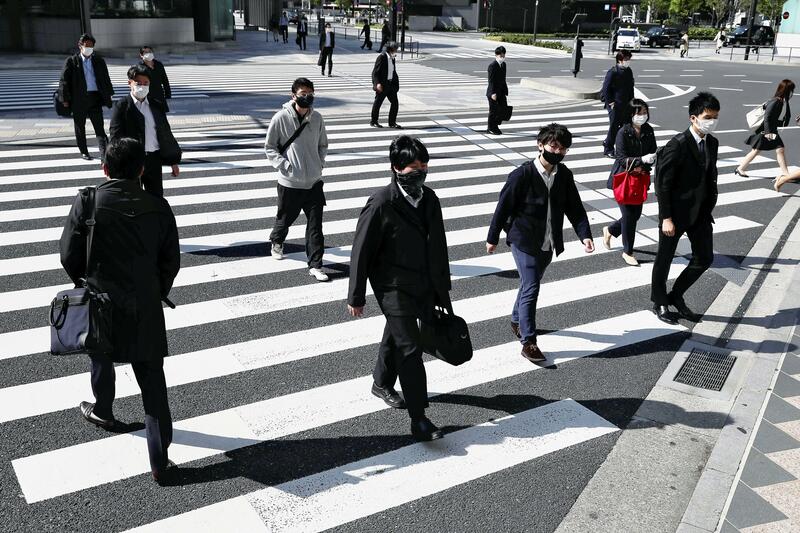
One year after the first state of emergency was declared to combat the spread of the novel coronavirus in Japan, the struggle against the virus looks set to continue for some time. Despite implementing an array of steps designed to slow and stop the coronavirus spreading -- such as avoiding crowded, confined spaces and doing more work and social activities online -- infection case numbers have risen sharply again since the second state of emergency ended in March. Whether this latest surge can be brought under control will largely hinge on whether complacency and a growing weariness of COVID-19 restrictions can be stamped out.
At a press conference Wednesday evening, the head of an advisory board to the Health, Labor and Welfare Ministry explained the importance of taking precautions to stop the virus from spreading, such as by wearing masks at dinner parties.
"I realize many people might be getting fed up, but I must once again ask them to follow these steps," said Takaji Wakita, who also is head of the National Institute of Infectious Diseases.
More than 3,400 new coronavirus infections were reported across Japan on Wednesday. Views compiled by the advisory board expressed concern about the latest rebound in case numbers.
"There are signs of new infections spreading due to factors such as increased human movements around the change of the fiscal year. Alerting people and appropriately sharing information about the risks are necessary," the board said.
The first state of emergency was initially declared for seven prefectures, including Tokyo, on April 7, 2020. This was later expanded to the whole nation and set a target of reducing person-to-person contact by 70% to 80%. Many restaurants, bars and shopping complexes closed, as did elementary, junior high and high schools.
According to data collated by Agoop Corp., a SoftBank Group Corp. tech company, average daily foot traffic in Tokyo's Shinjuku district during the first state of emergency plunged to about 30% of the level recorded in January and February of 2020. The figure was 20% for Osaka's Umeda district.
On April 7, 2020, 365 new coronavirus cases were reported. When the state of emergency ended on May 25, this number had dived by more than 90% to 21 new cases. This was successfully accomplished without imposing the kind of lockdowns adopted by the United States and European nations.
-- Eateries under the microscope
After summer and autumn passed, the year-end and New Year period arrived. This was accompanied by end-of-year parties and other social events that fueled a resurgence in coronavirus cases.
On Jan. 7, the government declared a second state of emergency. Restaurants and bars were considered key locations where the virus might spread, so countermeasures were focused on these establishments. Steps taken included requesting these businesses to shorten their business hours.
This time, however, foot traffic in both Tokyo and Osaka dropped to only about 60% of earlier levels. Coronavirus clusters broke out at elderly care facilities and venues offering daytime karaoke activities. Despite this, the nation's medical system fared reasonably well and new infections were declining.
Prime Minister Yoshihide Suga decided the state of emergency would be completely ended on March 21, although he frequently expressed concern over a possible rebound in infection case numbers.
-- Stage 4 reached
That warning has become a reality. Infections have quickly spread across Japan since the second state of emergency ended.
Emergency-level priority measures have been implemented in parts of Osaka, Hyogo and Miyagi prefectures. Eateries are still being requested to close their doors earlier than usual. Despite these steps, according to the Cabinet Secretariat, the occupancy rate of hospital beds secured for COVID-19 patients hit 72% in Hyogo Prefecture and 50% in Osaka Prefecture on Tuesday, reaching the 50% threshold for the highest and most severe level of the government's four-stage scale.
"Japan hasn't been implementing lockdowns, so the effectiveness of states of emergency and targeted priority measures hinges on whether residents accept and go along with them," said St. Marianna University School of Medicine Prof. Hiroyuki Kunishima, an infectious disease expert.
"It's vital that the government clearly explains just how important infection countermeasures are for society, and gets people to buy in to these policies. The public has no choice but to continue the obvious precautions such as refraining from unnecessary outings and dinner parties."
Read more from The Japan News at https://japannews.yomiuri.co.jp/