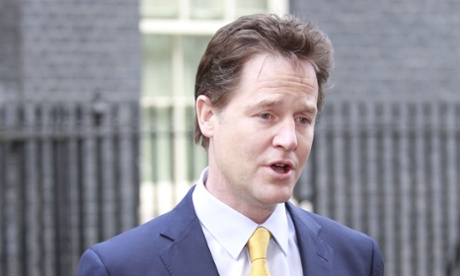
Nick Clegg told his surprisingly buoyant spring party conference in Liverpool that his party was going to do much better in May’s election than his many detractors predict. He was “still standing”, he told his battered, though resilient, audience, and would remain so after polling day.
Pressed to put a number on this confidence and say how many of the party’s existing 57 seats would still be theirs on 8 May, Liberal Democrat officials become understandably innumerate.
The current outside betting is around the “mid-30s”, an outcome that could leave the parliamentary party heavily reliant on its unelected peers and its MPs in the Commons – who are not exactly exemplars of diversity. Only seven of the party’s 57 MPs are female, and owing to the slim majorities they hold, those seven face a possible wipeout. On this worst-case scenario, not only Nick Clegg, the party leader, but also his closest ally in government, Danny Alexander, the Treasury chief secretary and key negotiator in any coalition talks, would lose their seats. This would force a demoralised party to look rapidly elsewhere for authority, even if Alexander would remain on the coalition talks team.
The debate in the party would focus on rebuilding outside government, and less on how much of the party manifesto could be imposed on one of the main parties in a programme for government.
But it is clear that the party headquarters does not see doomsday ahead, and insists it is not whistling on the way to a massacre.
The confidence is chiefly because party officials say they are unprecedentedly well informed about the state of play in the 40 or so specific seats on which the party’s fate rests.It is investing big sums with the polling company Survation surveying the state of the race in key constituencies, and checking how individual messages work.
On the basis of these polls, as well as the parallel polling by Lord Ashcroft in marginals, the party is brutally deciding where to put its resources. A relatively small number of Lib Dem seats have been cut loose, effectively told they have to swim, and probably sink, on their own.
In the party’s view, three factors will be critical in deciding the seats that are retained. The first and most important factor is the visibility of the party’s candidate, and specifically whether as MP he or she has a local campaigning track record in the seat.
Thus figures like Stephen Lloyd in Eastbourne or Andrew George in St Ives are deemed likely to hang on simply because they have a track record of independence, and fighting for their constituency. If there is any pork in any barrel, they have shown they will put their hand in it.
The second is whether the challenger in the seat is a Tory or Labour candidate. The party broadly thinks it is likely to do better defeating a Tory challenger by a mixture of winning over soft Tories and retaining an anti-Tory tactical Labour vote. The Ashcroft polling and its own private polling shows the swing from Clegg’s party to the Tories is much weaker than to Labour.
The third is the degree to which the local party is active. A surprising poll for instance showing Lynn Featgerstone neck and neck in Hornsey and Wood Green. Some have challenged the methodolgy of this polling, including the way the weighting is handled, but it suggests at minimum doorstep activism matters.
These local factors have to be matched by a national air war, boiled to broad message of the Liberal Democrats as the resilient party anchoring the main two parties in the centre ground. The message has the merit of simplicity. In the campaign expect some examples, sometimes illustrated by vivid Whitehall documentation, of extreme Tory ideas that the Clegg and his ministers managed to block the Tories from implementing.
The Lib Dems’ big private worry is a lack of money in the final two weeks when the party says it will need every penny it can muster to withstand a Tory bombardment of literature and messaging about the risk of a chaotic hung parliament, and the relative security of giving David Cameron an overall majority.
Senior Lib Dems, some of whom hoped to win a marginal seat in 2010, admit the party felt a breakthrough slipping from their grasp in the final three or four days of the 2010 campaign as they ran out of steam, Cleggmania waned and the Conservatives applied a squeeze.
The party is anxious not to repeat the experience, and it is one of the reasons why Nick Clegg accepted the dog’s breakfast of TV debates last weekend. The deal keeps Clegg involved alongside Cameron and Ed Miliband in the final back to back Question Time interviews on 30 April.
The risk of being overwhelmed by a last-minute Tory push are clear. The Lib Dems won 27 seats in 2010 with majorities of less than 10%, and Tories came second in 19 of these 27 seats. If there was a 5% swing away from the Lib Dems in all of its seats, the Tories would win 19 seats and Labour eight.
Ashcroft has polled 15 of the 19 seats where the Tories trail the Lib Dems by less than 10%. The average swing across the 15 seats is 4.6%. If that applied equally in every seat, the Tories would be ahead in all of them, but the polls instead show a big variation in swing.
For instance in Sutton & Cheam and Eastbourne, which the Lib Dems won by 3 %and 7% in 2010, the party now leads by 18 and 21 points. But in Chippenham, which they won by 5%, Duncan Hames, the talented newcomer, trails by 15 points.
Overall, the Tories lead in only six of the 19 seats in Ashcroft polling, predominantly in the south-west. Desperate for seat gains somewhere in England, the Tories have alighted on this crop of seats as a vital battleground.
Mid Dorset and Poole North (Lib Dem majority in 2010 0.6 %), Wells (1.4%), St Austell and Newquay (2.8 %), Somerton and Frome (3%), St Ives (3.3%) North Cornwall (6.4%) are all seats Cameron, on paper, should win. Hence both Clegg and Cameron sometimes seem encamped in the south-west, making almost weekly visits to make rival funding announcements.
By contrast a group of nine or so Lib Dem seats facing challenge from Labour look lost – such as Burnley, Redcar, Brent Central, Norwich South, Manchester Withington, Cardiff Central and Birmingham Yardley. Even Nick Clegg in Sheffield Hallam is potentially vulnerable if the Tory vote does not vote tactically to protect him from a lively Labour challenge.
In some Labour leaning seats, strong campaigners like Julian Huppert, Greg Mulholland and Simon Hughes might survive what should otherwise be a Labour victory. In some of these seats, the best Lib Dem hope is a strong Green vote to leave Labour short.
In Scotland the fate of the Lib Dems 11 seats looks equally bleak with only the Scottish secretary, Alistair Carmichael, and Charles Kennedy looking safe. One attendee at the Scottish Liberal Democrat conference claimed: “Every inch of the proceedings was soaked in dread, like watching an old children’s film just knowing the dog’s getting shot at some point.”
Retaining four seats in Scotland would be bloody, but in the current circumstance, survivable.
To end a pointless prediction, the Tories are set to win six to nine seats from the Liberal Democrats, Labour nine to 11, and the SNP five to eight. If the cards fall right, Clegg may still hold the balance of power for another five years. If he does, it will be down to the resilience of his local MPs as much as him.