With its gleaming, petrol-guzzling Ferraris or Porsches, the Geneva International Motor Show seems an unlikely place to kick off a new era of green energy. Yet, behind the scenes at this year’s show, Nissan, makers of the popular Leaf electric car, and Enel subsidiary Endesa struck a deal that promises exactly that.
The green technology in question is called “vehicle-to-grid” or V2G. It allows electric car owners to not only plug into the grid to charge their vehicles, but also feed and sell energy back at times of high demand. It means idle cars in a future smart city could act as a giant battery, helping to stabilise the energy supply and even provide backup power during blackouts.
The significance of the agreement in Geneva is that it paves the way for the first mass-market V2G system in Europe. The agreement is between energy multinational Enel’s Spanish subsidiary Endesa and Nissan – a world leader in electric cars, having sold over 160,000 Nissan Leafs, the first widely available purely electric vehicles (EVs). Endesa and Nissan demonstrated the commercial V2G system in Madrid earlier this year.
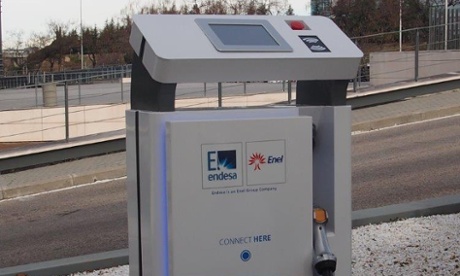
A crucial piece of technology from Enel will be charging units that allow power to flow both ways. The two companies are now working to bring the first commercial bidirectional charging units to Europe – technology that could bring huge benefits to electric car owners, as well energy companies and governments striving to meet climate change targets.
“It’s a technology that unlocks the potential of two-way charging and allows customers to reduce costs by selling power from electric vehicle batteries to the grid,” explains Federico Caleno, Enel’s head of end customer application and new technologies.
“EVs will become a critical part of the energy system, introducing new storage capacity at critical times and proving that the energy stored in an EV can be used for applications other than just mobility.”
The V2G system can also use off-grid energy and renewable power, alongside grid power from the two-way charger. The extra battery capacity will allow more renewable energy to be stored, with EVs taking up the slack when renewable production is high and demand low, and then feeding it back to the grid when conditions are reversed.
V2G also gives owners of electric vehicles the option to charge their car’s battery during off-peak times, when energy is cheaper, and discharge it during peak times, when energy is expensive – known as “peak shaving” – thus cutting running costs.
Owners can even decide to use the energy in their car battery themselves, with V2G becoming “vehicle-to-home” (V2H), a system that will particularly appeal to those with their own domestic solar or wind generation, the energy from which can be easily be stored in their battery and even used as backup power.
“I think, as we electrify our transport, using batteries or fuel cells, we’re going to end up with enough energy storage on a vehicle to make some useful contribution to the grid,” explains Redmer van der Meer, head of new business development at Nissan.
“As we again look to tackle emissions from our current electricity generation mix… and we try and green it with wind and solar, we need more storage on our system if we’re really going to make our grid as close to 100% renewables as we can.”
The first demonstrations of Enel’s technology were carried out at an Institute of Electrical and Electronics Engineers symposium in Madrid in 2012. The following year, six chargers were installed as part of the the Zero Emissions Mobility To All (ZEM2ALL) project in Malaga and one charger put in at Endesa’s Barcelona HQ.
But the history of V2G starts outside Europe. It was first conceived in the United States at the end of the 90s. Then, following the tsunami in 2004, bidirectional connectors were heavily promoted in Japan – and are now standard on all Japanese electric cars, explains van der Meer.
Importantly, he says, using a V2H system, an EV can supply an average home’s energy demands for around two days. “Being able to be grid independent for power if needed, for short periods of time, is something that is particularly attractive in that part of the world,” he says.
Currently, the Enel charger only works with Japanese cars equipped with the CHAdeMO Fast Charge inlet. But in the future Enel, with the cooperation of other car makers – and drawing on its V2G experience and involvement in the international V2G ISO15118 standard – is willing to develop V2G for EVs with the alternative CCS Fast Charger Inlet, as cars using this become available.
It is generally accepted that, for V2G to really make a difference, critical mass will be hugely important. “For the system – and peak shaving in particular – to work, you need volume of vehicles,” says van der Meer, and preferably all in the same place.
“If you’ve got a lot of energy storage in one area, you can cope with peaks because you can easily move that energy around,” he says.
Many trials of the technology were held in public car parks, where EVs can be put to good use while parked. The same is true of fleet cars and commercial vehicles such as buses, which have much bigger batteries and could make a major contribution to grid capacity and security while plugged in overnight in their depots.
There are other challenges too, says Andy Cruden, professor of energy technology at the University of Southampton in the UK. Legislation is one, he says, with rules on who can and cannot be an electricity supplier differing from country to country – preventing some EV owners from selling energy back to the grid.
“Communications are also important,” he continues, “and grid operators will need to know how much potential storage from EV batteries is available at any one time, something that’s made possible by the high level of telematics that many EVs already possess.”
In 2013, Navigant Research predicted that worldwide revenue from V2G will grow from less than $900,000 annually in 2013, to over $190m by 2022 – music to the ears of EV owners and figures that could lead to the mass ownership that V2G requires.
While EV owners can make obvious savings charging their vehicles using off-peak electricity, or “free” green electricity they have generated themselves, there are also likely to be payments from energy companies for using their batteries as extra storage, as well as for the energy they sell back to the grid. The price of the chargers currently starts at around €800 – but there may also be incentives to instal them.
Both Enel and Nissan say they are committed to making the technology as affordable as possible, in order to maximise the economic benefits when it is installed. In Germany, following the government’s decision to phase out nuclear plants by 2022 in the wake of the Fukushima disaster, the conditions for installing V2G technology are particularly favourable and huge demand for it is expected, says van der Meer.
V2G could also be good news for governments faced with tough climate change targets, as it encourages the take up of electric cars and plays a key role in maximising the use of green energy, helping to reduce CO2 emissions and local pollution in cities.
“It is the solution for many energy companies but also for governments and for cities,” says van der Meer. “It helps them to manage their CO2 footprint.”
Cities such as Amsterdam and Paris have already moved to take older, more polluting diesel vehicles off the streets, while others are offering incentives to drivers to switch to EVs.
“I think it [V2G] is the breakthrough of the century,” says van der Meer. “Less pollution, more EVs, lower energy bills, it’s the perfect story.”
Content on this page is paid for and produced to a brief agreed with Enel, sponsor of the energy access hub at the Guardian Global Development Professionals Network.