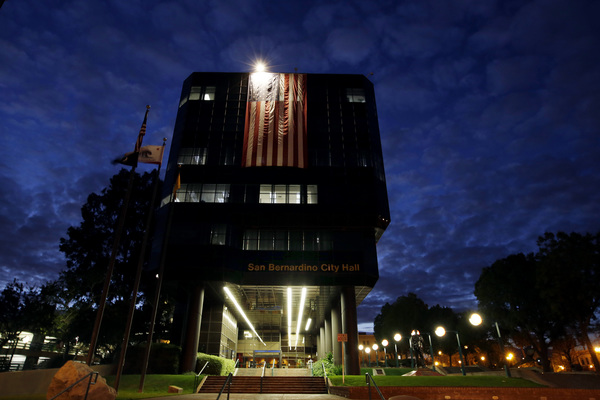
LOS ANGELES _ A federal judge said Tuesday she would approve the city of San Bernardino's plan to exit bankruptcy, marking a major step toward the end of one of the nation's longest-running municipal bankruptcies.
The judge's decision to approve the city's plan to pay its creditors and restructure its finances was touted by officials as the start of a new era for the battered Inland city, even as it faces a long road ahead and a daunting list of challenges to truly right itself.
"We want our residents to know, and we want people who would invest in the city... to know we've cleared this burden and we're ready to do business," said City Manager Mark Scott.
U.S. Bankruptcy Judge Meredith Jury's decision means the court has approved the plan as submitted by the city, which includes a long list of agreements with employees, retirees, municipal bond holders and many others.
The order is tentative until the official confirmation order is issued, which Jury said would be done within 30 days.
"Nobody is walking away from this proceeding without having taken some kind of hit," Jury said.
The plan, the broad outlines of which have been known for some time, preserves pension benefits for employees and retirees, though employees will have to contribute more to their pension plans and benefits were modified for new employees.
Retirees will also lose some health benefits they were promised.
Meanwhile, some bondholders will be paid only 1 percent of what they were owed.
"Every dollar of savings from the compromises with the city's creditors is going into rebuilding the city's badly depleted infrastructure and modernizing the delivery of municipal services," the city's representatives wrote in the plan.
In issuing her ruling, Jury noted that the city must be able to offer adequate services _ particularly safety services _ if it is to improve.
"Anybody who lives in this area knows that the crime problem in San Bernardino is significant," she said. "They have to be able to get safe in order for people to want to live there."
Years of cuts to public services and struggles to raise revenue in the impoverished city have battered its infrastructure and taken a heavy toll on its ability to meet basic public needs and attract new economic opportunities.
San Bernardino has been in bankruptcy since the summer of 2012, during a time when other municipalities have entered and emerged. Stockton filed in 2012 and exited last year. Detroit filed in 2013 and exited the following year.
The bankruptcy process and cost-cutting efforts in previous years mean the city is now a very different place than it was just a few years ago.
Its storied Fire Department has been outsourced to the county and trash collection, recycling and street sweeping services have been contracted out.
City staff has been cut by hundreds, while street repair, libraries, parks, community centers and other services have been severely neglected. The Police Department's staffing has also been cut by 30 percent, hampering its ability to deal with a recent spike in homicides.
"The public has had to put up with a lot," Scott said. "Nothing would make us happier than to get back to where we're serving them at a higher level."
But in a city that is among the poorest in the nation, officials say raising revenue will continue to be a major challenge.
The city declared bankruptcy having been devastated by the great recession and housing crisis, which left it grappling with huge unemployment rates, one of the highest foreclosure rates in the nation, and spiraling property and sales tax revenues.
Those tax revenues have improved moderately in recent years but are unlikely to do so significantly in the near future, officials have said.
Although city officials have explored raising various sales and other taxes to increase revenue, they concluded that the city's poor residents could be overly burdened by such increases and voters may not approve them. The city has taken steps to raise fees, which do not require voter approval.
To boost the city's economic foundation, officials hope now to attract new development. But challenges like the city's high violent crime rate, its difficulty providing needed services and the well-publicized bankruptcy itself, have made that difficult.