Afternoon summary
-
A Lib Dem peer, Lord Marks, has tabled amendments to the crime and criminal justice bill, which is being debated in the Lords this evening, that would give journalists a public interest defence in relation to various information offences. The amendments reflect policy agreed by the Lib Dems at their conference. Lib Dems in the Lords are also going to try to amend the bill to exempt under-18s from its tougher knife crime provisions.
Breaking: Lib Dems seek to exclude 16 to 18 year-olds from @nickdebois knife crime crackdown in Lords amendment tonight..
— steve hawkes (@steve_hawkes) October 20, 2014
-
Nigel Farage has backed a new Ukip calypso theme tune sung in a fake-Caribbean accent that criticises political leaders for allowing “illegal immigrants in every town”. David Lammy, the Labour former minister, said the video was “everything we’ve come to expect from a party whose politics is based firmly on prejudice, resentment and fear-mongering”.
'UKIP Calypso' is everything we've come to expect from a party whose politics is based firmly on prejudice, resentment and fear-mongering.
— David Lammy (@DavidLammy) October 20, 2014
That’s all from me for today.
Thanks for the comments.
Updated
Here’s a Rochester and Strood byelection round-up.
-
The Conservative party has denied being responsible for calls to voters in the constituency saying negative things about the Ukip candidate Mark Reckless. It’s a technique called push polling. On the Daily Politics Douglas Carswell, the Ukip MP for Clacton, questioned the denials.
Grant Shapps has very publicly said there isn’t [a link between the Conservatives and the calls], but we know one or two facts. We know that a telemarketing firm has been phoning people, putting identical questions to them to those that are found on Conservative leaflets, followed up by a question designed to smear ... If it turns out that there is any connection between the Conservative party and this telemarketing firm, it’s not just Grant Shapps’ credibility that will be on the line; the whole reputation of the Conservative party, I think, will be damaged.
Political Betting’s Mike Smithson has suggested that there could be an innocent explanation; calls from a legitimate polling organisation, Survation, may have been mistaken for push polling, he says.
Has this genuine question on Mark Reckless in Survation's Rochester poll sparked off the fake polling row? pic.twitter.com/mnQisPtAQk
— Mike Smithson (@MSmithsonPB) October 20, 2014
Tom Pride makes the same argument on his blog.
-
George Osborne has been campaignin in the constituency for the Conservatives.
With our canvassing team in Strood this morning. V positive response on doorstep pic.twitter.com/2efRnbgWmL
— George Osborne (@George_Osborne) October 18, 2014
Steve Odell, the chief executive of Ford Europe, who welcomed David Cameron to the company’s plant in Dagenham this morning, has said that Ford wants Britain to remain in the EU.
We are pro the EU because any change from that is further fragmentation, further complexity and businesses don’t like added complexity. I understand there are issues with some of the regulations which I won’t get into and indeed I push back on the EU from a Ford perspective on being over-legislated as well. But I think it is ultimately good for the British economy to remain part of the EU.
As Sky’s Faisal Islam points out, a ComRes poll at the weekend found that support for all EU citizens having the right to live and work in the UK has risen 13 points since last summer. But those opposed to this principle still outnumber those in favour.
"citizens of EU countries shd have right to live/ work in UK"..UP 13% on last year..says Comres Indy/mirror: pic.twitter.com/hYwtRo4rfD
— Faisal Islam (@faisalislam) October 20, 2014
Janan Ganesh has written a powerful critique of David Cameron’s EU policy for the Financial Times (subscription). Here’s an excerpt.
As for Mr Cameron, he appears to be two-thirds of the way to engineering a withdrawal from the EU that he has at no point actually desired. The pattern is this: malcontents hound him, he takes a step towards the exit, they cheer for a while, they hound him for more, he takes another step. The process works with the metronomic predictability of one of those executive desk toys.
He now wants the EU to check the right of free movement. In an announcement that Downing Street is still drafting, he may even make it a condition of his support for membership. He boxed himself into a sequence of events long ago, and it is clear where it ends. A prime minister should by all means recommend EU exit if that is his cold analysis of where the British interest lies. He should not do so to calm an atmosphere of unappeasable vexation.
Noting her country’s harshness on itself, Jeane Kirkpatrick, the majestically wry US diplomat, said: “Americans need to face the truth about themselves, no matter how pleasant it is.” So do Britons. They live in a rich country of rare dynamism and maturity, which has improved over their lifetimes. They are cranky because they take this as given. In fact, it is the accumulation of wise decisions over a long period. And it can be undone in a few hot-headed years.
Vince Cable accuses Cameron of trying to appease Ukip
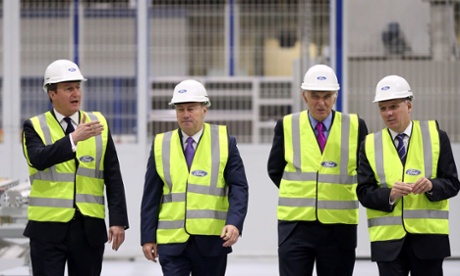
Vince Cable, the Lib Dem business secretary, was on a visit to the Ford plant at Dagenham with David Cameron this morning. Cable told BBC News that it was “a very good visit” and that he and Cameron were “on the same page” when it came to supporting the car industry.
But he then accused Cameron of trying to “appease” Ukip.
Ford pointed out very clearly that much of their investment is predicated on the assumption that Britain remains a member of the European single market. And I worry that in this attempt to appease Ukip supporters that we’re putting at risk our participation in this group which affects hundreds of thousands, millions of jobs in the UK ...
The single market, which is Britain’s big negotiating achievement, negotiated by Mrs Thatcher, has at its heart the principle of free movement of goods, services, capital and labour. That’s the fundamental principle of it. And once you start putting up barriers to free movement of workers within the European Union you destroy its whole essence which is why the rest of the European Union is not going to allow it.
I’ve taken the quote from PoliticsHome.
Labour says Cameron's EU stance making reform harder, not easier
Douglas Alexander, the shadow foreign secretary, says that David Cameron’s stance on Europe is making it harder, not easier, for Britain to achieve EU reform. He’s put out this statement.
Labour believes that Europe can and must be made to work better for Britain, but we understand that the right road for Britain is change in Europe, not exit from Europe.
Just a few months ago, Conservative ministers were praising President Barroso’s credibility when he spoke about Scotland and the EU, yet today they are trying to dismiss him because he has exposed that David Cameron’s approach to Europe is weakening, not strengthening Britain’s hand in Brussels.
Instead of trying to use Europe simply as a tool of party management, David Cameron should focus on using Britain’s leverage as a tool for securing real change in Europe. Europe needs reform, but David Cameron’s damaging approach is now making it harder, not easier, for Britain to secure the change we need.
David Cameron’s line about the British people being “the boss” is one that he road-tested at a private meeting with Conservative MPs last week, according to James Forsyth’s column in the Mail on Sunday. Forsyth says that Cameron was challenged by Ken Clarke.
Clarke, who had been a fixture in every Tory government since Ted Heath’s until Cameron retired him in the last reshuffle, growled that by talking up immigration, Cameron was playing into Nigel Farage’s hands. He argued the Tories should not try to out-Ukip Ukip and attempt to satisfy the public’s ‘insatiable appetite’ for action on immigration. Instead, he said, the Tories should be concentrating on the economy.
Those present tell me that hackles were raised by the intervention. Those on the right thought it was Clarke – one of the last pro-Europeans in the party – being drippingly Wet. A surprisingly large number of Tory MPs, however, feel that the old stager has a point. They worry that the leadership is losing sight of its own agenda and they complain that the party has said almost nothing in the past fortnight about the popular tax cuts it unveiled at its conference earlier this month.
Cameron countered Clarke with a robust defence of his strategy. I’m informed that he rose to his feet and said ‘the people are our bosses’ and that if voters are concerned about immigration, their representatives should be too.
Cameron tells Barroso the British public are 'the boss' on immigration, not the EU
Here’s the full quote from David Cameron.
What we need in Britain is a renegotiation of our relationship with the European Union and a referendum where the British people decide whether to stay in this reformed organisation or do we leave it. Now that’s what I will pursue, that’s what I will deliver and at the heart of that renegotiation we need to address people’s concerns about immigration. I’m very clear about who the boss is, about who I answer to and it is the British people. They want this issue fixed, they’re not being unreasonable about it. I will fix it.
Updated
Cameron tells Barroso the British public are 'the boss' on immigration, not the EU
David Cameron has told Jose Manuel Barroso that he is interested in what the British people want, not what the European commission thinks.
David Cameron on EU migration: "I'm very clear about who the boss is…it's the British people. They want this issue fixed…and I will fix it."
— Nick Sutton (@suttonnick) October 20, 2014
Who's the boss on Free Movement? Cameron says: I'm very clear about who the boss is, about who I answer to and it is the British people
— Chris Ship (@chrisshipitv) October 20, 2014
I’ll post the full quote when I get it.
Updated
Lunchtime summary
- José Manuel Barroso, the outgoing president of the European commission, has said that European leaders will reject any attempt by David Cameron to tamper with “fundamental” elements of the EU, such as the free movement of citizens. Downing Street has defended the need for EU reform, but refused to spell out details of what Cameron is proposing. A further announcement is expected in due course. (See 10.32am and 11.57am.)
-
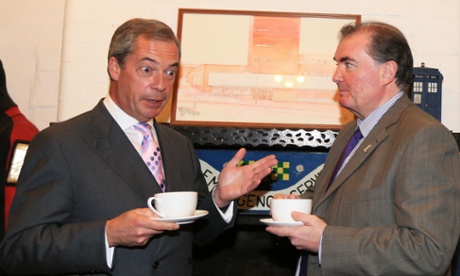
Nigel Farage, the Ukip leader has said that Barroso’s speech shows Cameron has been deceiving the British public. Speaking in Sheffield, where he was campaigning with the Ukip candidate in the byelection to choose a new South Yorkshire police commissioner, he said.
Mr Cameron has been saying to people ‘we can have our cake and eat it’. We can’t. He’s actually been deceiving the British public. What is a fact is you cannot do what Mr Cameron is pretending to do and remain a member of the European Union ... Mr Barroso was absolutely right and his successor [Jean-Claude] Juncker will say the same thing. It is one of the fundamental cornerstones of the European Union that you have the free movement of people.
-
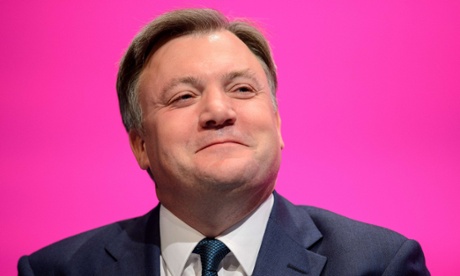
Ed Balls has said that, under Labour’s plan for a mansion tax, people in homes worth more than £2m but less than £3m will pay £3,000 a year. In an article in the Evening Standard, he also announced other features of the tax designed to assure Londoners that its impact would be limited, including plans to raise the threshold in line with high-value property inflation and to charge foreigners with second homes in London more than full-time London residents. He wrote:
First, we will guarantee that more modest properties are not brought into the scope of the tax. The Tories have been spreading desperate smears that properties worth far less today — even £1 million — will end up paying. This is simply untrue.
As I said earlier this year, we will raise the starting threshold as prices rise. And rather than raising it in line with overall inflation, we will do so in line with the average rise in prices of high-value properties over £2 million. This will ensure that the number of properties paying the tax will not increase. If prime property prices continue rising then by the time the tax is introduced the starting point will be higher than £2 million.
Second, the tax will be administratively simple. A banded system means valuations will not be needed for most properties as it will be clear which band — for example £2 million-£3 million — the property falls into. As with the government’s new tax on properties bought through companies, owners will be able to submit a self-valuation to HMRC.
Third, as we have always said, the tax will be progressive. We will ensure those owning properties worth £2 million-£3 million will only pay an extra £250 a month through this new tax — the same as the average top band of council tax. Owners and investors in properties worth tens of millions of pounds should make a much bigger contribution. And we will look at asking overseas owners of second homes in the UK to make a larger contribution than people living in their only home.
And finally, as I wrote on this page in June, we will protect the small minority of people who are asset-rich but cash- poor. Long-standing residents who now find themselves living in high-value homes but do not have an income high enough to pay the higher or top rate of income tax — in other words earn less than £42,000 a year — will be guaranteed the right to defer the charge until the property changes hands.
- The Social Mobility and Child Poverty Commission has said Britain is on the brink of becoming a nation permanently divided between rich and poor. As Patrick Wintour reports, its 335-page report likely to be a reference point against which the government’s anti-poverty record will be judged, and feature strongly in opposition party manifestos for the 2015 general election. The report says all three main Westminster political parties are lamentably failing to be frank with the electorate about the fact there is no chance of meeting the government’s statutory child poverty target by 2020. It also predicts that 2010-2020 will be the first decade since records began that saw a rise in absolute poverty – defined as a household in which income is below 60% of median earnings. A rise from 2.6 million households in absolute poverty to 3.5 million is now expected. A brief summary of the report is here, a 34-page summary is here (pdf) and the full report itself is here (pdf).
-
Clegg has called for stronger legal protections for journalists - including enshrining a public interest defence right into data protection, anti-bribery and other legislation. Speaking at his press conference, he said:
It’s incredibly important in a free society that journalists should be able to go after information, where there is a clear interest to do so, without fear of being snooped on or having all of their files rifled through without any justification. There should be a public interest defence put in law - you would probably need to put it in the Data Protection Act, the Bribery Act, maybe one or two other laws as well - where you enshrine a public interest defence for the press so that where you are going after information and you are being challenged, you can set out a public interest defence to do so.
Secondly, where the police ask for information which might reveal sources - privileged information - I think that shouldn’t just be done on the say-so of a senior police officer, it should be done on the say-so of a judge. It is a big thing to say to the press in this country: we can demand where you got your information from and we don’t even need to go to a judge.
Here’s the Guardian video with a clip from Jose Manuel Barroso’s speech.
Damian Green, the Conservative former Home Office minister and one of the few people in the party who could be described as pro-European, told BBC News that he agreed with Jose Manuel Barroso about the need for politicians in the UK to speak up for the EU.
I agree to an extent with Mr Barroso that there has to be a positive reason, there are positive reasons, for Britain to stay in Europe. It does benefit us economically; it gives us a bigger voice in the world and so on. But we do need to make the case and I think it does fall on people across the political spectrum who do want to make that argument, to start making it now because you can’t start making it at the beginning of a referendum campaign, which we all expect in 2017.
I’ve taken the quote from PoliticsHome.
The CBI has welcome Jose Manuel Barroso’s speech. This is from Katja Hall, the CBI’s deputy director general.
We’re living in a globalised world and being inside a reformed EU is the best way for the UK to secure its economic future and maximise its voice internationally. The single market anchors our trade and investment at home, and is the launchpad for us to break into new growth markets outside Europe.
The EU needs to do more of what it is good at, like signing trade deals and drawing on the strength of its single market, while interfering less in countries’ domestic rules.
Getting this type of reform would help to boost growth right across Europe, and as Mr Barroso said, the UK has influence in Brussels when it comes to the table with good ideas to make the EU work better.
Businesses recognise that free movement of workers within the EU is a sensitive issue but are clear that it is an essential part of the single market. It boosts the attraction of investing in the UK, creates jobs and offers firms here real benefits in working with our biggest trading partners.
On a lighter note, I see Boris Johnson, who is doing a Twitter Q&A today, is worried about London’s sparrow shortage.
#askboris How are we going to fix London's sparrow shortage?
— h⃘u⃘d⃘d⃘e⃘r⃘ (@AGH_UM_) October 20, 2014
we are planting 10000s of trees, increasing tree cover to 25 per cent of the city by 2025 ...but cats are a factor #askboris @AGH_UM_
— Boris Johnson (@MayorofLondon) October 20, 2014
I’d better keep him away from Mrs Sparrow.
Updated
I’m just back from the Number 10 lobby briefing. In terms of trying to learn more about David Cameron’s thinking on Europe, it was largely a waste of time. It would have been more productive to have stayed at my desk and read this blog by Nick Robinson, who’s been briefed on the thinking in Downing Street.
Here’s an extract.
The prime minister will announce plans to limit EU migration before Christmas but the search is still on for a way to do this without needing to re-write the founding treaty of the EU - the Treaty of Rome - which enshrines the principle of the freedom of movement of people.
Sources stress that no final decisions have yet been made on what the specific measures will be, how they will be announced (ie whether in a speech or an article or an interview) or when they’ll be made (ie before or after the Rochester by-election).
Yesterday’s Sunday Times story about a possible limit to the number of national insurance numbers issued to new arrivals from the EU is said to draw on current practice in Croatia - the latest country to join the EU ...
However, as yet, there is no sign of any other country wanting limits to the total numbers allowed to move from one EU country to another.
There is some frustration amongst the prime minister’s advisers that ideas are leaking out before they have had proper time to assess them.
That, of course, is the problem with simultaneously trying to solve a political problem - the rise of UKIP - by talking up how tough you’ll be in Europe at the same time as considering whether any of your promises will be agreed to by 27 other EU countries.
Barroso's speech and Q&A - Reaction
Here is some reaction to Barroso’s speech and Q&A
From the Financial Times editor Lionel Barber
#Barroso's prediction that City firms will move to Frankfurt/Paris post Brexit is highly questionable - but Tory drift is palpable
— Lionel Barber (@lionelbarber) October 20, 2014
From the Reuters editor-at-large Hugo Dixon
City firms will not move wholesale across Channel if UK quits EU. But i believethey will shift a chunk of their activities #CHEvents
— Hugo Dixon (@Hugodixon) October 20, 2014
From Roger Helmer, the Ukip MEP
Barroso: "Even the proudest nation can't shape globalisation by itself". But it can respond to it a whole lot better without the EU.
— Roger Helmer (@RogerHelmerMEP) October 20, 2014
From Shneur Odze, a former Ukip MEP candidate
I'm today petitioning @Nigel_Farage to award @BarrosoEU the 'Ken Clarke award' for services to UKIP. Trying to book him for late April 2015.
— Shneur Zalman Odze (@ShneurOdzeUKIP) October 20, 2014
From John Redwood, the Conservative MP
The so called case to stay in is based on three errors. The first is Germany and France would not sell us their goods any more if we left. Germany has of course confirmed they would want continuing access to our markets so we would keep access to theirs. The second is western Europe would be fighting itself with no EU. It’s not even worth refuting that nonsense. The third is the UK would have no influence in the world outside the EU, when we would be able to speak for ourselves again in the main world institutions instead of having to depend on the EU to do it.
From the SNP MP James Dornan
Jose Manuel Barroso’s comments are an embarrassing slap-down to the Prime Minister. David Cameron is now being told by the man the Tories said gave ‘definitive’ opinions on Europe that his plans to renegotiate the UK’s membership of the EU simply can’t happen – and that the UK would have ‘zero’ influence if it voted to leave the EU in a Westminster in/out referendum.
The Westminster parties were falling over themselves to tell us we should listen to Mr Barroso during the independence referendum campaign – so his intervention today will be deeply embarrassing to the Tories, and shows just how dangerous it is to allow European policy to be led by UKIP’s right-wing agenda.
James Bloodworth has written more about this in a blog for Left Foot Forward.
From Matthew Elliott, chief executive of Business for Britain, a Eurosceptic group campaigning for EU reform.
President Barroso’s assertion that the main problems faced by the EU in Britain are a lack of support from politicians and an overly critical media is typical of how detached the European Commission has become. The examples of EU reform given by Barroso are contradicted by the fact that the European Parliament is reversing budget cuts and proposing yet more damaging red tape. The EU must change, or no amount of speeches by politicians will prevent voters from considering the alternative to an EU unwilling to move into the 21st century.
I’m off to the Number 10 lobby briefing now. I’ll post again after 11.30am.
Barroso's Q&A - Summary
A European commission president quoting Margaret Thatcher? It was probably unintentional, but it was hard for anyone with ears attuned to British politics not to hear an echo of the former prime minister’s “No, no, no” in what José Manuel Barroso had to say about the idea of Britain demanding the right to cap the number of EU migrants coming to the UK.
The European Commission released the text of Barroso’s speech to journalists under embargo overnight, and it contained the main thrust of his warning to Cameron. But he firmed it up, and added some new lines, in his Q&A. Here are the key points.
-
Barroso insisted that the EU would never allow Britain to remain a member while also giving it the right to impose an arbitrary cap on the number of EU migrants coming into the country. That would create two classes of EU citizen, he said.
What would be the criteria? The wealth of the country? Are we going to create a European Union with first and second class citizens? No, no. We have to see the proposals [from David Cameron.] I cannot yet tell you exactly the response, but it seems to me that an arbitrary cap will never be accepted.
Barroso also said that Cameron himself had urged the European Commission to defend the free movement principle in relation to Britons in Gibraltar wanting to travel to Spain.
-
He said large banks and manufacturing companies had told him they would leave Britain if it left the EU.
Indeed, publicly and privately, as you know, many economic sectors are telling us - in fact, they told me, some of the most important companies, global companies - that they will move out of Britain, from the City, to Frankfurt or Paris if Britain leaves the European Union. In financial services it’s quite clear. It’s quite clear in the automative sector and in other manufacturing sectors.
- He said other EU countries wanted Britain to remain in the union, but that there were limits to what compromises they would accept.
-
He said the EU would move towards further integration.
All central and easter European countries, contrary to what people sometimes think, every time there is a step for further integration, at the end they will be there. Why? Because they have a very right perception and intuition that that is where the power is. And they don’t want to feel second class ...
But my opinion, my assessment, is that the trend will be for more and not less integration ... Every time there was a discussion [in the EU in recent years] to go forward in integration, from the new governance to the fiscal compact, all the member states except Britain were for.
-
He dismissed Grant Shapps’s description of him an an “unelected bureaucrat”. For 29 years he was an elected politician in Portugal, he said, and as commission president he was elected by the European parliament.
I was 12 years in the government of my country, as prime minister, as foreign minister. I don’t know who the gentleman is, but certainly he doesn’t have more democratic legitmacy than I have.
-
He said he was not sure whether Turkey would ever join the EU.
Clegg backs Barroso
At his news conference Nick Clegg said he agreed with José Manuel Barroso’s comments about the Conservative position on Europe.
Clegg on Barroso comments: "The Tories are embarked on a strategy that has only one clear outcome, leaving the European Union"
— Paul Brand (@PaulBrandITV) October 20, 2014
Clegg agrees with Barroso:"Do you really think Washington's even going to bother picking up the phone if UK can't punch above weight in EU?"
— Paul Brand (@PaulBrandITV) October 20, 2014
And Vince Cable, the Lib Dem business secretary, also said he agree with Barroso. He told the Today programme:
Yes, I do agree [with Barroso]. It’s very much in British interests, and very much in the interests of the car industry, that we retain our position in Europe.
Many of the companies that are investing here are investing on the basis that they can export their products to the European single market. Any attempt to cast doubt over that will seriously impede our economic recovery.
Q: Should the EU be recognising Palestinian statehood?
Barroso says this is a matter for national governments.
Q: What do you wish you had known when you took on the job? And what advice do you have for your successor?
Barroso said he had a lot of experience when he arrived at Brussels.
But he did not understand enough about the “Brussels beltway”. It took him time to learn how the culture of Brussels operated, he says.
But he survived. One British paper said he would not survive his first time. It turned out to be wrong.
He says people do not like getting public advice from their predecessors. So he will not give Jean-Claude Juncker public advice.
But Juncker has a passion for Europe, he says.
Q: Do you think Turkey will ever join the EU?
Barroso says the move towards Turkey joining has not evolved in the right way, partly because of what has happened in Turkey and partly because of what has happened in the EU.
He says we should keep the door open to Turkey joining.
But he cannot give a guarantee that it will happen. There is concern about this in the capitals of some EU states.
That’s it. The Q&A is over.
I’ll post a summary of the main points shortly.
Q: [From David Vines, a professor of economics at Oxford] How sustainable is your position on free movement? And is there a case for the Australian points system for immigration?
Barroso says the Australian points system does not apply to a free market.
If one country benefits from freedom of movement, it should extend that benefit to others.
Q: Is the position of Jean-Claude Juncker compromised because of his stance on the tax treatment of Luxembourg?
Barroso says he is not going to comment on Juncker, whom he regards as a good colleague.
Q: Why does the EU interfere in areas like VAT on glasses?
Barroso says the EU does not have to regulate all aspects of life. There has been a change, he says.
This is not always easy.
On VAT on spectacles, he says this was approved unanimously by EU governments. So the questioner is wrong to blame this on Eurocrats. That is not fair, he says.
Your government has voted for it.
(Barroso sounds quite angry at this point, although it is not clear whether he is just raising his voice for effect.)
Q: Is Britain losing friends in the EU? And does it have enough friends left to influence the debate?
Barroso says Britain has a lot of friends in the EU.
But, please keep them.
Q: [From the BBC’s James Robbins] Is the chance of Britain leaving the EU increasing? And is there a chance of giving Cameron some of what he wants? Could benefits for EU migrants being cut? And is a curb on EU migrants unacceptable? And Grant Shapps says you are an unelected bureaucrat. What do you say to that?
Barroso says he has not seen any proposal from the UK.
But any kind of arbitrary cap on migration from the EU would not be accepted, he says.
That would put in question the principle of freedom of movement, he says.
He says Cameron called him and told him he wanted freedom of movement for people in Gibraltar wanting to go into Spain. Cameron called him and asked him specifically to guarantee freedom of movement in this case.
And there are 700,000 Britons living in Spain. There are 1.4m Britons living in the rest of the EU. In the winter it is 2m, he says.
And how would you block people? By the wealth of the countries? Are we going to create two categories of EU citizen? No, he says.
On Shapps’ point, Barroso says he was democratically elected when he was a politician in Portugal.
And, as commission president, he was elected by the parliament, he says.
Updated
Q: [From Robert Moreland, a former Conservative MEP] What is happening about enlargement? Are we holding out expectations that will take a very long time to fulfill?
Barroso says enlargement has been one of the great achievements of the EU.
Over the last 10 years EU membership has almost doubled.
In some quarters there is enlargement fatigue.
He says he thinks the Balkan countries will come in.
But the new commission says there will be no enlargement within the next five years.
There is a risk of some kind of disappointment. We have to manage that.
Without enlargement, there will be many more Ukraines, he says.
The EU is a great producer of stability. We should not lead a “black hole” in the Balkans.
We must make it clear that, even though it will not happen in five years, it will happen after that.
He says he visited Serbia recently. It really wants to join the EU.
Q: The Scottish referendum also showed the effectiveness of negative campaigning. Is there a parallel with the EU debate. Should the EU be doing more to highlight the disadvantages of leaving? Could the UK leave the EU and retain access to the single market?
Barroso says he is not able to say. The debate in the EU has not reached this point.
There is a great willingess in the EU to accommodate UK concerns.
The sentiment in Europe is that we should keep Britain in. And it is sincere.
Even countries not instinctively pro-British think this, he says.
But there are “red lines”, he says.
He says he cannot reveal what these are.
But this question should be put to the Eurosceptics. What model are they proposing? The Lichtenstein model? The Swiss model?
Barroso says some big firms have told him privately that they will leave the UK if it leaves the EU.
Q: [From a student] How do you view the Czech reluctance to accept the fiscal pact?
Barroso says Vaclav Klaus, the Czech president, rejected the fiscal pact. He was also a climate change denier, he says. But he has gone. He says the Czech Republic will accept the fiscal pact.
EU countries like the Czech Republic do not want to be left behind, he says. The trend will be for more integration.
Barroso's Q&A
Barroso is now taking questions.
Q: How do ensure that national parliaments have more say in EU affairs?
Barroso says the role of national parliaments has been increasing, and will increase.
That’s because EU politics are not foreign politics. They are domestic politics.
Ultimately decisions are not taken by bureaucrats. They are taken by politicians, he says.
He says the Lisbon treaty has improved the role of national parliaments.
He says he sends all legislation in advance to national parliaments. The House of Lords is one of the best places for responding, and analysing what is proposed.
But he says he does not favour a new chamber of national parliaments. The system is already complicated enough, he says.
Barroso says every country in the EU has its own wish list, and its own red lines.
Countries have to pool their interests, and compromise, he says.
He says negotiating constitutional concern in the EU would be “difficult and very risky” and that business is expressing condern. Allies like the US are worried about the prospect of the UK leaving too, he says.
Barroso acknowledges that people in Britain may not listen to him. But he says politicians in the UK should make the case for the EU more strongly.
As I see it, British membership of the EU is a double win. Being in the EU is good for the UK, and having you in the EU is good for a united, open and stronger Europe.
But maybe it matters little what an outgoing President of the European Commission thinks: this case is one which needs to be made nationally. It is now high time to get out there and dispel the illusions.
Barroso says David Cameron needs to learn some lessons from Scotland.
My experience is that you can never win a debate from the defensive. We saw in Scotland that you actually need to go out and make the positive case. In the same way, if you support continued membership of the EU you need to say what Europe stands for and why it is in the British interest to be part of it.
In fact, even if I understand that emotionally the case for keeping the United Kingdom are different in nature, rationally many of the arguments used by the three main political parties in the Scottish debate are just as relevant for British membership of the EU.
And you need to start making that positive case well in advance, because if people read only negative and often false portrayals in their newspapers from Monday to Saturday, you cannot expect them to nail the European flag on their front door on Sunday just because the political establishment tells them it is the right thing to do.
Barroso says there will be a debate in the UK over whether to say in the EU.
But he does not accept the premise of this debate.
What I do have difficulties with is the assumption – largely unchallenged by politicians here – that there is a permanent tension between the UK interest and the European interest. My experience is to the contrary.
When the UK engages, your voice carries weight, your arguments motivate and your pragmatism convinces.
Barroso provides some examples.
- firstly, energy and climate change, where successive British Governments have strongly supported our climate policy proposals. The current Government is fully behind the 40% emissions reduction target which I hope the European Council will agree this Friday;
- secondly, foreign fighters and radicalisation, where the action plan the UK brought to the last European Council meeting found strong endorsement;
- thirdly, Ukraine, where the UK has shown great solidarity and has been among the strongest supporters of a principled European response to Russia’s actions.
Just three examples of where Britain is on the right side of the argument, backing the right solutions to the real problems.
But would the UK have been able to accept the costs of climate change mitigation without knowing that competitors would make the same commitment? Could the UK alone have imposed capital market sanctions on Russia without others making similar efforts in other sectors?
In short, could the UK get by without a little help from your friends? My answer is probably not.
Barroso turns to free movement.
There are wide-spread concerns in the UK and elsewhere about abuse of free movement rights. I get that. Already in 2011, after constructive dialogue with the British Government, the Commission took forward changes to the way income support is dealt with under European social security rules. This benefit is now only due to those who have already worked and paid into the UK system. Since then we have undertaken concrete actions to support Member States as they apply the anti-abuse rules, for example on sham marriages.
And now he comes to his warning to David Cameron.
I believe that any further changes to address some of the concerns raised should not put into question this basic right, which cannot be decoupled from other single market freedoms.
The Commission has always been ready to engage constructively in this discussion. But changes to these rules need all countries to agree.
And it is an illusion to believe that space for dialogue can be created if the tone and substance of the arguments you put forward question the very principle at stake and offend fellow Member States. It would be an historic mistake if on these issues Britain were to continue to alienate its natural allies in Central and Eastern Europe, when you were one of the strongest advocates for their accession.
Barros says understands the concerns Britons have about the EU.
You don’t like the idea of a huge EU budget. I get that. By the way, it’s not – and with just 1% of Europe’s GDP we will need to fully use the agreed flexibility if we are pay our bills to those we are committed to invest in. Like Cambridge University for example, which consistently tops the tables for winning EU research funding.
But it’s a shame that the political debate here focuses only on absolute figures, when quality of spending is so much more important. This Commission has reformed the budget to focus on providing funding in countries and regions for the things that really matter – investment in research, in young people, in a more connected Europe.
You don’t want to be paying for armies of Eurocrats. I get that. We are cutting one in twenty staff across all EU institutions and agencies. The reforms we have introduced will save €2.7 billion by 2020 and €1.5 billion per year in the long run.
Personally I support the government’s aim to get more of Britain’s best and brightest to work in our institutions. The number of British officials is less than half of what it should be and falling quickly. Constant criticism and a pending existentialist debate do not make us the most attractive employer for young British graduates.
You don’t want Europe to meddle where it should not. I get that. Since 2004, the Commission has cut red tape worth €41 billion to European business. We have not interfered with the height of hairdressers’ heels, or the ergonomic design of office chairs.
We have scrapped legislation on bendy cucumbers – although the supermarkets were the first to complain. We have introduced evidence-based policy-making, consultation and impact assessment as the norm.
Barroso says he accepts the UK’s right not to join the euro.
My vision of the Europe is as a union of citizens who share the same basic values of peace, freedom, democracy, and a just society.
A union which is stronger because we cherish our diverse histories, cultures and traditions.
That is why I have never challenged the UK’s preferences on the euro – and indeed have personally ensured that every proposal we have made to reform financial services legislation has guaranteed the integrity of our internal market and fairness for everyone, whether in or out of the euro.
I have never argued you should join Schengen and open your borders, nor did I criticise your decision to exercise your opt-out rights under the Treaties. But I have worked to ensure that the UK can re-join the 35 police and criminal law measures identified by the government as key for bringing security to the British people. And that is even more important given the very real and direct threats our societies face today.
Barroso says he still believes that the EU’s future is as an “ever closer union”.
I believe that our future is as an ever closer union of the peoples of Europe – acting as sovereign nations to freely pool their effort and power where that can deliver results that are in their own self-interest. My experience is that those countries which use European leverage to project their interests globally matter more. Those who are reluctant are missing an opportunity to maximise their influence.
Barroso turns to the UK.
In 2006 I gave the third annual lecture in memory of the observant and incisive journalist Hugo Young. I took as my starting point what he called ‘the hallucinations… that have driven the British debate for so long’. I argued that if our proud nations are to maintain their place and prosperity in a new, complicated globalised world, Europe simply cannot be an add-on.
I still believe that as passionately today.
Just as nearly 70 years ago peace could not be built by one country alone, today even the largest, proudest European nation cannot hope to shape globalisation – or even retain marginal relevance - by itself. It is only together that we have the weight to influence the big picture.
Does that mean a relentless march to one single super-state as some would have us fear? For me the answer is a resolute no. I may prefer a glass or two of good red wine than a pint of beer when I am out on the election trail. But I too come from a country with a long history, a trading nation, proud of its culture and tradition. And it may be a revelation to some, but the vast majority of people living in Europe are also rather attached to their national identity – however they may choose to define it.
Barroso says the European commission has promoted structural reforms that have encouraged employment and growth.
And banking has been reformed, he says.
And we have overhauled financial services regulation and supervision. When I proposed banking union with a single supervisor for euro area banks in an interview with the Financial Times in June 2012 it was met with scepticism and, in some quarters, outright opposition. But today it is a reality.
These reforms created the conditions without which it would have been much more difficult for the European Central Bank to reach its independent decision to be ready to use all means to uphold the euro.
The countries which share the euro will need to honour their commitments to structural reform and deepen their cooperation further in the coming years. I believe this should be done through the existing Treaties and avoiding parallel institutions, because that is also the best guarantee of equal treatment for those who have not yet, or will not, join the single currency.
Barroso says the EU has become stronger.
My third point is that because Europe is much larger and because of the reforms we are making, Europe today is stronger than it was ten years ago.
In the last decade the European Union’s inherent power of attraction has brought in 13 new countries, almost doubling its membership, increasing its political influence and economic potential and guaranteeing that half a billion people can live in freedom.
It is no secret that some believed that wider and deeper were not mutually compatible, and perhaps even shaped their policies accordingly.
That seems to be a reference to the UK. There were some in the UK who thought that promoting enlargement would stop the EU becoming a super-state. But Barroso goes on:
But the consolidation of enlargement to the central and eastern European countries has been successful. The Lisbon Treaty has given us a solid basis for our Union to work effectively with 28 Member States and to stay united in our diversity.
Barroso say his second reflection is about openness.
My second reflection is that if we stand together, openness to the world is a unique asset.
Because we resisted the pressure to think national at the height of the crisis, Europe was able to speak with authority globally.
The G20 was a European initiative. Through it we obtained a global commitment against protectionism, but also coordinated frameworks for sustainable growth and tough action on financial market irresponsibility and on tax evasion.
He lists some of the trade deals negotiated by the EU over the last 10 years. They could add 2.2% to EU GDP, he says. But trade deals are also about spreading European values, he says.
Barroso says he has three reflections he wants to share from his time in charge.
My first observation is that unity is essential if we are to face the challenges of today.
The crisis dispelled any illusions about how interdependent European economies are, particularly - but not only - for the countries which share the common currency.
When the financial crisis turned into a sovereign crisis and then an economic crisis, the risk was that countries would pull back, and look to protect their own. The risk of fragmentation and disunity was a real and present danger. And that would have had a disastrous impact for all.
Had the European Commission not been so firm in upholding our common rules on state aids, we would have entered a costly subsidies race. A bad way to spend tax-payers money, but also bad news if – like the UK – over half of your trade is with other Europeans, and access to a free market of over 500 million people is one of the big draws for your foreign inward investment.
Barroso's speech
José Manuel Barroso, the president of the European commission, is speaking now.
His speech is about his 10 years at the helm of the EU.
He says a lot has changed since 2004.
The past years have brought unprecedented economic shocks and seismic shifts in global geopolitics. Europe has faced challenges no-one could have foreseen in 2004.
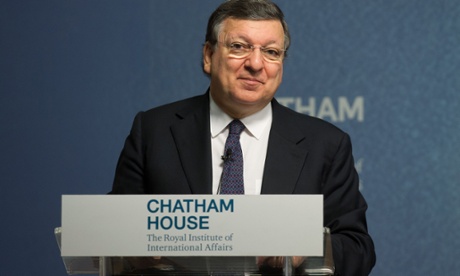
José Manuel Barroso is delivering his speech at Chatham House.
On the Today programme Bernard Jenkin, the Conservative MP, and Bruno Maçães, Europe minister in the Portuguese government, are discussing José Manuel Barroso’s speech.
Maçães says the free movement of people is fundamental to the EU. It is even more important than free movement of capital, he says.
Jenkin says the UK joined the European Union (or the then EEC) because it wanted trade and cooperation. It did not want a superstate, he says.
(I thought Barroso himself was on the programme, but I must have misread the programme’s running order.)
Nick Robinson, the BBC’s political editor, says that Number 10 is now saying that Cameron may not be giving the speech on Europe and his “red lines” that reports said he would making.
Robinson says it is also impossible to find other EU leaders who support the plans that is supposed to be considering, such as his demand for the right to cap the number of EU migrants coming to the UK.
José Manuel Barroso is stepping down at president of the European commission shortly, but he’s not going quietly. He’s in London today and, as Nicholas Watt reports, he is going to give a speech highly critical of David Cameron’s EU strategy.
David Cameron is making a “historic mistake” by adopting a defensive approach towards the EU which risks increasing the chances of a British exit, the outgoing European commission president José Manuel Barroso will warn on Monday.
In the strongest attack by Brussels on the Conservatives over their handling of the EU, Barroso will say that the prime minister’s plan to impose an “arbitrary cap” on immigrants from eastern Europe is contrary to EU law and will alienate Britain’s natural allies.
Barroso, the most anglophile commission president of the last 30 years, will give vent to deep frustration at British tactics when he takes the highly unusual step of venturing into internal UK affairs by warning that the Tories should learn from the Scottish referendum and not wait until the final days to make a positive case.
I’ll be covering the speech in detail, and all the reaction it provokes.
Here’s the agenda for the day.
8.30am: Barroso gives his speech.
9am: Nick Clegg hosts his monthly press conference.
10am: Alan Miliburn, chair of the social mobility and child poverty commission, publishes its annual report.
11am: Number 10 lobby briefing.
As usual, I will be also covering all the breaking political news from Westminster, as well as bringing you the most interesting political comment and analysis from the web and from Twitter. I will post a summary at lunchtime, and another at the end of the day.
If you want to follow me on Twitter, I’m on @AndrewSparrow.
Updated