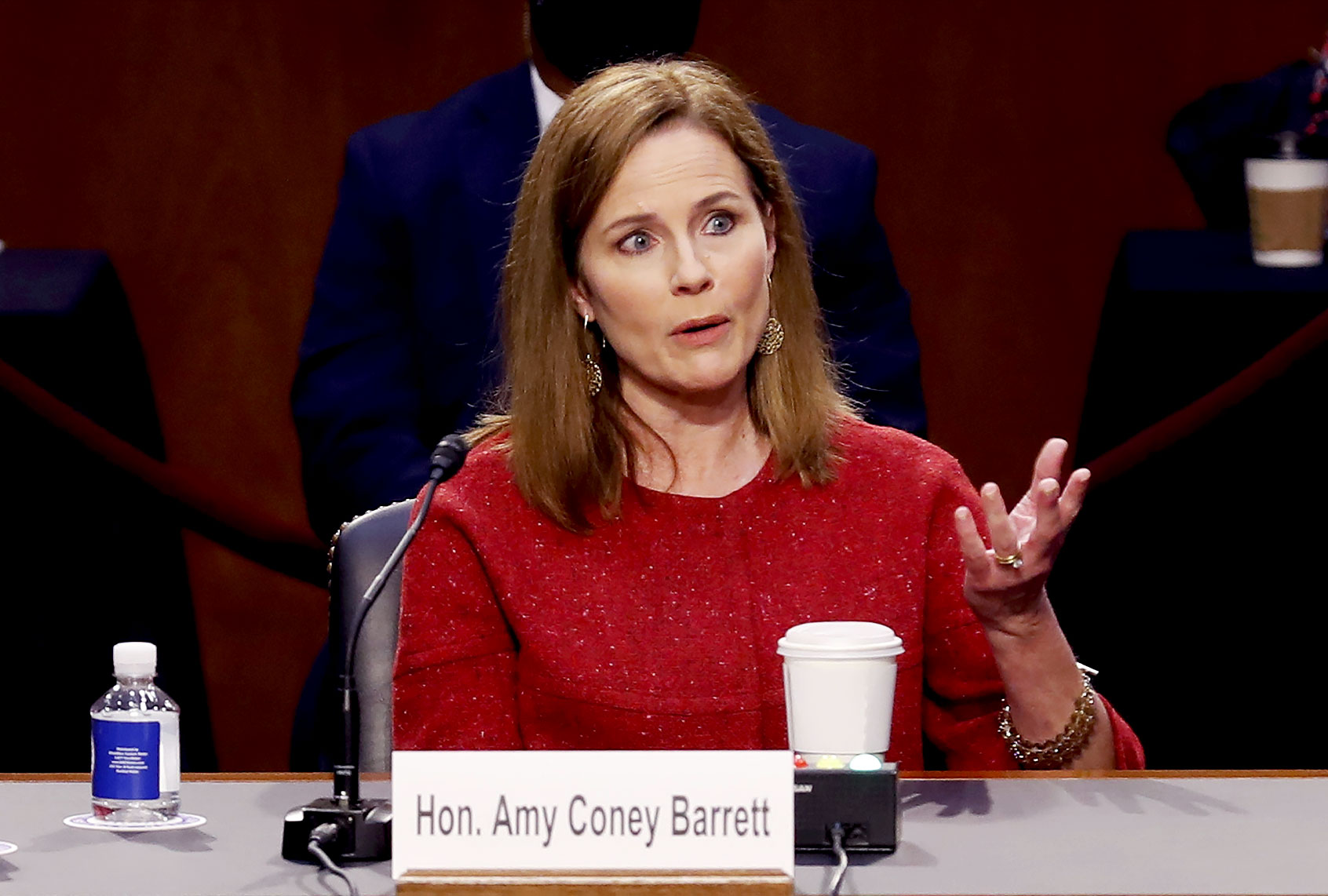
U.S. Supreme Court Justice Amy Coney Barrett ruled in favor of a major donor to her confirmation battle without explaining her ties to the plaintiff.
The Americans for Prosperity Foundation sued over a California law requiring charitable organizations to disclose the identities of their major donors to the state attorney general's office, but Barrett not only declined to recuse herself from the case -- she also vigorously took part in oral arguments and joined the majority opinion without addressing questions about her involvement, reported The American Prospect.
"There is no mechanism to force a justice to adhere to the Court's own prior rulings in their ethical conduct, or to hold them accountable for failing to do so," wrote columnist Steven Lubet. "Self-regulation, in other words, does not work. In fact, it creates an essential imbalance, as those justices who conscientiously follow recusal practices take themselves out of cases, while those with no such concerns do not."
The Koch-funded advocacy group publicly committed more than $1 million promoting Barrett's confirmation weeks before Donald Trump lost his re-election bid, and the newly minted justice was personally alerted to that backing in a letter from Sen. Sheldon Whitehouse (D-RI), Sen. Richard Blumenthal (D-CT), and Rep. Hank Johnson (D-GA) calling on her to recuse herself from the case.
The senators detailed efforts by Americans for Prosperity to secure Barrett's confirmation and pointed out that federal law provides that a Supreme Court justice is disqualified in any case where her "impartiality might reasonably be questioned."
The test outlined in the statute does not require evidence of bias, but only the showing of circumstances where a judge's "impartiality could reasonably be doubted," but Barrett never responded to the senators' letter or acknowledged their question about her involvement in the case, which the court found 6-3 in her donor's favor.
"It has been the Supreme Court's 'historic practice' to leave recusal questions to the determination of each individual justice, rather than submit them to the full court," Lubet wrote. "The unfortunate consequence of that approach is fully evident in this instance, where Justice Barrett has seemingly disregarded both a federal statute and a previous SCOTUS decision."