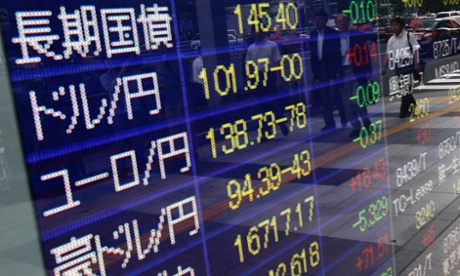
Japanese policymakers have revealed surprise plans to pump more stimulus into the economy, triggering widespread cheer among international investors.
The Bank of Japan will inject ¥80tn (£447bn) a year into the financial system, mainly through the purchase of government bonds, in a bid to ward off the threat of deflation.
In a week when the US Federal Reserve announced it was calling time on its bond-buying programme, the Bank of Japan moved in the opposite direction by increasing stimulus through an expansion of its quantitative easing (QE) programme. The central bank was previously pushing money into the system at a rate of ¥60-70tn a year. It also halved its growth forecast for the current fiscal year, to 0.5% in the year to March 2015 from 1% three months earlier.
The bank’s governor, Haruhiko Kuroda, said policymakers were determined to avoid a return to deflation which plagued the Japanese economy for years. “Whatever we can do, we will,” he said.
He added: “The Japanese economy is now at a critical moment in its process of getting out of deflation. The [stimulus] measures this time show the Bank of Japan’s unwavering determination to exit deflation.”
When the impact of a sales tax hike in April from 5% to 8% is stripped out, annual consumer inflation fell to 1% in September, half the central bank’s 2% target.
Lower oil prices are expected to bring inflation down, and consumer spending has also taken a hit in Japan following the sales tax increase.
The move by Japan’s central bank buoyed international markets and sent the yen to a near-seven-year low against the dollar. Asian stock markets all closed higher, led by Japan’s Nikkei 225 index which was up 4.8%. Investor cheer spread throughout Europe, with all major indices up, including the UK’s FTSE 100, which was up 1.2%.
The dollar surged to 111.53 yen, the highest level for the US currency since January 2008.
Anna Stupnytska, global economist at Fidelity Worldwide Investment, said: “The Bank of Japan’s decision to expand its monetary easing programme comes as a big surprise, which – conveniently – coincides with this week’s Fed decision to end its QE.
“As for the wider economy, this doesn’t really solve the issue of low growth expectations in the longer term, which is the main reason behind the negative real wage growth, sluggish demand and investment. As always, monetary policy is not the only answer but it will keep the markets pleased for now.”