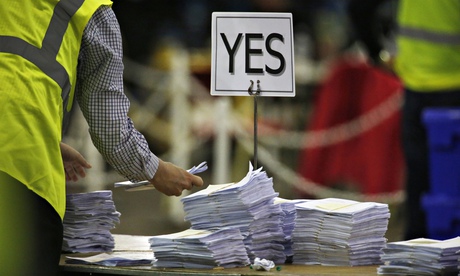
The Bank of England was ready to flood the financial markets with millions of pounds of emergency funding if Scotland had voted to break away from the UK in last month’s referendum.
Outlining the contigency plan that would have been rolled out in the event of a “yes” vote, the Bank of England was also ready to stand behind bank notes issued by Scottish banks in an attempt to reassure customers that there would be no immediate changes.
“Under current arrangements, Scottish banknotes are backed fully by their issuers’ holdings of Bank of England notes, UK coin and deposits at the Bank of England. This would have been a key public message in the event of a ‘yes’ vote,” the Bank of England said.
The details released by the Bank’s financial policy committee – set up by the coalition in the wake of the 2008 crash – show the extent of the planning that had been put in place ahead of the referendum. In the event, Scotland voted by 55.3% to vote to stay in the United Kingdom.
But in the immediate days before the poll on 18 September there had been sufficient concern for Bank of England governor Mark Carney to fly back to London from Cairns in Australia where he should have been attending a G20 meeting, while chancellor George Osborne did not attend at all.
“In the extreme, it was possible that the prospect of that risk materialising in the future could have threatened financial stability in the present. If depositors, policyholders and other creditors believed that an independent Scotland would adopt a new currency, they might have preferred not to take the risk that their assets might be redenominated into that new currency,” the Bank said.
“If financial companies believed they would face currency mismatches and therefore potential capital losses in the event that Scotland adopted a new currency, they too might have preferred to reduce their exposures to Scottish assets,” it added.
In the event of a ‘yes’ vote, the Bank of England would have issued a statement immediately reaffirming its responsibilities for financial stability, prudential regulation, banknotes and monetary policy in the entire United Kingdom, including Scotland, until legislation enacting independence came into force to try to reassure bank customers. It would have been co-ordinated with the Financial Services Compensation Scheme – which oversees the system which guarantees savings up to £85,000 in each firm – and the Treasury.
The Bank of England would have immediately launched an exercise to put more liquidity in the markets through the Indexed Long-Term Repo (ILTR) mechanism, which allows banks to get more liquid assets from Threadneedle Street. An operation had been scheduled for 7 October but the Bank had decided not to wait that long. Between £200m and £300m of cash is usually accessed this way by banks each month.
“It was subsequently decided by the Bank that, in the event of a ‘yes’ vote, and as a precautionary measure to backstop sterling money market liquidity, the Bank would immediately announce its intention to conduct additional operations in each of the two succeeding weeks, bridging to the already scheduled 7 October operation,” the Bank said.
The Bank of England was more concerned about the impact on the credit rating of an independent Scotland rather than of the United Kingdom.