European markets close higher
Despite more weak Chinese data and worries about US rate rises in December, markets have recovered a little poise. A spate of well received earnings reports from Europe, including Carlsberg, helped matters, while the AB InBev bid for SABMiller also lifted investors’ spirits. The final scores showed:
- The FTSE 100 finished up 21.92 points or 0.35% at 6297.20
- Germany’s Dax added 0.7% to 10.907.87
- France’s Cac closed 0.82% higher at 4952.51
- Spain’s Ibex ended 0.39% better at 10,377.2
- An exception was Italy’s FTSE MIB which dipped 0.26% to 22,385.11
On Wall Street the Dow Jones Industrial Average is currently up 37 points or 0.2%.
On that note, it’s time to close up for the evening. Thanks for all your comments and we’ll be back tomorrow.
You heard him! Drinks on Mark #BoEOpenForum
— Fergal O'Brien (@fergalob) November 11, 2015
And then Carney is gone, after a promise of drinks in the crypt for those in the Guildhall, drinks on the Daily Mail’s Alex Brummer for those who attended his session in Edinburgh and for those at home, drinks in the local pub on the Bank thanks to its QE programme.
Carney: [It is] the responsibility of authorities to explain why things are being done. Lot of postings said there is a lot of jargon...even as we are trying to explain things.
Updated
In his closing remarks, Bank of England governor Mark Carney - who maintained his net contribution was to come up with the words Open Forum - repeated the disconnect between the sector and the public:
We are all going to go back and reflect on what we’ve learned.
[In the sessions there was] almost universal reaffirmation of the imporatance of markets,... not just to the econmy but to people’s everyday lives.
But the level of trust is quite low. Disconnect in how we in finance see sector and how public see the sector.
The disconnect is not in public’s mind.
There is optimism around institutions, a lot has been done to make banks stronger, they are beginning to adjust their business models. [We can say to them] there is no other big wave of capital regulation coming, last pieces of puzzle are put in place.
Now it’s about adjusting business models to new realities. Business models pre-crisis not going to be effective now.
Back to trust and he said:
Trust is low for two reasons, because of misconduct. lack of client focus.
As we edge towards the close, both the Bank’s Jon Cunliffe and chair of this final panel Sir Richard Lambert agree the discussion has been useful and should continue after this event finishes.
Updated
Giles Fraser says its time to get rid of acronyms - it’s a part of group think we should do without.
Call by @gilesfraser for ban on acronyms goes down well in Edinburgh #BoEOpenForum
— BoENorthEast (@BoENorthEast) November 11, 2015
Sir Jon Cunliffe, deputy governor at the Bank of England on credit:
John cunliffe responding to my earlier Q: ''credit is a public good like water - like water you can drown in it.'' Quite so. #BoEOpenForum
— josh ryan-collins (@jryancollins) November 11, 2015
A rival candidate for quote of the day, from the final panel going on now. Talking about debt and credit, the Reverend Canon Giles Fraser said:
We are approaching this terrible time called Christmas.. go into the Westfield shopping centre and you’ll see tens of thousands of people buying lots of things they don’t want with money they don’t have for people they don’t like.
We’re encouraged to do this because of this thing called growth. I worry about moral hazard of debt...
Updated
Nobody knows how money works these days, we just hope it's there when we need it - quote of the day Blythe Masters #BoEOpenForum
— Hugh Stickland (@CABHugh) November 11, 2015
Blythe Masters, the chief executive of Digital Asset Holdings, was speaking at one of the afternoon sessions.
But there is a divergence between how the bankers and the public think reform of the sector is going:
Great comments by Gillian Guy @CitizensAdvice on gulf between industry and public on how banking reform is going #BoEopenforum
— Fran Boait (@franboait) November 11, 2015
'Not enough for the public to understand finance. The financial industry needs to understand the public'. Gillian Guy at #BoEOpenForum
— Mette Reitzel (@MetteMorph) November 11, 2015
Updated
Adding to the theme of banking and its wider role in society as heard at the Bank of England’s open forum, Mark Taylor, Dean of Warwick Business School and a former senior economist at the Bank, said:
Mark Carney is on a charm offensive in order to encourage the public to think about bankers in a better way. After all we need a strong financial sector, it represents eight per cent of the UK’s GDP and 20 per cent of income in London alone. It is an important part of the economy, and in order to grow other sectors like manufacturing we need a strong financial sector. But the banking sector needs to act ethically and in the best interests of society for it to work properly. We need bankers to think of their impact on society and not just on their wallet.
European Central Bank president Mario Draghi may not have caused any market moving sparks in his speech at the Open Forum earlier.
But Reuters is reporting that the ECB is considering extending its QE programme by buying municipal bonds of cities like Paris or regions like Bavaria, according to sources. Reuters says:
This regional bond buying could be one in a series of measures to be rolled out in the coming months, although one of the sources said time was short for a full launch in December and that this would likely come by March next year.
The ECB declined to comment.
Despite the ECB’s scheme of quantitative easing (QE) to buy chiefly state bonds, the eurozone’s economy is growing only modestly and the central bank is urgently considering what more it can do to improve it and stagnant price inflation.
As part of preparations for the next rate-setting meeting of policy-setters on Dec. 3, ECB officials are now analysing whether and how to extend its shopping list to municipal bonds, issued by, say, Madrid or Mainz, or a federal German state.
“You have big markets, such as Spain and Italy. France has a well developed market,” said one person.
According to data from Thomson Reuters IFR, almost $500 billion of bonds issued by European cities and regions are in circulation. The regions have sold more than $76 billion of bonds over the last year.
The source said that while some cities were risky, they had the fallback of central governments. Municipal bonds typically have a lower credit rating than governments. It is a fragmented market in Europe, with many small issues.
Back with the Bank of England’s Open Forum, and here’s something to illustrate the main themes, ahead of the day’s summing up.
Here's some of the key themes and challenges coming out of #BoEOpenForum drawn by our visual artists pic.twitter.com/wEo8fKFd5x
— Bank of England (@bankofengland) November 11, 2015
Elsewhere, the Bank of Spain has said the country’s third quarter GDP grew 0.8% quarter on quarter.
It repeated its estimate of 3.1% growth in 2015 and 2.7% in 2016. But it admits the risks to these forecasts have increased since June.
Meanwhile in Greece, the country’s banks will need less than €10bn for recapitalisation, MNI is reporting.
There’s not much to argue with here....and maybe that’s the problem:
Participants in the Edinburgh #BoEOpenForum are reporting back on the themes of their round-table discussions pic.twitter.com/rusB3xCnIk
— BoENorthEast (@BoENorthEast) November 11, 2015
Increasing financial education, transparency, trust and responsibility are big themes of the groups' findings so far #BoEOpenForum
— BoENorthEast (@BoENorthEast) November 11, 2015
Some analysis of Draghi’s speech:
This speech is definitely a thinly veiled attack on Cameron's vision of a capital market union supervised by natl institutions #BoEOpenForum
— Jonathan Algar (@jonathanalgar) November 11, 2015
Just read this whilst listening at #BoEOpenForum - Draghi makes the case for the EU if you want a single market https://t.co/M3yg2DezwV
— Anne Fairweather (@AnneFairweather) November 11, 2015
Superb comments by @MazzucatoM on how rent-seeking and VC short-termism undermine value-creating financial innovation at #BoEOpenForum
— John Fingleton (@JohnFingleton1) November 11, 2015
Professor Mariana Mazzucato has been busy debunking hype in the world of financial innovation.
She told a panel at the Open Forum that many new wizzy ideas have actually helped companies to extract wealth, and give very little back society:
Financial innovation has increased outsized free riding/rent extraction effect in GDP not reduced it, says @MazzucatoM (my hero)
— Izabella Kaminska (@izakaminska) November 11, 2015
We need the right sort of innovation, not rent seeking innovation, says @MazzucatoM #boeopenforum
— Izabella Kaminska (@izakaminska) November 11, 2015
Has the Bank of England done any war gaming and worked out under what conditions it would intervene in the markets?
Couldn’t possibly say, Minouche laughs. But generally, Bank officials have done a lot of work on this general issue to prepare for a liquidity crisis.
Axel Weber, chairman of UBS, warns there is a ‘vacuum’ in the markets now as some institutions - such as UBS - no longer act as market makers.
He cites the impact of new tougher regulations, which make it too risky and costly.
And that could be a risk, when the next crisis strikes and everyone wants liquidity....
BoE's Shafik: Very real risks in emergency liquidity operations
Flicking between this afternoon’s discussions at the Open Forum, there’s a lot of talk about market liquidity.
Asset managers are explaining that liquidity could easily evaporate once the next crisis strikes, as many investors have already cut their exposure to riskier assets.
And deputy governor Minouche Shafik is also discussing it, saying:
Liquidity is a public good, and central bankers have a duty to guarantee it.
And the last crisis showed that central banks can widen their remit and pump money into non-banks (such as insurance group AIG in America).
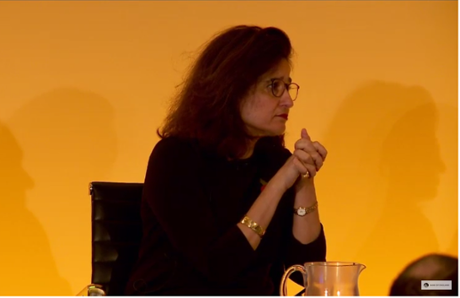
But there are “very real risks”, Shafik continues, in acting like a market-maker of last resort, and buying assets when everyone wants to sell.
1) The moral hazard issue: banks won’t worry about maintaining their own liquidity levels if they think the BoE will save them.
2) Financial risks: liquidity operations are much riskier than simply buying assets, And its harder to tell if an entity is solvent.
3) Political risks: there are ‘distributions’ consequences (ie: wealth distribution -- bank assets are owned by the rich, but bailouts are paid by everyone)
So, it should only be a ‘last line of defence’, Shafki concludes.
Updated
Over on Wall Street, e-commerce magnate Jack Ma is preparing to ring the opening bell:
MOMENTS AWAY: Alibaba CEO Jack Ma rings the NYSE opening bell from China & then joins @SquawkStreet LIVE. pic.twitter.com/COPNZMfEbR
— CNBC Now (@CNBCnow) November 11, 2015
He’s got the honour because today is Singles Day - the world’s biggest day for online shopping (invented by, you guessed it, Alibaba).
There are now more ‘breakout sessions’ underway - you can follow them here:
An open discussion on the role of markets in society
(there’s an icon in the top left corner to click to jump between them)
What does Mario Draghi mean when he calls for a “uniform deposit insurance scheme”?
Well, back in June, he and four other eurozone presidents called for an EU-wide deposit insurance by 2017. That would sit on top of existing national deposit schemes, providing extra protection.
Currently, each eurozone nation guarantees €100,000 of savings if a bank goes under. Those guarantees, though, are only as strong as the country in question.
This is a bit harsh:
#Draghi nods off during his own speech pic.twitter.com/sy5VG9KsS3
— ForexLive (@ForexLive) November 11, 2015
OK, it wasn’t the speech you’ll tell your grandchildren about - but this is serious, nitty-gritty stuff, with major ramifications if regulators make another hash of things.
And that’s it! Draghi isn’t taking any questions, much to my dismay.
And the speech didn’t contain anything to get the markets moving - no hints about future stimulus measures.
whaT. zero zip nada hint from #Draghi regarding expand/extend QE or possible cut in deposit rate @CNBC
— Louisa Bojesen (@louisabojesen) November 11, 2015
Latest bit of commentary from Draghi & co is a bit...boring. Nothing too revealing or interesting yet re: December policy action. $EURUSD
— Christopher Vecchio (@CVecchioFX) November 11, 2015
The eurozone does already have some banking union, with the ECB responsible for banking supervisions.
But it doesn’t yet have a uniform deposit insurance scheme. This is still controlled by national governments.
Mario Draghi’s message is that politicians need to pool more sovereignty, to ensure their financial markets work better:
Draghi: In Europe national policymakers cannot fully protect citizens without pooling more sovereignty #BoEOpenForum
— ECB (@ecb) November 11, 2015
Draghi: ECB banking supervision benefits citizens, member countries and the single market #BoEOpenForum
— ECB (@ecb) November 11, 2015
Updated
Draghi: Eurozone needs proper banking union, ASAP
OK we’ve got to the meat of the speech.
Mario Draghi is urging eurozone leaders to crack on and actually implement a full banking union across the eurozone, including a single deposit insurance scheme to protect savers when their bank fails.
The ECB president says:
With a single currency the benefits of a single market are commensurately higher. But the costs of the market fragmenting are commensurately higher, too. For countries that share a single currency and a single market, therefore, the case is clear – I would say almost undeniable – for stronger common governance and deeper institutional integration.
Today, that means as a priority completing banking union: a fully-equipped single resolution mechanism and a uniform deposit insurance scheme.
That would mean that money was equally seen as safe wherever it was saved in the eurozone, to stop panic spreading .
This is a controversial issue in the eurozone -- German taxpayers may be worried about potentially compensating Greek savers.
But Draghi is clear - it’s simply too risky to not have such guarantees in place when the next crisis arrives.
Draghi: To reap benefits of open and free markets appropriate governance is necessary #BoEOpenForum
— ECB (@ecb) November 11, 2015
Draghi’s conclusion --all markets need proper governance to be truly free, especially in a single currency union:
Those countries have entered into an irrevocable union, built on the fertile ground of Europe’s common values and history, but also on deep mutual vulnerability. For those countries it is even more important to complete economic and monetary union in all its aspects.
Updated
Draghi adds that attempts to clean up the asset-backed securities market after the 2008 crash also caused problems:
There was “too much opacity” about what had been bundled into those products, a damaging breakdown of confidence in the integrity of those who packaged and sold them.
And the immediate temptation of regulators was to impose punishing capital charges on holdings of asset-backed securities, independent of their individual characteristics, mixing the wheat with the chaff.
A proper market must offer the freedom to take part, and also protection to ensure that freedom isn’t lost, Draghi continues.
There must be fair competition, respect for property rights... in short, the Rule of Law.
If that doesn’t happen, then people lose confidence and the whole system becomes destabilised.
Fair enough! But we’ve seen an example recently when this simply failed, causing major panic.
Draghi explains:
During the crisis, the market for securitised assets was all but destroyed by a collapse of confidence. Lack of oversight allowed excesses to be committed and market abuse to take place. Securities that were previously deemed safe, certainly with some measure of complacency and too much blind confidence, turned out to be very unsafe indeed, and imparted significant losses on their holders.
Updated
Global trade is more important and intertwined than ever, Draghi says, with technology means distance between buyers and sellers is no longer as important.
Global markets are also more closely linked, with the cost of moving capital between borders now almost zero.
Draghi begins by saying that markets can be defined by the instruments traded on them - oil, gold, etc - but they’re also defined by the people who use them.
And you need appropriate governance to prevent misconduct - especially when markets cross borders.
Mario Draghi speaks in London
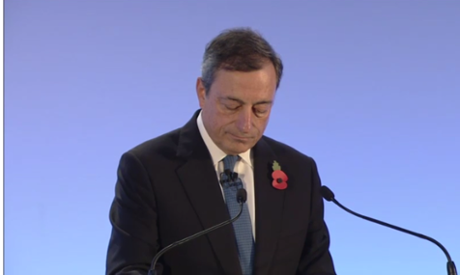
Lunch is over at the Guildhall, and Mario Draghi is taking the stage at the Bank of England’s Open Forum.
He’ll be speaking for 45 minutes on the financial markets.
Andy Haldane, the Bank’s chief economist, is introducing him. He reminds us that Draghi pledged 3 years ago in London to do “whatever it takes” to protect the euro.
Those ‘magic three little words’ helped to calm the eurozone crisis, and put the global economy on a more even keel.
We all have a lot to be thankful for to Mario, Haldane says.
You can watch the session here.
Updated
In other news, the car emissions scandal appears to be spreading beyond Volkswagen.
German regulators have announced they will test 50 models from 23 different brands, issued by German and foreign car companies, to see if they also breach nitrogen oxides emissions levels.
According to Reuters, the list includes models from BMW, Daimler, Fiat Chrysler, Peugeot and Toyota.
German motor vehicle watchdog widens diesel probe to 23 brands: FRANKFURT (Reuters) - Germany's ... https://t.co/R1wwqunPNg ... #business
— Aktienmanufaktur (@Aktienexperte) November 11, 2015
We’ll have more details online shortly.
Updated
In 30 minutes time, Mario Draghi will give his views on financial markets to Forum attendees - who are currently knocking back some lunch.
The ECB president seems to be enjoying his visit:

Andrew Bailey, the Bank’s deputy governor for Prudential Regulation, has spoken about the challenges in running a 21st century bank:
BoE's Bailey makes a great point: To mitigate terrorism risks as a bank, you make sure you can move services across locations seamlessly.
— Peter Spence (@Pete_Spence) November 11, 2015
But to mitigate cyber attack risks, you want to do the opposite, as you want to limit ways people can access your system. Big tension.
— Peter Spence (@Pete_Spence) November 11, 2015
Updated
A km worth of legal docs required for review and action on new regulation... #BoEOpenForum pic.twitter.com/9mAXynTrUz
— Charmian Love (@charmianlove) November 11, 2015
Hard to believe that anyone has actually read so many pages, let alone implemented it properly....
From the Open Forum, lawyer Robin Henry confirms that the public are more sceptical about the state of Britain’s financial sector than the people regulating it:
Clear from comments that regulators' rosy view of reforms is not shared at all by the public #BoEOpenForum
— Robin Henry (@Robin_Henry_CB) November 11, 2015
Many comments on the need to move away from top down regulation of the financial markets #BoEOpenForum
— Robin Henry (@Robin_Henry_CB) November 11, 2015
Is it time to stop raking over off the mistakes that helped to cause the financial crisis?
Tracy McDermott, who runs the UK’s financial watchdog (the FCA) suggests it might be:
McDermott is asked at #BoEOpenForum if the FCA is going soft on banks. She says its time to start looking at the future
— Jill Treanor (@jilltreanor) November 11, 2015
The FCA was set up after the crisis; it’s imposed chunky fines for various offences in recent years, including rigging the foreign exchange rates.
The Bank of England is also conducting opinion polls; they’ve showed that people don’t believe the financial system is working well enough:
Clear answer to Question 1 posed on #SME finance at #BoEOpenForum - Not enough being done to improve credit access pic.twitter.com/jA9KhBT1Hm
— James Sherwin-Smith (@26left) November 11, 2015
80% participants say UK economy too dependent on bank debt - Live questions at #BoEOpenForum breakout session. pic.twitter.com/y5HLVnFCbt
— Positive Money (@PositiveMoneyUK) November 11, 2015
Updated
One problem with playing host to the world’s biggest banks is that they often collect the world’s biggest fines:
#BoEOpenForum. Four uk banks in top 10 of world's most fined. So proud. pic.twitter.com/FPsS9eoXg1
— Ben Morris (@Ben_Morris1) November 11, 2015
#BoEOpenForum just heard "here's a list of bank fines....we can be proud we have 4 banks in the top 8".... Everybody starts laughing ?!?!?
— Cryptolution (@jay_mm1) November 11, 2015
One attendee has already warned that innovation can’t be chained down:
Provocation from the audience at #BoEOpenForum 'rules don't work - I'm an innovator and will work around them'
— Charmian Love (@charmianlove) November 11, 2015
Financial economist Jonathan Algar puts his finger on the problem with ‘professionalising’ the City:
Term "banker" been used generically at #BoEOpenForum. BoE aspire to make it a profession. Problem: in reality, not a job with a standard..
— Jonathan Algar (@jonathanalgar) November 11, 2015
..set of skills. Even within cap mkts banking, syndication & origination totally diff skills, cultures. Then there’s structures, quants,..
— Jonathan Algar (@jonathanalgar) November 11, 2015
Updated
Various breakout sessions are now taking place at the BoE’s event:
Jill Treanor is tweeting the key points from the Guildhall:
Acting FCA Tracey McDermott at #BoEOpenForum says traders were "operating in a little bubble where [they thought] rules didn't apply"
— Jill Treanor (@jilltreanor) November 11, 2015
RBS chairman Sir Howard Davies tells #BoEOpenForum the bank is trying to again public approval by rooting the bank to customer needs
— Jill Treanor (@jilltreanor) November 11, 2015
(that should be ‘regain public approval’ - silly autocorrect)
Updated
I missed this, unfortunately, but it’s a key issue:
'Laughs' at my question at #BoEOpenForum - do we want the biggest banks the the world? I don't think it's that funny....
— Fran Boait (@franboait) November 11, 2015
Osborne was clear this morning that despite the crisis of 2008 and its aftermath, Britain is still aiming to be a world-leader in finance, based around the City.
The aim is to make the market function fairly, and much better than before, but that hasn’t been tested yet....
Fran Boait is executive director of Positive Money, which is “a movement to democratise money and banking so that it works for society and not against it”.
Updated
The thorny issue of the huge pay packets handed out in the City has finally reared up at the Guildhall.
The public believe it is a crucial cause of the crisis - so will it be fixed?
David Kynaston, visiting professor at Kingston University, argues that City remuneration must be tackled.
He tells the Open Forum that:
If the City and the financial markers are serious about achieving a genuine social licence, real action needs to be taken on pay because it remains a grotesque disparity.
Rabbi Baroness Julia Neuberger agrees, warning that badly-structured packets create an incentive to trade that isn’t in the interests of the market, but is in the interest of the individual.
[This argument is often made by supports of a Tobin Tax, or Robin Hood tax]
Helena Morrissey, CEO of Newton Investment Management, argues that there needs to be more “symmetry” among pay -- if traders get a chunk upside for doing well, there should be more downside when it goes wrong.
[new rules allowing bonuses to be clawed back years after they were granted go some way to addressing this]
And Jim O’Neill points out that Goldman Sachs was a partnership for some of the time he worked there - so individual’s capital was on the line. (that ended when Goldman floated in 1999).
That could be a better model for some parts of the City, but probably not for client-facing roles, he concludes.
Updated
Jim O’Neill has warned the audience that there will be new financial crisis sooner or later.
But if we have more diverse companies operating in the sector, the damage might be less.
A financial crisis will happen again says Lord Jim O'Neill at #BoEOpenForum More diversity needed, the Treasury minister says
— Jill Treanor (@jilltreanor) November 11, 2015
There is a bit of a theme developing, about conflict between desire for safety and need for risk-taking to support growth #BoEOpenForum
— Frances Coppola (@Frances_Coppola) November 11, 2015
This is crying out for a caption competition.....

It’s a similar message in London:
Who feels "it's job done" in terms of regulatory changes, the room at #BoEOpenForum is asked? two or three hands go up..
— Jill Treanor (@jilltreanor) November 11, 2015
There’s not much confidence in Birmingham that the financial markets are fixed.
The Bank of England has set up a smaller forum in Britain’s second city, to shadow events in London.
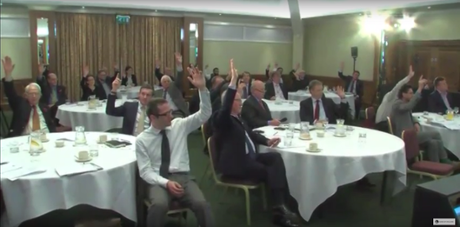
Attendees were asked “do you think Financial Markets had a key role creating the financial crisis and the recession that we experienced in the UK?”. Virtually everyone raised their hands:
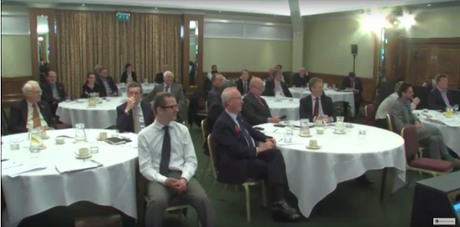
And second, “are you now confident that financial markets are operating in an ethical way that would prevent such a crisis and a recession hitting us again?”
Cue much sitting on hands.....
Treasury minister Jim O’Neill, a former top executive at Goldman Sachs, cautions against thinking that the financial crisis can be easily ‘solved’
It’s right that we’re trying to explore why the hell it was so bad...but we have to also acknowledge that we might not fully know.
It’s dangerous to think we’ll find some magical solution to protect us for decades ahead.
A panel discussions is now underway now in the Guildhall.
Rabbi Baroness Neuberger is taking a historical view, saying bankers have been criticised for several generations - and they’re always relieved when another industry is hit by scandal (such as Volkswagen’s emissions scandal or the oil spill in the Gulf of Mexico).
Julia Neuberger tells #BoEOpenForum that bankers were relieved by the VW and BP oil spill disaster
— Jill Treanor (@jilltreanor) November 11, 2015
Baroness Neuberger also argues that a banking code of conduct won’t push up standards on its own.
It takes outsiders to show when something is being done wrong, even if professionals are following the code.
Updated
While Osborne was speaking, new data showed that Britain’s unemployment rate has hit a new seven-year low of just 5.3%.
But it’s not all good news - wage growth was weaker than expected. Average earnings rose by 3% annually in the last quarter, but only 2% in September alone.
Touching distance. UK unemployment falls to 5.3%, a whisker away from 2000-07 average of 5.1%. pic.twitter.com/goiGmZrXW2
— RBS Economics (@RBS_Economics) November 11, 2015
#Employment rate 73.7% for Jul-Sep 2015, highest since records began in 1971 https://t.co/Cx4CoquCVb pic.twitter.com/pW6dHUMoYK
— ONS (@ONS) November 11, 2015
For Jul-Sep 2015 wages up 3.0% on a year earlier including bonuses, & 2.5% excluding bonuses https://t.co/ujz2apLFKh pic.twitter.com/C8pmI6prQ6
— ONS (@ONS) November 11, 2015
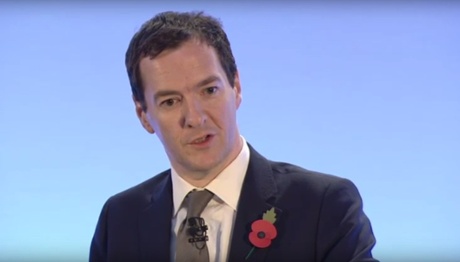
Osborne: Public are right to be angry over banking crash
Does George Osborne understand why the public are still so angry about the crisis, and believe that the people responsible never paid a penalty?
He says he does, telling the Bank of England’s Open Forum that it’s perfectly understandable.... and he shares some of this frustration and anger.
We were told that the City was well regulated, and people were paid high salaries because they ran big risks and would lose their jobs if things went wrong.
Then along comes a big banking crash, and it turns out that the person standing behind the bank is the taxpayer.
If you go and shoplift at the local WH Smiths you go to prison, but if you’re the market trader on the trading floor of a big investment bank and you rip off people to the tune of millions of pounds, there are no criminal offences available to deal with you.
There was a lot of totally understandable anger.
The chancellor also says it’s “a bit optimistic” for bankers to ask him when we can move on from the crisis.
This was the biggest single economic crash of our lifetimes.
This was a financial crisis probably larger than anything experienced since the Victorian age in our country, and an economic crash and a recession as great as anything since the 1930s.
The industry, regulators and politicians must prove that the banking sector has cleaned up its game.
And that’s the end of his session.
Updated
A questioner from the floor challenges Osborne on that last point.
She points out that big fines are paid by shareholders, not the staff responsible. And the 2008 bailouts were paid by the taxpayer, not the bankers who led their firms to the cliffedge.
Surely we need more accountability?
Osborne says the government has created new criminal offences to cover benchmark manipulation. And individual bankers who cause their banks to fail would face seven years in prison.
When I got into office [after the 2010 general election] and found out about the scandal, I changed the law.
Updated
Onto questions: Would a bankers code of conduct help to restore financial trust?
Osborne says that Banking, like the medical profession, engineering, architecture, has a proud history. The best practitioners want to enhance that status, and regulated by the industry itself as well as the government.
The Banking Standards Board is doing good work getting codes of conduct up to date, improving exams, to reflect the ethical standards need.
But he then argues that monetary penalties should keep bankers in line.
If anyone thinks being unethical in the financial services industry is a good way to make money, I’d suggest they take a look at the very, very large fines that a number of institutions have had to pay.....and ask whether it was worth it.
Management and shareholders must take the lead, to ensure that staff don’t make an extra buck on the trading floor that leads to a massive penalty for the firm, Osborne concludes.
George Osborne also congratulated the Bank for running a webinar for school children this week, and admitted it was a new term to him.
Osborne #BoEOpenForum didn't know the word "webinar" - good example of top politicians' isolated; no wonder their actions often out of touch
— Sigrun Davidsdottir (@sigrunda) November 11, 2015
At least he’s not the technology minister....
Osborne: No repeat of the RBS fiasco

George Osborne says that his predecessor, Alastair Darling, had very few options when Royal Bank of Scotland hit the rocks in 2008.
He didn’t have legal powers to intervene, he was worried if the cash machines would keep running, he was worried about how the the retail bank would cope if the investment bank failed.
So in the end, Darling had little option but to launch a huge bailout.
It’s vital that the chancellor has many more options the next time this happens, says Osborne. New rules on ring-fencing, capital reserves and bail-in regulations will all help.
Osborne says 'the uk wants to have the biggest banks in the world' - do we? Not everyone does #BoEOpenForum
— Fran Boait (@franboait) November 11, 2015
Osborne: We want City to innovate, and be safe
Chancellor George Osborne is now speaking, discussing the financial crisis, its aftermath, and the ‘dilemma’ created when you try to run successful markets.
He explains that Guildhall was once the place where people turned up to pay their taxes, so the attendees are all ‘very welcome’.
(don’t worry, Osborne’s too busy worrying about tax credits to announce any new taxes today)
Osborne tells the audience that holidaymakers and businesses lost out because City insiders rigged the benchmarks for foreign exchange rates and derivatives.
We want financial firms to innovate, create jobs, fund business.
We want to be the home of the world’s biggest banks. But we also want them to be safe.
Osborne "dilemma between risk and safety for financial markets" #BoEOpenForum
— Hugh Stickland (@CABHugh) November 11, 2015
Carney "don't just want to end boom and bust cycle but also regulatory reform and complacency cycle" #BoEOpenForum
— Hugh Stickland (@CABHugh) November 11, 2015
A date for the diary:
"5 years from now, UK financial services will be the best regulated in the world" - Mark Carney at #BoEOpenForum
— Frances Coppola (@Frances_Coppola) November 11, 2015
Anyone hoping for a smaller City will be disappointed, though.
Carney argues that, done right, Britain’s financial sector could be bigger than ever in the decades ahead.
Financial sector 'could increase from six to nearly 15 times UK GDP by 2050', Carney says. City going to be bigger than ever ....
— Philip Aldrick (@PhilAldrick) November 11, 2015
We have also reformed financial benchmarks to end ‘ethical drift’, Carney adds.

Mark Carney explains that new rules on loss-absorbing capital mean that banks will no longer be ‘too big to fail.’
The era of ‘heads I win, tails you lose’ capitalism is drawing to a close.
(It’s been a long road - Lehman Brothers collapsed more than seven years ago, triggering a massive bailout programme to prevent the whole system imploding)
Updated
Carney: Markets must be fair
Mark Carney is now speaking.
He’s explaining how it’s vital that financial markets work well, and are seen to work well.
They should be fair, with people competing on merit not colluding online (a nod to the various scandals that have rocked the City, such as Libor).
And the financial crisis has shown that the financial services sector failed to live up to these standards, says Carney, adding:
So, it’s not surprising that only one third of people think financial markets work in the interest of society.
And that ratio actually falls among other people - experience of the financial markets leads to less confidence, not more....
London’s Lord Mayor is kicking the Open Forum off, telling the audience that every firm in the financial sector must be “fully engaged” in society, so they’re doing good for Britain.
He then plugs his own City Giving Day, which pushes firms to volunteer and fundraise for good causes.
Watch the BoE Open Forum here
The Bank of England’s Open Forum is starting now in the Guildhall, just across the road from its own building - you can watch it live here.
Banking still looks something like this, but it's changing, says Mark Carney. pic.twitter.com/3i8e5bAAR5
— Jamie McGeever (@ReutersJamie) November 11, 2015
And here’s the agenda of today’s Bank of England Open Forum, which kicks off in a few minutes.
(The ‘senior Cabinet Minister’ is chancellor Osborne)

Updated
Today’s Open Forum is part of Carney’s drive to end the Age of Irresponsibility in the City.
Those attending will hear from the chancellor, George Osborne, as well as Carney, Draghi and many senior figures in the sector:
Here’s our preview:
The latest attempt by the government to rehabilitate the battered reputation of the City of London takes place on Wednesday when Mark Carney, the governor of the Bank of England, invites the public to have their say on the future of financial markets.
Carney has invited the chancellor, George Osborne, and the president of the European Central Bank, Mario Draghi, to be the guests of honour at a day-long event at the Guildhall in London.
Half the 400-strong audience will be made up of members of the public who were allocated their seats by ballot and will have the chance to sit alongside representatives of the banks blamed for crashing the economy and besmirching the reputation of the financial sector....
Mark Carney will soon find out whether the public respect bankers -- 200 people won tickets to today’s Open Forum in a ballot:
The venue for today's #BoEOpenForum. Good that 200 members of the public will be there, not just bankers. @Peston pic.twitter.com/DkOXn6sVop
— Richard Lloyd (@RichardJLloyd) November 11, 2015
The interview ends on a mildly comedy note, as Sky’s Eamonn Holmes asks Mark Carney how he copes with such Clooney-style good looks in the world of central banking.
“It’s a very low bar”, Carney twinkles back.
Eamonn Holmes to Mark Carney on @Skynews: "You are the George Clooney of the banking world." Carney: "It's a very low bar."
— Zoe Catchpole (@mazoe) November 11, 2015
Hopefully that won’t upset Mario Draghi -- the dapper chief of the European Central Bank is speaking at lunchtime.
India’s central bank chief also has his fans...
I think Raghuram Rajan is more attractive than Carney, but I'm in a small minority of financial journos.
— Mike Bird (@Birdyword) November 11, 2015
Carney vows to root out 'bad apples'
Mark Carney has also vowed to ‘root out’ the remaining ‘bad apples’ in the banking sector.
He told Sky News that “the system is changing” so remaining bad apples in the barrel are held to account.
Like any profession, finance has a lot of talented people, working with integrity to do the right thing, Carney continues. It’s the UK’s largest exporter, contributing 8% of GDP.
We’ll still work and root out those bad apples, but we need to recognise there is a lot of good in financial services. It makes a huge contribution to our economy.
I might not be hugging any bankers, but increasingly the British people will be respecting them.
Updated
Mark Carney: I won't hug any bankers
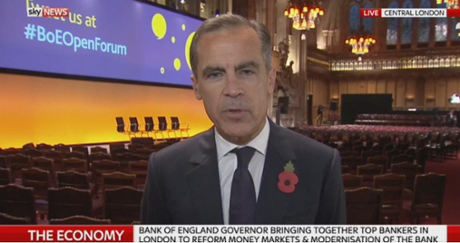
The governor of the Bank of England governor has ruled out ‘hugging any bankers’, as he prepares to welcome the public to its first Open Forum in London.
Interviewed on Sky News, Mark Carney said that Britain’s financial sector has fixed some of the problems that contributed to the last financial crisis.
Travelling around the UK, he’s seen that the public expect two things.
1) Banks should be allowed to go bust like any other business, rather than being bailed out because they’re ‘too big to fail’
2) Individual bankers should be held to account.
Carney insists that progress has been made:
“I think what’s happening now is that the bankers are starting to be part of the solution, not part of the problem.”
But any City workers hoping to be embraced by the dashing Bank boss will be disappointed.
Asked if he’ll ever hug a banker (an echo of David Cameron’s famous pledge to Hug a Hoodie in 2006), Carney replies:
I won’t think you want your governor giving that kind of advice....Neither I nor my successors will be hugging any bankers.
But his goal is to reach the point where people respect bankers, and bankers can crack on with serving the public.
Head of @bankofengland, #MarkCarney, is convinced #bankers are now "part of the solution", not problem #BoEOpenForum https://t.co/dFCn7xNEMq
— Michiel Willems (@michielwil) November 11, 2015
More to follow....
Updated
The Agenda: UK unemployment and Bank of England Open Forum
Good morning, and welcome to our rolling coverage of the world economy, the financial markets, the eurozone and business.
Today we’ll be looking at the UK economy, with the latest unemployment report released at 9.30am GMT.
It’s expected to show another steady pick-up in wages - average earnings could rise by over 3%, while the jobless rate may remain at just 5.4%. A strong report might raise the chances of an early interest rate rise, although policymakers did dampen expectations last week.
Michael Hewson of CMC Markets comments:
A strong wages number will further reinforce the widening gap between wages and inflation and raise concerns that the Bank of England is not only behind the curve, but is on the way to being lapped.
It’s a big day at the Bank of England too, as the UK central bank throws open its doors for its first ever Open Forum (well, the Guildhall’s doors, anyway)
Those lucky enough to get a ticket will hear from governor Mark Carney, and ECB chief Mario Draghi at 1.15pm. It kicks off at 9am:
Excited about the #BoEOpenForum tomorrow? A huge variety of stakeholders will map a positive future for markets https://t.co/XqZxYRIHC7
— Bank of England (@bankofengland) November 10, 2015
BofE's Open Forum with 50% general public with a # for twitter questions. Blimey. Its modern for the old lady of thread needle st.
— Louise Cooper (@Louiseaileen70) November 11, 2015
In the City, supermarket chain Sainsbury’s is reporting financial results. Sales and profits are down, as deflation continues to stalk the sector.
Sainsbury's underlying pretax profit down 18% to £308m in first half, like-for-like sales down 1.6%
— Julia Kollewe (@JuliaKollewe) November 11, 2015
Sainsbury's says food sales down nearly 1% in first half but clothing up 10%
— Julia Kollewe (@JuliaKollewe) November 11, 2015
While in Greece, talks will continue with creditors over the remaining milestones which Athens must hit before it can receive its next aid payment.
Fresh round of talks today in Athens btwn #Greece Mins & officials and Quadriga heads. Gaps hv narrowed but an agreemnt's still not in sight
— Yannis Koutsomitis (@YanniKouts) November 11, 2015
We’ll be tracking all the main events through the day...
Updated