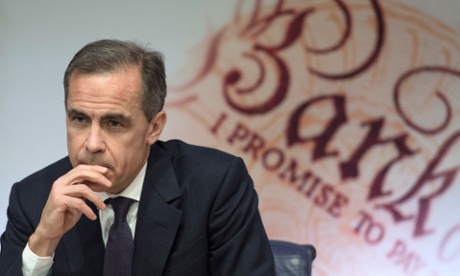
Recent speeches by Bank of England policymakers have focused on the power of the central bank to influence inflation.
Mark Carney said today in Sheffield that such was the strength of the UK economy, prices would soon start to rise, allowing the central bank to raise rates. A deflationary spiral, feared by some economists, was possible, but rising wages and a higher pound (increasing import costs) would spur inflation, next year if not this.
Martin Weale, one of the nine members of the monetary policy committee, said in a speech in London earlier this week, that rest assured, if inflation returns, as it surely will, he will pull the interest rate lever and choke it off.
Kristin Forbes was first out of the blocks a couple of weeks ago. Forbes is also an MPC member. Her speech was laced with dire warnings about the next financial crash and the need to have all the central bank tools in place to save the economy from the next disaster, including rates at 4% to 5%.
But to arrive at a point where inflation requires base rates even at 3% (which would push mortgage rates from 2.5% to 5% and beyond) there needs to be a bubbling geyser of domestic pressure on prices.
This can only come from one source of economic magma – wages. But a sustained increase, year on year, in wages can only be based on increases in productivity or it quickly becomes unaffordable.
To enhance profitability and create surplus value, such that it can be shared with the workers, productivity improvements must be fed by increases in business investment.
And here’s the catch: business investment growth is back to where it was in 2009 according to the latest official GDP figures, which is not good enough to move the dial on productivity. Making the situation worse, banks that say they are lending to business for investment are often disguising the fact that the money is buying property, not plant and machinery, new IT systems or modern manufacturing techniques.
As an open economy, the UK will have bouts of deflation, as it does today following a halving of the oil price, and periods of inflation, possibly when oil prices rise again, along with other commodities and food. On the other hand, a sustained increase in demand based on rising wages looks unlikely for several years, possibly until the end of the decade.
With five more years of austerity to come, a standstill in export growth and enough political and economic uncertainty to deter business investment, the UK economy can do little more than recover lost ground. Recovering lost ground does not spur inflation.
As if to emphasise the point, industrial production figures from the Office for National Statistics this week showed manufacturing in January was still 5% below its peak and industrial production 10% below its peak.
Over at the Office for Budget Responsibility, experts say lots of productive capacity was lost in the crash, so the previous peak is irrelevant. The peak is effectively lower now, which means it won’t be long before the current means of production cannot cope with much more demand and firms will be forced to raise prices.
Maybe so, but with a steady influx of highly qualified labour, much of it from the continent, employers can expand production and increase profits without increasing wages or productivity.
Of course, the demand created by almost 64 million people (compared with 2005’s 60 million people) may still trigger enough activity for Weale and Forbes to lead a charge for higher rates. But policymakers should remember that the UK’s rising population means that the share we all have of the national cake has not risen as fast as the cake itself. In other words GDP per capita is still below its peak. Raising mortgage and loan costs when most are still worse off than in 2008 would be only for the brave.