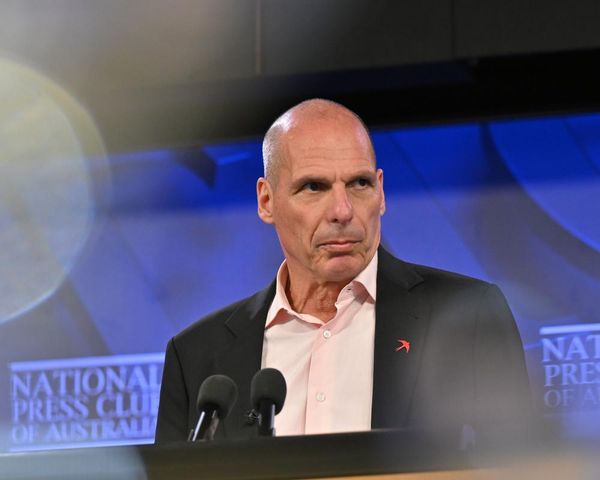
The NAB chief executive, Andrew Thorburn, has faced a more aggressive and disciplined House committee on the final day of the Turnbull government’s banking inquiry.
Thorburn spent much of his time defending NAB and was noticeably uncomfortable at times.
Asked about NAB’s poor financial advice since 2009, which led to $15m in compensation being paid to 750 customers, and the sacking of 43 of its 1,700 planners, Thorburn said the bank had made mistakes.
But he refused to describe it as a “systemic issue” and said he didn’t think any senior executives had been fired over it.
He admitted that NAB had not written to every customer of financial advisers who had been deregistered by the Australian Securities and Investments Commission.
ANZ’s chief executive, Shayne Elliott, made a similar admission on Wednesday.
Thorburn said he was happy that only 700 complaints were made about NAB to the financial ombudsman last year, down 64%.
He also said credit cards were getting less profitable after margins halved over the past 20 years, and few customers had credit cards with the highest rate these days.
He said NAB had stopped making political donations to all levels of government because it wanted to kill the perception that banks were conflicted or seeking favours from politicians.
“It comes back to wanting to be respected as a bank and a company. And make sure that our customers don’t see a conflict,” Thorburn said.
“In essence we felt the donations we were making to political parties were being misconstrued and misinterpreted incorrectly.”
According to NAB’s policy statement on political donations, its board of directors resolved in May 2016 “that the making of any political donations would cease with immediate effect”.
The decisions means the federal Liberal, National and Labor parties have lost a crucial source of political funding.
Elliott had said on Wednesday that ANZ’s board was considering its own stance on political donations.
“We are having discussions at our board about the role of political donations and what our position is on that,” he said.
Thorburn argued that even though 43 financial planners had been dismissed from the bank, there were 1,700 planners and “the vast majority are doing the right thing”.
He was challenged on that point by the committee chairman, Liberal MP David Coleman, who said one in 40 planners was hardly a “black swan event”.
Thorburn disagreed, but said some executives had still had bonuses withheld as a consequence and harm had been done to the bank’s reputation.
When asked about NAB’s the wealth management division that has paid over $25m in compensation to 62,000 customers in recent years, Thorburn played down the payments, noting the bank had $180bn in assets under management.
Thorburn said his annual pay was $2.3m, but he received short-term incentive payments worth a similar amount and long-term incentives worth a similar amount.
In the afternoon, Westpac’s CEO, Brian Hartzer, appeared before the committee.
He revealed bank bosses had spoken to the treasurer, Scott Morrison, about a tribunal to regulate banks in April or May. He said in six years 22 financial planners had been referred to Asic and none of them were working at the bank anymore.
He also said Westpac had “no plans” to change its political donations policy, which allows it to buy seats at fundraisers but not to give cash to political parties.