High street bank chiefs have warned of the costs that would be involved in breaking them up as they brace for a final decision by the competition watchdog on Thursday on whether to conduct a full-scale inquiry into the £10bn-a-year market for personal and business accounts.
The Competition and Markets Authority (CMA) could consider splitting up branch networks or ending fee-free banking if it goes ahead with an 18-month investigation into the sector that was first signalled in July but delayed by a consultation on whether to proceed.
The big four banks – Barclays, HSBC, Lloyds Banking Group and Royal Bank of Scotland – have a 77% market share of personal current accounts and control 85% of small business accounts.
RBS, 81% owned by the taxpayer, and Lloyds Banking Group, 24% owned by the taxpayer, are already in the throes of carving out branch networks to comply with terms imposed on them by the EU when they were bailed out six years ago.
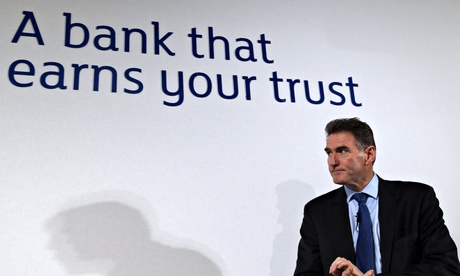
Ross McEwan, the RBS chief executive, told City analysts last week that the cost of hiving off Williams & Glyn, a brand it is reviving to hang over 315 branches, was a very big expense involving 3,300 staff.
“It’s as complicated as you’ll ever find it, which is why I think why people who chat about breaking up banks and distributing them all over the place should have a chat to us at some point in time on just how difficult these things are,” McEwan told the analysts.
António Horta Osório, his counterpart at Lloyds, has previously said it cost £1.8bn to split off TSB, which has 600 branches and has been part-floated on the stock market. RBS is aiming to float W&G at the end of 2016.
Lloyds and RBS are both closing branches as customers increasingly carry out their banking online. The Lloyds boss, who announced 200 branch closures over the next three years, says the current account market is competitive but the one for small businesses more of an potential problem.
Will Samuel, chairman of TSB, which is positioning itself as a challenger bank, has called for a “full market review focusing on substantive structural reforms as well as behavioural remedies”.
The CMA revealed in July that the industry had devised a number of ideas to deter a full-blown investigation, including setting up comparison websites to make it easier to compare accounts. It is thought that the watchdog, set up in April to replace a number of competition authorities, has rejected these ideas after a two-month consultation that ended in September. It would not comment on Wednesday night.
It is now thought to be ready to set out its intention to launch an investigation that would not be concluded until after the May 2015 general election and which the industry has been wary of since it was first suggested by Sir John Vickers in his 2011 independent commission on banking.
The shape of the banking industry is expected to be a topic of debate during the election campaign and Labour has already talked about calling for a competition investigation.
The structure of the industry is also being discussed by top bankers who are already preparing to make changes to the way they run their businesses to comply with the Vickers’ recommendation that they ringfence their high street and investment banking arms.
Douglas Flint, the chairman of HSBC, has asked the government to delay the implementation of the ringfencing rules while the CMA’s investigation is taking place.