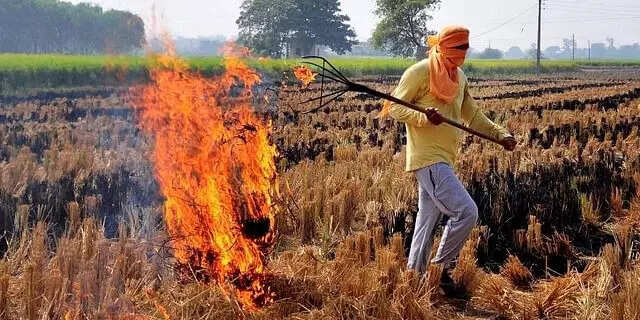
NEW DELHI: Any farmer you talk to in Delhi-NCR region would tell you how bad the practice of stubble burning is for human and soil health, but they would also argue that immediate concerns, including high cost and time-consuming option of better farm practices, force them to opt for burning the paddy harvest remnant.
Sensing this dilemma, the central government’s apex farm research body — Indian Council of Agricultural Research (ICAR) — has stepped in to devise ways that would directly help farmers in earning money through trade in carbon credits accumulated by adopting sustainable farm practices such as by not burning biomass or opting for crop diversification/methods that lead to lesser methane emission.
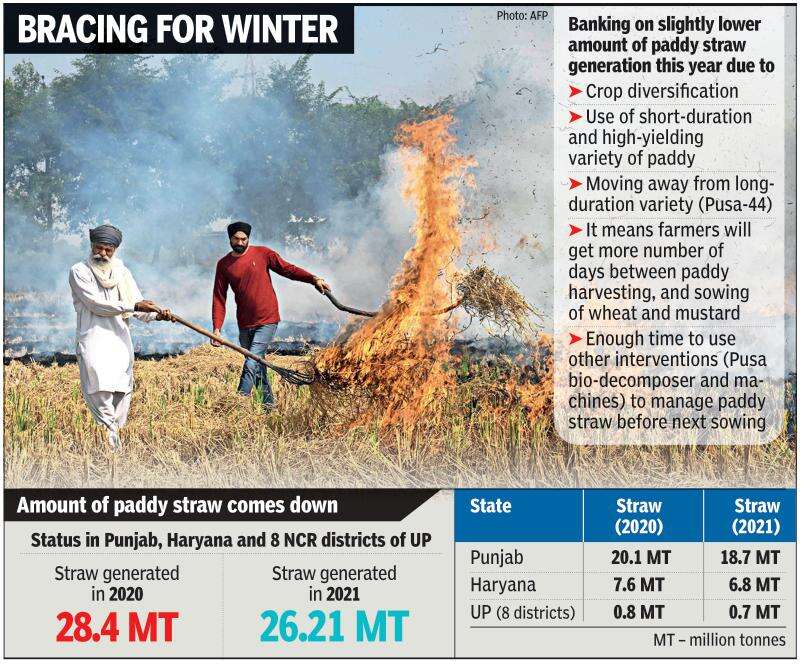
Use of the Pusa bio-decomposer, a bio-enzyme developed by the ICAR’s Indian Agricultural Research Institute (IARI) to break down crop stubble, is one such method which is slowly gaining ground among farmers of Haryana, Punjab and Uttar Pradesh after successful trials in Delhi. IARI director A K Singh told TOI that farmers earning carbon credits would be the next big thing in boosting their income. This would not only help them monetarily, but also save Delhi-NCR regions from the menace of air pollution linked to the burning of crop remnants after the paddy harvest in early winter.
Asked how this is possible when most farmers cannot do it themselves, Singh said, “IARI has licensed 10 private companies and each is keen to help farmers to curb the straw burning through mass production of the Pusa bio-decomposer product and its ready availability. We have also got these companies in touch with state governments to increase the footprints of the decomposer’s use.”
Singh said one company, nurture.farm, a subsidiary of UPL Group, has already taken on board thousands of farmers to use the bio-decomposer free of cost in Punjab and Haryana. The company will also assist farmers on a carbon credit trading platform.
Over 20 districts in Punjab and Haryana have already signed up to spray the Pusa bio-decomposer over six lakh acres of paddies owned by nearly 26,000 farmers with the help of nurture.farm, which has been doing business in sustainable farm practices.
Since farmers have to convert the Pusa bio-decomposer capsules into a solution through a time-consuming process, the company has converted the bio-enzyme capsule into powder form that can be mixed with water and more easily used by farmers. “We realised that one of the impediments in the mass scale adoption of the Pusa bio-decomposer was the unavailability of a ready-to-use solution. We, along with IARI, devised a mechanism to convert the capsules into a ready-to-use spray,” said Pranav Tiwari, CTO, nurture.farm. “We have deployed 750 boom sprayers to carry out the spraying activities. We have already sprayed 20,000 acres. We noticed the stubble began decomposing within eight days, allowing farmers to go for sowing at that stage itself.”
Farmers are, however, sceptical about the outcome as this is the first season they are trying the decomposer. “We’ll get to know its result after a few days. If this is successful, we won’t mind paying for the powder and use of boom spray from the next season,” said Bhupinder Singh of Takhana village in Haryana’s Karnal district.
Interventions in other states, including UP, will eventually see farmers using the bio-decomposer over nearly 12 lakh acres of paddy farm this year. Though this is just over one-fifth of around 57 lakh acres of fields where farmers burnt paddy stubble, its success in 2021 will lead to substantial jump in its use in the coming years.
Asked how soon farmers could earn money from the carbon trading mechanism if they resorted to a sustainable way of managing their paddy stubble and adopted other farm practices, IARI’s Singh said the feasibility study was being done. It involved private partners and it would make it possible for farmers to earn money from as early as 2022. “There are many high emission industries such as fertilisers, cement and others that would be interested in buying carbon credits from farmers under an evolved mechanism of carbon trading,” noted Singh.
It was a revelation for user of Pusa capsules Rajesh Saini of village Mirpur in Hoshiarpur district of Punjab when the TOI asked him whether he was also using the bio-decomposer powder for spraying it in his paddy field to manage stubble.
“I didn’t know about the ready to use solution. I had to first prepare the solution myself using capsules and jaggery. It took seven days as I had to leave it to get it properly fermented before use on stubble in the farm. If such ready to use solution or powder is made available, more and more farmers will use it in coming days,” said Saini.






.jpg?w=600)