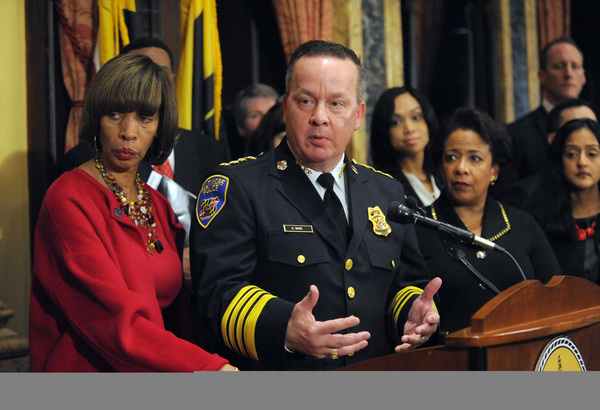
BALTIMORE _ Baltimore Police Commissioner Kevin Davis on Tuesday said he is "ready to roll" with the city's pending consent decree with the U.S. Department of Justice, and fully opposes the federal agency's request for a 90-day pause in the police reform effort.
"I want to say to the community in particular that the police department is absolutely dedicated to the consent decree process. There's no backroom deals. There's no sleight of hand," Davis said. "It'll make us better, it'll make the city better, it'll make our relationships with the community better."
Davis said he and Mayor Catherine Pugh are "both disappointed" that the Justice Department asked for more time to "review and assess" the proposed agreement, which is pending in U.S. District Court in Baltimore and must be approved by a judge if it is to become binding.
He said Justice Department officials made their request "without a whole lot of justification."
The city remains "clearly resolved" to reform _ "We're not going to back up. We're not going to throw the towel in" _ and reforms "are going to take place no matter what," Davis said.
But without the federal deal, he said, they may not take root as quickly.
Davis spoke Tuesday morning, after the Justice Department filed a motion late Monday asking to delay a public hearing scheduled for Thursday by 90 days.
The motion was filed along with a memo issued by Attorney General Jeff Sessions to his top deputies instructing them to initiate a review of a broad spectrum of department activities related to law enforcement, particularly around local policing initiatives and consent decrees.
The motion cited President Donald Trump's executive order in February calling on the department "to prioritize crime reduction" and Sessions' formation of a task force to ensure the agency is using its resources to push that agenda. It said the department "determined that permitting it more time to examine the consent decree proposed in this case in light of these initiatives will help ensure that the best result is achieved for the people of the City."
Judge James K. Bredar, who is overseeing the case, had yet to rule on the motion as of Tuesday morning.
The consent decree was reached after months of negotiations between Baltimore officials and Justice officials under the former Obama administration. Those negotiations followed a sweeping investigation by the Justice Department into the Baltimore Police Department and a report last summer that determined city police routinely violated local residents' constitutional rights.
The report found that police engaged in unconstitutional stops and searches, particularly in poor, predominantly black neighborhoods, and mistreated a range of people from protesters to people with disabilities and youths. It found the department mishandled sexual assault cases, and that officers were poorly trained and supervised.
The consent decree, if approved, would be a binding agreement mandating the police department implement sweeping reforms to address the discriminatory and unconstitutional practices identified. A federal monitor would be appointed to oversee the process, reporting directly to Bredar.
Pugh has committed the city to funding the reforms, which are expected to cost millions of dollars to implement. A major finding in the Justice Department's report on the police department was that it is woefully lacking in needed technology.
On Tuesday, Davis noted that the city and the police department welcomed the federal oversight from the beginning, since before Justice Department investigators arrived after the death of Freddie Gray from injuries suffered in police custody and the subsequent unrest in the city in 2015.
Davis also noted that city officials had "accelerated" negotiations with Obama officials specifically in order to sign the consent decree under the former administration, in hopes of locking in the deal before the change in administrations could derail the process.
"We did that intentionally because we know that a consent decree will make the Baltimore Police Department better, both with the crime fight and our community relationships," he said.
Even before winning confirmation to his post, Sessions had expressed skepticism about consent decrees.
With the Justice Department's request for a delay on Monday, Davis said he understands "the anxiety associated with what seems to be a can that was kicked down the road ... without a whole lot of justification" among community members.
He urged the Justice Department to honor its commitments in Baltimore.
"I don't hear any particulars associated with the need to get a 90-day extension," he said. "The challenges in our city are documented, they're detailed in the report. If we want to sit down around a table and have a discussion before we break the huddle and start the consent decree, I'm not opposed to that. But I think requesting a 90-day extension was unnecessary."