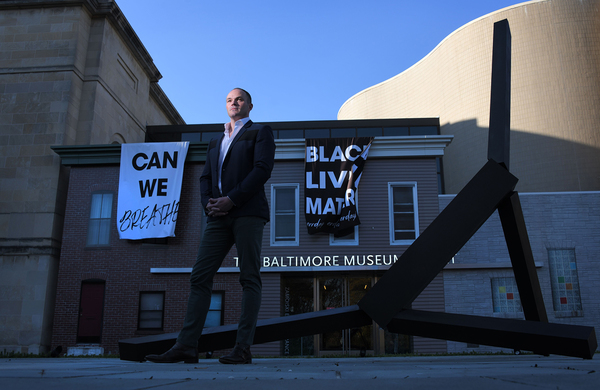
BALTIMORE — Baltimore Museum of Art director Christopher Bedford's admirers say he tries to change the world with every ounce of energy he's got.
So why have his methods made some people so angry?
Bedford was at the center of a recent controversy regarding the Baltimore Museum of Art's planned sale of three paintings to fund programs aimed at making the museum more diverse.
When the museum's board of trustees voted Oct. 1 to part with Andy Warhol's "The Last Supper," Clyfford Still's "1957-G" and Brice Marden's "3," the decision immediately came under fire. Art lovers nationwide praised and condemned the plan. During October, the BMA was battered by more negative publicity than it has endured in recent memory.
Bedford, 43, acknowledges he made mistakes but said the errors resulted from a surfeit of zeal.
"The desire for change burns very bright inside me," he said. "To do this work, you have to be a true believer. Otherwise, why would you do it? There are a million easier ways to run a museum."
The debate over deaccessioning — art-world lingo for selling museum-owned artworks — climaxed six days before Americans went to the polls to elect a president. The conversation in Baltimore seemed almost a microcosm of the nationwide debate. Both aroused intense feelings, often about racial issues.
"The controversy at the BMA mirrors the political climate in this country," said James Thornton, vice chairman of the museum's board.
"It reflects the racial divide we're dealing with as a society. Our country is shifting and the Baltimore Museum of Art is trying to shift along with it. That takes a lot of hard work, and it makes people uncomfortable."
The discussion became as much about Bedford's leadership style as it was about deaccessioning, and Thornton thinks that's unfair.
"I'm really concerned Chris became a lightning rod for people's uncomfortable feelings," he said, "instead of the institution supporting him."
But Bedford is the BMA's public face, and sometimes does and says things that elicit a visceral response.
His critics say he made statements that came perilously close to name-calling and widened the city's racial chasms. They're alarmed by what they perceive as Bedford's willingness to manipulate rules governing museum practices. And they worry that he reshapes facts to conform to his wishes.
One example: The BMA announced Oct. 28 that museum leaders had "decided to pause" the sale of the artworks, leaving it unclear whether the deaccessioning had been rescinded or merely postponed. Bedford later conceded that was "a euphemism for returning the works to the museum's collection."
The uproar "has led many people to conclude there is a need for radical change in the BMA's leadership," said Laurence Eisenstein, the former trustee who spearheaded a campaign to stop the auction.
Former BMA board chairwoman Connie Caplan agrees — and identified the heads she thinks should roll.
"The trustees should decide who they want to be their director and board chairman," she said. "They should consider what the controversy did to the museum's reputation. With proper leadership, this community would rally behind the BMA."
BMA board chairwoman Clair Zamoiski Segal doesn't plan to resign but said she understands why people are angry.
"The question keeping me up at night, she said, "is 'Was there another way to handle this?' It was very painful. If I had to do it over, I would devote more time to community outreach. That was unfortunately a weak spot for us."
In contrast to the recent imbroglio, Bedford began with a bang.
Following curatorial stints in California and Ohio and after leading Brandeis University's Rose Art Museum for four years, Bedford became the BMA's director in 2016.
Within months, he thrust the BMA into the international spotlight by capturing the commission to present the U.S. Pavilion at the 2017 Venice Biennale, often described as "the art world Olympics."
Other programs also brought the BMA national attention: A partnership with the Greenmount West Community Center launched in 2018 teaches silk-screening to kids from impoverished families, putting money in their pockets. And last fall, the museum struck a blow against the historic marginalization of female artists by announcing it would purchase only artworks created by women in 2020.
The rapidity of the shake-up is noteworthy since it's taking place inside museums, a field with its gaze fixed on the past. Under Bedford, the BMA seemed relevant and energized, at the forefront of a national discussion about using art to generate social change.
"I've never met anyone with a stronger vision than Chris," Segal said.
"He's so crazy smart you just want to keep up with him. He knows exactly what he wants to achieve and figures out how to do it. The board believes in his vision, so we go along with him."
Bedford has a knack for making fiercely loyal friends and resolute opponents.
To understand him, it helps to know he played football for Oberlin College in the 1990s as a nose tackle, a defensive position aimed at disrupting the opposition. It's a task for a player with a single-minded focus and unstoppable will who's prepared to take a pounding.
Bedford's nose tackle attributes were readily apparent in October.
The Association of Art Museum Directors sets ethical standards for American museums. Though the organization can't overrule decisions made by individual institutions, museums flout association directives at their peril. An AAMD sanction discourages other museums from loaning to your institution or collaborating on exhibits.
"Your museum gets shunned in an almost Amish way," said Lisa Strong, who directs Georgetown University's graduate program in art and museum studies. "It hurts your reputation terribly."
In April, the association temporarily relaxed guidelines determining how museums could use proceeds from artwork sales. Bedford seized the opportunity to solve a big problem.
At weekly staff meetings he was hearing of financially vulnerable employees "guarding priceless works of art for an hourly wage that doesn't allow them to pay their bills," he said. "It left me with a staggering sense of whiplash."
A traditional fundraising campaign would take years. Selling a few artworks could raise money for raises in months.
Moreover, Bedford is convinced that museums have too much stuff. Of the 95,000 items in the BMA's collection, 1,600 are on view. It's akin to having an overstuffed, increasingly crowded attic but never being permitted to hold a yard sale.
"I don't believe a museum's sacred charge is to hoard treasure," Bedford said.
"I believe a museum's sacred charge is to use objects in our collection to reflect, engage and inspire the different individuals we serve. Human beings are fundamentally more important than objects."
He set the wheels in motion. On Oct. 1, trustees voted to sell three paintings and to use $55 million of the estimated $65 million in proceeds to create an endowment. Interest of about $2.5 million annually would fund diversity programs and provide raises.
But Bedford's critics claimed he was taking advantage of a loophole intended for a completely different purpose.
"Many museums are facing severe financial challenges from COVID-19 and the AAMD didn't want them to go under," said Martin Gammon, author of "Deaccessioning and its Discontents" which chronicles 400 years of museum sales.
Before going public with the proposed sale, Bedford brought his plan to the association, which initially neither endorsed nor opposed the deaccessioning. But as the backlash mounted, the association's ambivalence solidified into resistance.
"The relaxed guidelines as first articulated left room for ambiguity," Gammon said. "I don't think the AAMD ever anticipated someone would drive a truck through the ambiguity that went well beyond the reason for the change."
Association spokesman Sascha Freudenheim declined to be interviewed, but said the association determined the BMA was "in technical compliance" with its guidelines but wasn't acting "within their express spirit and intent."
On Oct. 27 and 28, the association issued statements urging the BMA to call off the sale. Two hours before the Marden and Still paintings were scheduled to go under the gavel, the museum complied.
"I believe the regulations around deaccessioning need to be relaxed," Bedford said, "but I want to do it as part of a like-minded cohort."
The anti-deaccessioning camp had prevailed.
But underlying tensions remained, partly because of public comments in which Bedford characterized opposition to the deaccessioning as an investment in a system "that is very deeply centered in white power and white privilege."
His rhetoric "offended many people," Eisenstein said. "He shouldn't have described this as a battle against white supremacy when we were motivated by love for the BMA. It caused divisions that will be difficult to heal."
Bedford said he was taking aim at ossified museum practices, not specific individuals — many of whom are BMA donors.
"I don't believe most people who opposed the deaccession had a racist agenda, he said. "I do mean to hold everyone accountable, myself included, for undoing a system of bias. While I believe in change in my core, I don't want to get there through division."
Since people on both sides say they're in favor of a more inclusive BMA, there may be opportunity in the future to find common ground.
"Let the water that's under the bridge stay under the bridge," advised the Rev. Kobi Little, president of the Baltimore branch of the NAACP, who supported the sale.
"To those on the other side who want to come together in concrete ways to create a more diverse museum, I say: 'Let's get to work.'"
And if Eisenstein and Caplan are willing to wait, they'll get their wish for new museum leaders.
Segal's term as board chairwoman expires in mid-2022. Bedford is giving himself "20 to 30 months" to raise a $55 million endowment and other initiatives aimed at transforming the BMA into the equitable institution of his dreams.
Then he'll move on.
"I am not a forever director," Bedford said. "I am an architect of change."