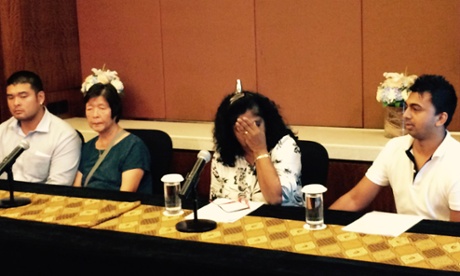
The families of condemned Australian drug traffickers, Andrew Chan and Myuran Sukumaran have publicly pleaded for mercy for their sons, who they say have been “the driving force behind making Kerobokan a better prison for inmates”.
The mothers of the two men sentenced to be executed some time this month released their statement in Jakarta on Monday afternoon, addressing the Indonesian president Joko Widodo, vice president Jusuf Kalla, attorney general HM Pratseyo and the Indonesian people.
“I beg you to take the time to look properly into the facts of this case,” read the plea from Raji Sukumaran and Helen Chan.
“I understand the serious crime my son committed. They are both very sorry for this. We are very sorry for this.”
Chan and Sukumaran were sentenced to be executed by firing squad for attempting to smuggle more than 8kg of heroin in 2005. The other members of the so called Bali Nine were imprisoned.
Australia’s foreign minister, Julie Bishop, said on Tuesday the government was making daily representations in a bid to save Chan and Sukumaran.
“And we will not give up, we continue to do that on a daily basis,” Bishop told the Nine Network. “The prime minister has been making representations to the Indonesian president.”
The families’ statement stressed the pair’s rehabilitation and work for other inmates of Kerobokan prison.
“They are not the same people who committed that crime more than 10 years ago,” it said. “These days Myuran and Andrew think very little of their own needs. They are far more focused on making life better for others.
“The good things that Myuran and Andrew have done from within Kerobokan prison has become big news all around the world, please take time to investigate this,” the statement said.
The two mothers spoke of the praise they have heard from other prisoners’ families about their sons.
“This makes me so proud of my son and I thank your country for giving my son this opportunity in the Bali prison, but I just want you to please spare him from the firing squad.”
A number of people who have worked with Chan and Sukumaran have reported similar respect for the men from fellow inmates.
The families asked the Indonesian officials to revisit the testimony of former Kerobokan prison governor Bapak Siswanto, who in 2006 controversially spoke in support of the two prisoners and said they should be spared the death penalty.
Helen Chan told the ABC’s Four Corners she was proud of the way her son had conducted himself in prison.
“This is what I am proud of. I feel that he is very down to earth - facing death every day, but not crying or making a scene,” she told the program.
“Therefore this time when I see him, although I am sad, I have inner peace.”
On the ABC’s Q&A program on Monday night a professed friend of Sukumaran read out a statement on his behalf.
“I acknowledge more than anyone that I’ve made mistakes and that I’m not a perfect person, but I’ve learned a lot in prison and I am grateful to the Indonesian justice system and to the prison guards for allowing [me] to achieve all that I have for myself and for the other prisoners,” Kavita Krishnan said.
“Andrew and I are not the same people we were 10 years ago, but who is really?
“We did commit a serious crime and deserve punishment, but we have also paid a great deal for our crimes, as have our families. Please allow us to stay in prison and live.”
Pratseyo has confirmed the Australian men are scheduled to be executed among the next round, later this month.
Todung Mulya Lubis, the Indonesian human rights lawyer acting on their behalf, said on Monday the legal team would try another avenue of appeal - directly challenging the president.
Widodo has declared a “drug emergency” in Indonesia and said no drug traffickers would be spared. He refused a group of clemency appeals - including those of Chan and Sukumaran - at once and Mulya said such a sweeping rejection was challengeable. He told the ABC cases must be assessed individually.
“Indonesia is a state based on law, and we also ratified a lot of international human rights instruments. It means we respect human rights,” he said.

.png?w=600)