Australia’s credibility in arguing for clemency for Andrew Chan and Myuran Sukumaran was tarnished by the federal government’s inconsistency about the death penalty, says a lawyer for the two men.
Peter Morrissey SC, who worked pro bono on Chan and Sukumaran’s case for several years, told ABC radio on Wednesday that Australia took the “very moral high ground”, but our foreign policy on capital punishment was resented in Indonesia.
“Our credibility was a little tarnished there … We were rather applauding the death penalty when it came to the Bali bombers,” he said.
“That fact caused a lot of resentment. We need to be very consistent about it [and] that may have affected our credibility within Indonesia on this occasion.”
When two of the Bali bombers were condemned to death in 2003, both the government and the opposition supported it or did not speak out strongly against it.
“Some people say that I should be thumping the table and saying, ‘Don’t execute,’” John Howard, the then prime minister, said at the time. “I’m not going to do that because I do respect the judicial processes of Indonesia.”
Chan and Sukumaran were executed along with six other men – including four Nigerians, a Brazilian and an Indonesian – on Tuesday night. Mary Jane Veloso, a Filipina, was given a last-minute stay of execution shortly before the men were shot.
Gillian Triggs, president of the Australian Human Rights Commission, said she executions were “tragic” and that she hoped they could be used to press the case for an abolition of the death penalty across Asia.
“Our concerns as a human rights commission is that the executions breach international law,” Triggs told Guardian Australia.
“I feel the prime minister and minister for foreign affairs, and all government officials, really pulled out the stops to prevent it, they did all they could do in the circumstances, and I was pleased it was a bipartisan effort with Tanya Plibersek [Labor’s foreign affairs spokeswoman] given the difficult political environment of the last few months.
“My personal view is that anger is never very helpful, revenge isn’t helpful. We should take this opportunity in a positive way to reach consensus among Asian nations that we should never do this again. We will certainly be working with groups in Indonesia and Malaysia so that we can come together for a unified view on capital punishment.”

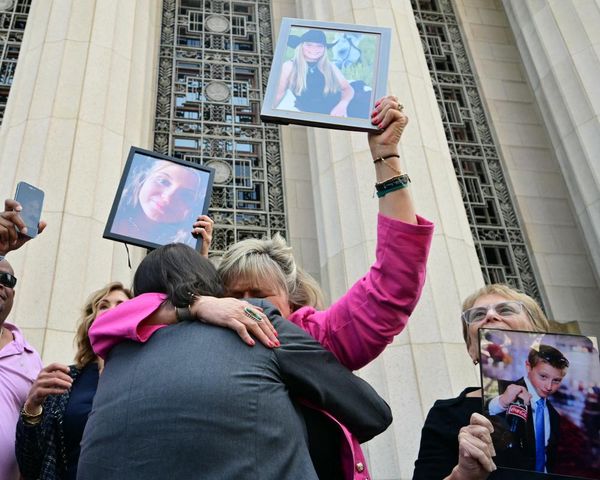
In a joint statement, the Chan and Sukumaran families said the duo “asked for mercy, but there was none. They were immensely grateful for all the support they received. We too, will be forever grateful.”
Dharminie Mani, Sukumaran’s cousin, posted on Facebook that he told her during the final family visit that he was going to miss seeing the new Avengers film as well as the boxing fight between Floyd Mayweather and Manny Pacquiao.
“My mum and aunt had silent tears streaming down their faces as Myu smiled and joked trying to cheer them up. But that’s who Myu is. He is that friend that places himself last in order to support those around him.
“I saw smiles so wide and humbling on the faces of other prisoners when Myu tasked me with the job of handing out his chocolates and nut bars that he “no longer needed”. Myu spent both today and yesterday trying to take care of other people. Trying to organise everything so that others would be taken care of. That’s Myu through and through.”
The Mercy Campaign, which has called for Chan and Sukumaran to be spared after they were among nine Australians arrested in Bali in 2005 for smuggling drugs, also expressed its “devastation” at the execution of the men. The campaign gathered more than 250,000 signatures urging clemency.
“We are still trying to process it,” said Brigid Delaney, co-founder of the Mercy Campaign and features editor at Guardian Australia. “We are devastated we lost, but we are thankful that it may make it easier for the next lot because there was such a fight from so many people. Maybe it will make it harder to execute the next batch of people.
“The Mercy Campaign is essentially two people but we felt that we were an army of many hundreds of thousands. We’ve been overwhelmed by the support of people we’ll never meet but have been very present in the campaign.”

Anger at the executions has surfaced outside Australia, with Amnesty International condemning what it called a “wasteful act of state-sanctioned murder”.
The British entrepreneur Sir Richard Branson said he was “shattered and disappointed” by the deaths of the eight men.
“It’s a devastating blow to all of us who hoped that mercy and common sense would prevail,” the Virgin boss said. “Instead, tonight’s killings will have a significant negative impact on Indonesia’s standing in the world.
“To paraphrase Oscar Wilde: ‘The only difference between saints and sinners is that every saint has a past while every sinner (should have) a future.’ Everyone deserves a second chance. Let’s do away with the death penalty once and for all.”
The Brazilian government condemned the execution of Rodrigo Gularte, who has twice been diagnosed with schizophrenia and died alongside Chan and Sukumaran.
In a letter sent on Monday to the government in Jakarta, the Brazilian foreign ministry declared the death sentence “unacceptable” and “contrary to the common sense and basic standards of human rights protection” .
But there was joy in the Philippines at Veloso’s reprieve, which may be temporary. Her mother, Celia, told local radio station DZMM: “We are so happy, I can’t believe it. I can’t believe my child will live.”
Australia has recalled its ambassador from Jakarta in protest against the executions. Professor Damien Kingsbury, of Deakin University, predicted the removal of the ambassador may last for “a month or two”.
“But really Australia can’t afford in the longer term to break off relations or to have a blockage in relations with Indonesia,” he told the ABC.
“Indonesia is a big, important country. It is there, it’s not going away, and we are going to have to make some compromises on how we deal with it.”