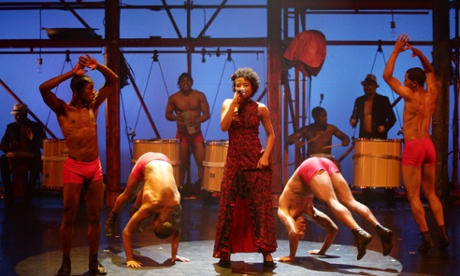
If someone could tap the energy and high spirits of Brazilian dance company Balé de Rua, they might just power the nation. The company was founded in 1992 by a group of street dancers smitten by the funky moves of Michael Jackson, James Brown and American hip-hop, and their show Baila Brazil is a compilation of numbers from their repertoire – those early influences still present within a bubbling blend of samba, capoeira, Brazilian folk and funk, acrobatics and MTV culture.
It opens with some traditional samba: nattily suited men, with their characteristic wobble-headed, slink-hipped gait. More subversively, a group of what look like pious women unfold their cowls into lavish gowns and reveal themselves as boisterous men, bopping to an uptempo version of Ave Maria. The only female dancer of the group (Uiara Cristina Ferreira) comes on dressed like a ballerina but dancing like a carnival queen, and you’ve never seen a tutu with this much bounce.
The mixture of religion, irreverence and pleasure is infectious, putting a twitch in both your step and your spirit. Some of the show is pure celebration – giant flowers, blooming luxuriously from the set – and some is pure show-off: tumbles and backflips, frenetic speed, amazing multiple headspins (by Jardel Santos Silva) on a platform held high in the air. Yet it also has a darker heart, with passing images of slavery, of suffering and labour, power tools spraying sparks on to one man’s bare skin.
A shame, then, that the show sometimes crowds out its own best qualities.
The energy always pitches high, numbers always end punchily, choreographic variety – a group caught in a cat’s cradle of elastic, a flailing female solo – soon cedes to more fast formation dancing, and the female vocals (sung by Alexia Falcão Lopes, an astonishingly assured 16-year-old) are too often overwhelmed by the masculine thump of percussion. There’s no shortage of sheer energy here, but it could do with more channelling.
- At Royal Festival Hall, London until 15 August. Box office 0844-875 0073