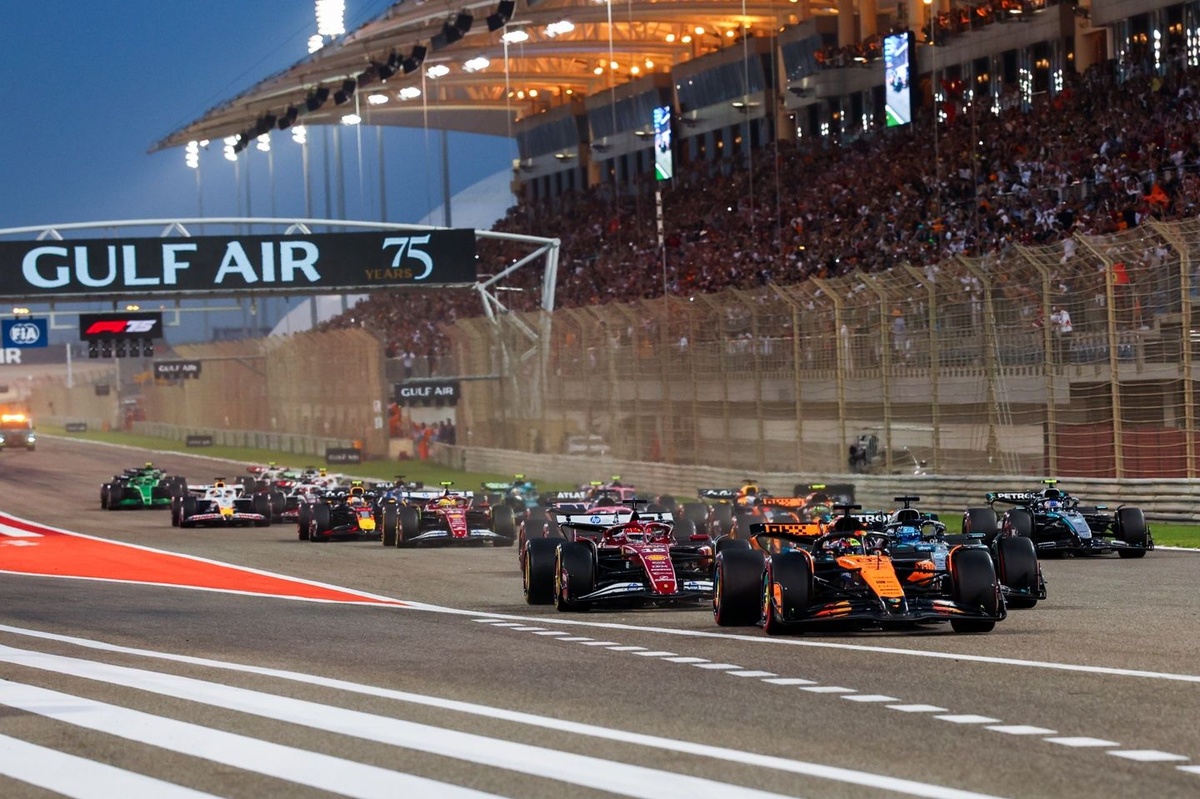
The announcement that Formula 1's return to Malaysia this year would be branded as the Bahrain Grand Prix prompted both amusement and confusion.
Sepang, after all, was the first of the Hermann Tilke-designed generation of modern F1 circuits in Asia, making Malaysia an important fixture on the calendar. Even after the country terminated its contract with FOM in 2017, the circuit has remained popular among fans, with many calling for a comeback amid wider debate over the increasing number of street circuits on the schedule.
Sepang is also located next door to Kuala Lumpur International Airport, Malaysia’s main international gateway. So branding a race at one of the country's most recognisable sporting venues as the Bahrain Grand Prix is therefore an unusual proposition.
But the ongoing conflict between the US/Israel and Iran has created an unusual situation, with Bahrain retaining the naming rights of a race that it cannot host within its own borders.
While the Malaysia/Bahrain arrangement is unprecedented in some aspects, it is not the first time F1 has staged a race under the name of a different country.
San Marino GP

The best-known example is the San Marino GP. Held for the first time in 1981, the race was named after the tiny landlocked nation of San Marino, despite actually being held in Italy. Imola even hosted the Italian Grand Prix in 1980 while Monza was undergoing refurbishment, and was thus unavailable. But when the revamped Monza track was ready to host racing again the following year, F1 had to give the Imola event another name to differentiate the two races in Italy.
Interestingly, when Autodromo Internazionale Enzo e Dino Ferrari returned to the F1 calendar in 2020 during the pandemic, the race was once again given a different identity in reference to the region of Italy it is located in.
As such, Imola has now hosted F1 races under the three different names: Italian Grand Prix, San Marino Grand Prix and Emilia Romagna Grand Prix.
Luxembourg GP

Luxembourg has only one permanent race track, which was not built to F1 standards. It is used by owner Goodyear primarily for driver training, with a TCR race in 2016 marking its highest-profile motorsport event.
Yet, there were two occasions in the 1990s when the Luxembourg GP name appeared on the calendar. Both races were actually held at the Nurburgring in Germany, some 80km away from the border between the two countries.
This was a time when F1 was booming in Germany, with Michael Schumacher’s success propelling the series to new heights in the country.
From 1995, Germany began hosting two rounds of the world championship. The Hockenheim event retained the German GP name, while the Nurburgring became the host of what was called the European GP. But the naming rights to the European GP went to Jerez in 1997, and the Nurburgring race ended up being branded the Luxembourg GP for two years.
From 1999, however, Nurburgring organisers were able to brand their race as the European GP again, and the Luxembourg name disappeared from the F1 calendar.
Swiss GP

Switzerland was one of F1's original world championship venues, hosting races at the Bremgarten circuit between 1950 and 1954. In fact, Switzerland was already hosting major motorsport events in the pre-championship era, with Auto Union (now Audi) and Mercedes-Benz dominating the early editions of the Swiss Grand Prix in the 1940s.
But all that changed after the infamous Le Mans 1955 disaster in France, with Switzerland banning circuit racing on safety grounds. Over time, the Bremgarten track in Bern was taken over by nature, and motor racing did not venture on Swiss soil until Formula E visited Zurich in 2018.
However, between 1955 and 2018, two motor races ran under the Swiss GP name, except they did not take place in Switzerland.
A non-champion race was held at Dijon in France under the Swiss GP title in 1975, and the event was promoted to full points-paying status when it returned in 1982. It was at Dijon where Keke Rosberg scored the one and only victory of his title-winning campaign with Williams.
Earlier this year, Switzerland lifted the ban on motorsport entirely, having already made an exemption for electric racing to allow Formula E to host events in Zurich and Bern.
2016 European GP

The 2016 European GP was another anomaly, even if the race did not technically run under a different country’s banner. When Formula 1 made its debut on the streets of Baku in 2016, the event was branded as the European Grand Prix rather than the Azerbaijan Grand Prix. Although Azerbaijan is commonly described as a transcontinental country spanning Europe and Asia, its capital Baku lies east of the Greater Caucasus and is generally regarded as being in Asia.
The decision therefore felt unusual, particularly as previous editions of the European Grand Prix had been staged at circuits such as Donington Park, Jerez, the Nurburgring and Valencia.
From 2017, the Baku race adopted the Azerbaijan GP mantle, which it continues to use to date.