Welcome to this week’s Fortune Gulf Brief. We’ll be covering:
- Exclusive interview with H.E. Noor, CEO of Bahrain’s EDB
- IMF forecasts MENA economies to shrink by 0.5%
- U.S. ends AI chip export curbs for UAE in major policy shift
- Tesla partners with Esyasoft on 15 GWh global storage push
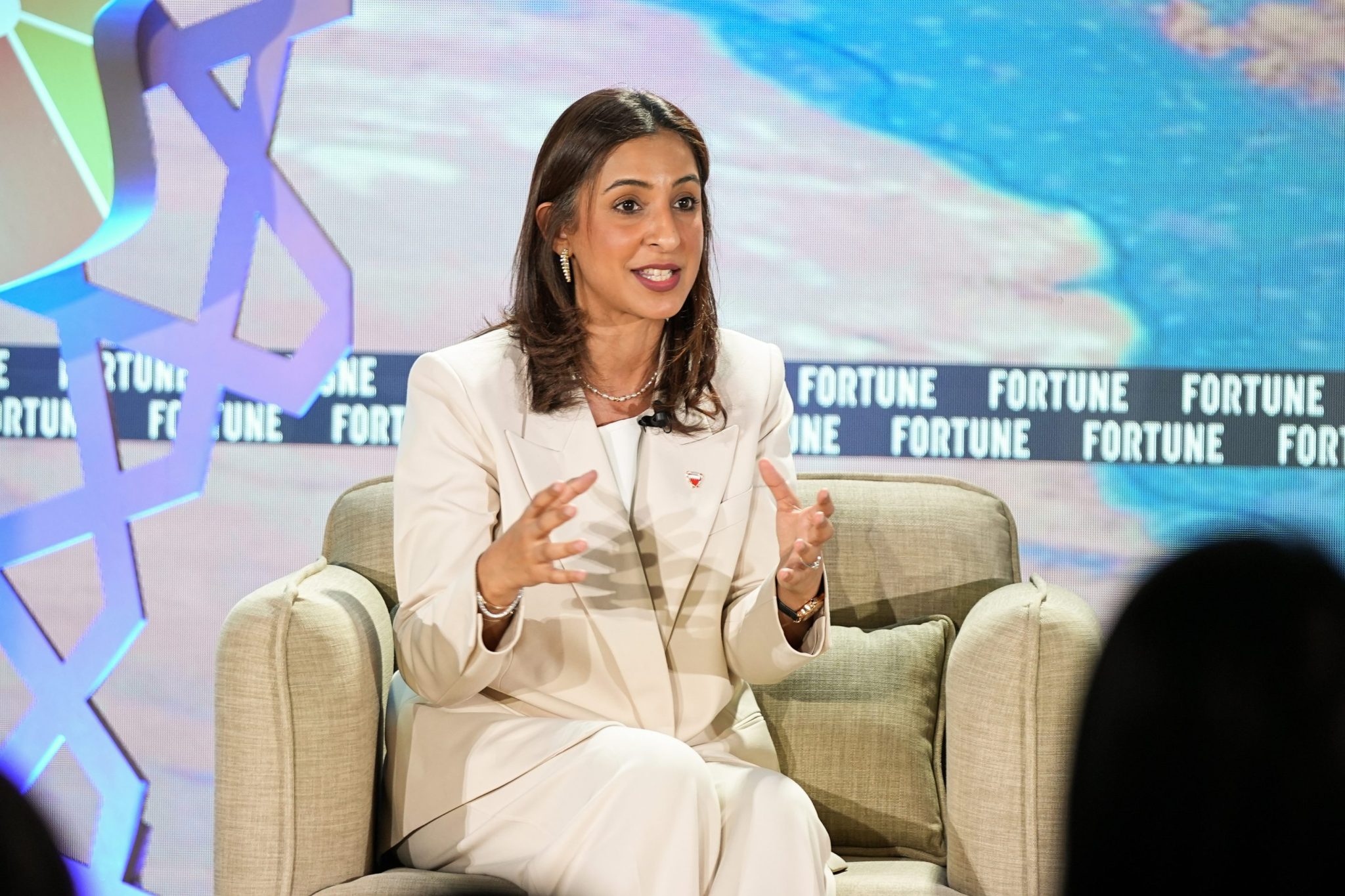
Last week, I met with the CEO of Bahrain’s Economic Development Board (EDB), H.E. Noor bint Ali Alkhulaif, who was in the U.K. on a five-day visit to deepen economic ties and attract new investment.
It followed hot on the heels of a five-day visit to China and Hong Kong at the end of June, which also sought to reinforce existing ties. China is Bahrain’s third-largest trading partner, with bilateral trade reaching $2.43 billion in 2025.
As the smallest of the Gulf states, with a nominal GDP of $48.85 billion and the highest debt burden, Bahrain has arguably never had a more pressing need to maintain economic momentum and find new avenues for growth.
With the U.K.-GCC free trade agreement (FTA) concluded in May, the EDB is eager to capitalize on the opportunities it may unlock; the U.K’.s trade with the GCC currently totals £53 billion ($71 billion) and could increase by 19.8% annually as a result of the agreement.
H.E. Noor highlighted manufacturing, energy, life sciences, and the healthcare sector as key targets: “You will hopefully see a very clear plan starting to emerge once the FTA is officially signed, but we’re laying the groundwork now to make sure that we’re ready for it.”
Back home, the kingdom is also betting on AI and cloud computing. Both Amazon Web Services (AWS) and Oracle are looking to expand their presence, and discussions are underway about growing Bahrain into a regional data-hosting hub.
H.E. Noor noted that the drone attacks that disrupted the UAE and Bahrain’s AWS data centres earlier this year have moved the conversation beyond digital sovereignty and towards digital resilience.
While H.E. Noor maintained that the EDB “has not seen much disruption” regarding existing and planned investments into the kingdom, she conceded that sectors such as manufacturing, logistics, and tourism have felt the impact of the war.
She also didn’t shy away from acknowledging the recent sharp fall in Bahrain’s foreign exchange reserves, which dropped 56% to $1.5 billion at the end of May. This is their lowest level since the Covid crisis.
“You saw the news, they did dip,” she said, adding that the kingdom has not tapped the $5.4 billion currency swap line extended to it by the UAE in April.
“The Emiratis wanted to support us, not because of an immediate need, but as an added assurance for the local market, the banks, and potential investors. It’s a good buffer to have.”
Bahrain is the only GCC state not to be rated investment grade by the three major credit rating agencies due to its high public debt and large fiscal deficits.
Given both the economic and geopolitical challenges at home, Gulf states know that shoring up investor confidence is critical to their future development and recovery plans.
Renewed Iranian attacks on multiple GCC states, including Bahrain, over the past week have underscored the obstacles that may lie ahead.
You can read my full interview with H.E. Noor here.
Melissa Hancock
melissa.hancock@fortune.com
Get in touch: Reply to this email with feedback or contact me directly at the address above.