The figure of Big Brother towers over the citizens of Airstrip One, his image looming from billboards across the city; the eyes following Winston Smith, even home into his flat, peering into his eyes, reminding him that he is always being watched.
In Big Brother, Orwell created a terrifying villain, one who exists mostly, if not completely, in the imagination. He is everywhere, knows everything and is all-powerful; a god created by the Inner Party to control the citizens of Oceania. Whether or not he was the founder of the Party is inconsequential; his power comes from the fact that he is unknown and above it all. He is never wrong, has no idiosyncrasies that can be exploited, no personality that can be manipulated, no desire that can be leveraged against him. You can’t imagine him putting his pants on the morning, or sitting on the toilet reading the paper, because he isn’t real, he doesn’t have any pants and he most certainly does not go to the toilet.
During his interrogation in the Ministry of Love, Winston asks if Big Brother exists in the same way he does. His torturer, O’Brien, answers: “You do not exist.” He is right: all the core beliefs that make Winston himself - his hatred of the Party and desire for all things to be corrupted - are destroyed and instead he becomes everything he was resisting. His personality is blown apart and remade along Party lines.
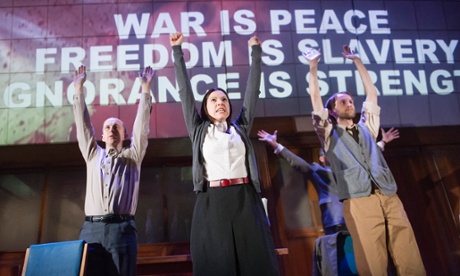
Big Brother, in contrast, cannot be remodelled because he is the model after which everyone else is formed. He is reality. But just like the slogans on the walls of Oceania - “War is Peace, Freedom is Slavery, Ignorance is Strength” - he embodies a paradox. He is the ultimate Party leader because he never changes, but he is unchanging because his form is constantly evolving to reflect the new truth. In the skewed world of Nineteen Eighty-Four, this is what makes him real.
He is the god the citizens worship, just as Goldstein will always be the devil they screech at during the Two Minutes Hate. It’s not enough for Party members to just obey Big Brother, they have to love him too, not despite, but because of, the suffering he inflicts on them. “There will be no love, except the love of Big Brother” O’Brien tells Winston. He can’t just pay lip service to Big Brother: his devotion must be real; he has to believe it himself.
The real horror of Big Brother and the Party isn’t just that they exercise complete control over their citizens, but that they make the citizens complicit in their own manipulation. In the end, sitting in The Chestnut Tree café, Winston finally feels love for Big Brother and “the long-hoped-for bullet […] entering his brain”. He is dead already, just as he and his lover Julia knew they would be as they started their affair.
This time, however, he realises it with a sense of contentment because it means he is cured, as O’Brien told him he would be. He has become one of the Party, part of Big Brother himself: perfectly happy to betray anyone: Julia, his neighbours, himself. In Nineteen Eighty-Four it is people, as well as history, that are written and rewritten by the victors.