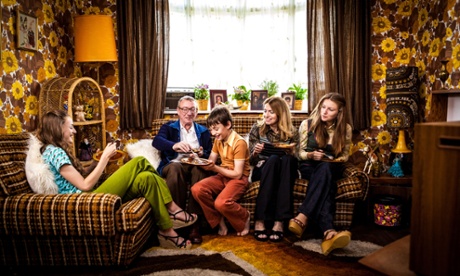
It has been one of BBC2’s most popular factual programmes this year – and it seems that Back in Time for Dinner, the time-traveling culinary show, and its stars, the likeable Robshaw family, could be back for second helpings.
The show, designed to illustrate how food has shaped family life through the decades – from the 1950s to the turn of the millennium – has served up audiences of around 3 million.
We’ve watched Londoners Brandon and Rochelle and their three children – Miranda, Rosalind and Fred – sample half a century’s worth of British food and its associated lifestyle, giving a fascinating insight into postwar and late-20th-century social history, and particularly the changing role of women.
Living a different year every day, with the production company remodelling their kitchen and sitting room as that of a family from the same era, they’ve eaten everything from microwaved chickens smeared in marmite to vegetables set in a jelly ring and whole meals fried in lard.
In the final part of the six-part series, which airs on Tuesday evening, presenters Giles Coren and Polly Russell, who is a food historian, give the Robshaws a glimpse of the future of food.
Coren told The Guardian he thought the success of the series was partly down to nostalgia but also to the choice of the Robshaws and their “beauty and brilliance”.
On previous shows he has fronted such as the popular Supersizers strand, people loved watching things about the 1970s and 1980s such as “a Sodastream being squirted,” he said.
But viewers have also warmed to the family in Home in Time for Dinner. “I guess it’s also because the Robshaws are so amazing. They are a great family. I particularly warmed to Brandon. It was important to find a normal family – they are and they say intelligent things.
“And the children were so photogenic, even AA Gill, in a typically mean review of his, when he said it was handsome people going ‘yuk’ at least said they were handsome. They also made people feel very optimistic and showed people what a normal family is like … when you see yourself in the Robshaws it’s a nice reflection.”
BBC features and formats commissioning editor Alison Kirkham, who co-ordered the show, said the show was “wonderfully nostalgic whilst also illuminating” – and that food had acted as a prism through which programme makers could “examine and explore our lives and values”.
Coren said he understood that Kirkham wanted to “go back further” in time in another series. “We’re certainly discussing options. I’m thrilled that people have taken to the series as much as I have, so watch this space!” she said.
The show has averaged 2.7 million viewers, with some episodes topping 3 million – a big audience for a BBC2 factual programme.
The producers of the series, Wall to Wall, have a record of successfully transplanting formats to different periods having had a hit over a decade ago with The 1900 House on Channel 4 and subsequently following it up with The 1940s House and The Edwardian Country House.
Going too far back in time, however, might not work said Coren. While “there would be lots of social history and it would be lovely to see Brandon dressed as a medievel court jester, you can’t knock down a 1930s house in London and replace it with a hovel.”
But he said he had also discussed with the producers the idea of the family experiencing different styles of holidays down the decades such as Blackpool and package holidays abroad.