
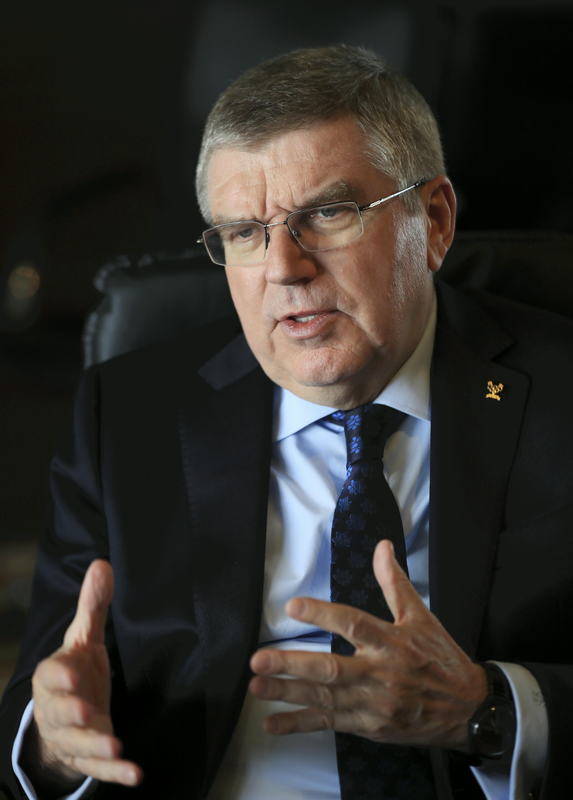
The Pyeongchang Olympic Games saw North and South Korea's joint march and Russia's participation restricted to an individual capacity in the wake of its systematic doping scandal. What should we expect for the Tokyo 2020 Games? Thomas Bach, International Olympic Committee president, shares his views in Pyeongchang.
Yomiuri Shimbun: North and South Korea's joint gestures seem to have opened a passage in current political negotiations. How do you observe these developments?
Thomas Bach: We are very happy to see this development. It is pretty amazing both with regard to depth and speed, how they used this Olympic momentum to drive this dialogue forward. I think this is a major step, because only when you sit together, then you can come to solutions. I think we can say that with the initiatives that the IOC took, we have opened the door for this. It is our mission to make the world a better place through sports, and we can say so far, mission accomplished, by opening this window of opportunity for the political world.
Q: You say the Olympic Movement needs the political side as a partner. How do you keep the autonomy of sport, not letting politics use the Olympic Games as propaganda, as some critics suggested prior to the Pyeongchang Games? Where do you draw a line?
A: It is naive or unrealistic to believe sports and the Olympic Games could live in their own world outside society or outside politics. This world is run by politics and not by sports organizations. Therefore, to preserve the autonomy, we have to have a partnership and mutual respect. There, on the one hand, our respect for the priorities of politics, and on the other hand, respect of the politics for the autonomy of the IOC, making them aware that we can only accomplish our mission if we have this autonomy, if we are politically strictly neutral. And what this means, you can see from the Korean issues. If we would not have been strictly politically neutral, we could never have achieved the joint march behind the one flag nor the joint women's ice hockey team.
Q: For the Paralympic opening ceremony, North and South decided to march separately, because of a disagreement whether to put Takeshima island on the unification flag. What are your views on this?
A: I cannot comment on this negotiation because the IOC was not a part of it, but we know by our own experience that these negotiations are not easy. In fact, in this very room, where we are sitting here, we reached the final agreement four hours before the opening ceremony. And there also, the question of this island played an important role. This was an important point in a number of discussions we had. So we are very happy that we could achieve the solution at that time, and that this has generated a momentum.
Q: You said in the past that even at the height of the political tension, the IOC continued the dialogue [with North Korea]. What was the key, from the IOC point of view, to keeping the dialogue open?
A: It is hard to believe that it was just five, six months ago, when the tensions were at their peak. In the most difficult time, the question was not about the participation of the athletes from North Korea. It was, could the Games take place here? And this was the difficult and the greatest challenge, which we had to address in this context, can we send the best athletes, winter athletes of the world to the Korean Peninsula, to Pyeongchang?
But there again, the political neutrality and the partnership allowed us to not only continue the dialogue at the time of the highest tensions, but also to continue the preparations for Pyeongchang in this very difficult time. The discussions we have had since four years [ago], we had built the relationship of trust with different parties, and we could see from all parties the commitment to protect this political neutrality of the Olympic Games.
Q: The strength of the Olympic Movement lies in inclusion. For Tokyo 2020 security, how vital is the participation of North Korea? Your planned visit to Pyeongyang, is it to keep the dialogue for Tokyo and beyond?
A: The participation of every National Olympic Committee is vital. We want to have all 206 NOCs participating in the summer Games, and there the NOC of DPRK is on the same level with others. Like all the other 205 NOCs, we are also supporting the athletes and the NOC of DPRK, while respecting the U.N. sanctions. The topic in this dialogue now is how can we support and assist summer athletes from North Korea to prepare, and if possible to qualify, for the participation in Tokyo, and for winter athletes for Beijing 2022. This dialogue is continuing regardless of the visit. The invitation [from North Korea] was for a mutually convenient time, and we are discussing it now. This is just the matter of timing, and there is no urgency at this moment.
Appropriate sanctions
Q: Russian doping. When the IOC lifted the ban on the Russian Olympic Committee shortly after the Pyeongchang Games, it triggered a question of whether the sanction of three months was appropriate for systematic doping offenses.
A: First of all, this was not the suspension of three months, this was the exclusion from the Olympic Winter Games. We had in 2014 systemic manipulation of the anti-doping system in Sochi; for this, the sanction was exclusion of Russia from the Olympic Games 2018 in Pyeongchang. And with regard to the lifting, we have made our conditions very clear in the decision when we were suspending the Russian Olympic Committee. It was to respect the letter and the spirit of this decision, and this the ROC has done. There was no appeal by the ROC, neither against the decision nor about following sanctions and measures, and they have apologized for this. And this was the reason, with the unanimous approval of the IOC session, the IOC Executive Board unanimously came to the conclusion that the conditions to lift the suspension have been met.
Q: The IOC was not sanctioning Russia for responsibility for the systematic doping, but for their unfulfilled responsibility to protect athletes and the anti-doping system. What are the merits of welcoming Russia back at this stage?
A: These considerations did not really play a role. The decisions are more about the principle. First of all, every sanction has to come to an end. Secondly, the IOC can only sanction for something for which we have the authority. And we have the authority for the Olympic Games. There was the sanction of exclusion of Russia.
What we think about the role of politicians in this systemic manipulation of the anti-doping system in Russia, I think we made it very clear by the lifelong exclusion for the then minister of sport, now vice prime minister, and his then deputy, from any Olympic activities. This is a very strong signal and the toughest individual sanction we can have.
Q: Will there be any issues for Tokyo 2020 stemming from the Russian saga?
A: The IOC sanction on Russia has come to an end, and now we have to see further development and that Russia is hopefully giving the opportunity to the World Anti-Doping Agency to reinstate the Russian Anti-Doping Agency [RUSADA] as soon as possible. These questions are in the hands of International Federations [IFs] and the WADA.
We know that there is still a lot to do in Russia, for the reinstatement of RUSADA, but this does not mean that Russian athletes are not tested. We made sure together with the IFs before Pyeongchang that Russian athletes have been tested more than any other Olympic team here. We see now in Russia there is an anti-doping law, which addresses in particular entourages assisting and facilitating doping -- even to motivate doping makes a criminal offense. So now WADA is working with RUSADA to prepare the ground for reinstatement. There, some conditions have to be fulfilled, and there WADA has our full support for this, but it is not under the authority of the IOC.
Showcasing 'real' Japan
Q: Lessons learned from Pyeongchang for Tokyo 2020. For instance, how did you observe the attendance by spectators and the importance of the engagement of people before the Olympic Games?
A: With regard to awareness, there I have no worries with regard to Tokyo 2020 at all. We can already see now a great mobilization in Japan when you are following public engagement, and when you look at the success of the marketing program. With the strong commitment of Japanese business, it will set a new Olympic record in the sponsorship. We have already now worldwide anticipation with regard to Tokyo. The world is looking forward to these Games.
Here in Pyeongchang in Korea, the conditions were very different. Because of all these political issues, including the domestic political issues before, the focus of the Korean people was not on the Olympic Games until the end of last year. Only after the tension was eased, the attention was turned to the Games. Because of the political tensions, many people in a number of countries decided not to come.
Q: People will watch whether the cost of hosting the Games is worth investing for tangible and intangible legacies. Will the Agenda 2020 reforms including "The New Norm" change people's perception?
A: The Games always leaves tangible and intangible legacies. In Tokyo, you will have a tangible legacy of rejuvenated sports infrastructure at the disposal of people in Tokyo, which Tokyo needs because the 1964 Olympic Games were a long time ago. You will also have an improved traffic management system and new housing for generations to come.
The intangible legacy is in many forms. It will be first of all a great opening of Japan to the world and will be a great opportunity for Japan to show the reality of Japan, show the hospitality and openness of Japanese people. It will secondly be a unique showcase for Japanese technology. You will have the soft legacy of tens of thousands of volunteers, who will learn foreign languages, who will get in touch with people from all over the world, and as we can always see, it will change their personal and often professional lives for the better. The IOC's commitment to show our support and appreciation for the people in the devastated areas, by organizing some events there. And all these will be achieved with a balanced budget of the organizing committee, with the support of the IOC contributions.
We are in the stage of the Olympic Agenda 2020 reform coming to fruition. We see a new candidature procedure, we see The New Norm, which means less expense for the organization of the Games; we see the Olympic Channel capturing the attention of the young generation across the globe. Perception will change.
(This interview was conducted by Yomiuri Shimbun Senior Writer Wakako Yuki.)
--Thomas Bach / International Olympic Committee president
Fencing team gold medalist at the 1976 Montreal Olympic Games. Founding member of the IOC athlete's commission in 1981. Former president of the German Olympic Sports Confederation. IOC executive board member and IOC vice president before becoming 9th IOC president in 2013. He is a lawyer.
Read more from The Japan News at https://japannews.yomiuri.co.jp/













