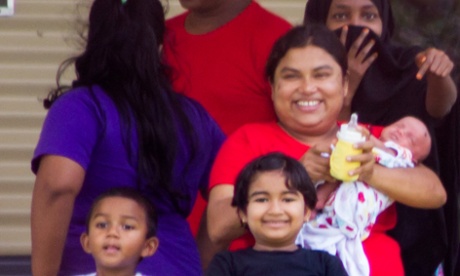
Baby Ferouz, the infant son of asylum seekers who was confined in an Australian detention centre since his birth almost 15 months ago, has been released with his family into the community.
In a change of heart by immigration authorities, Ferouz, his parents and two siblings have been allowed to leave a Darwin detention centre to stay with relatives in Melbourne while their claims for protection visas are assessed.
Other Australian-born children of asylum seekers born in detention have been released in recent days, according to Ferouz’s lawyer, Maurice Blackburn senior associate Murray Watt.
Ferouz was at the centre of a high-profile legal battle in which the federal court upheld the Australian government’s decision that the infant was an “unauthorised maritime arrival” like his parents, despite being born in Brisbane’s Mater hospital in November 2013.
He and his parents and siblings, who are members of the persecuted Rohingyan minority of Burma, have been granted bridging visas.
Immigration staff had repeatedly told the family they would be sent back to offshore detention in Nauru, his father told Guardian Australia last November.
Watt said the family’s first taste of freedom in Australia was a particularly special moment for Ferouz’s parents in particular, who “never stopped fighting for a fair go for their children in seeking a better life and they are now finally able to start making that a reality”.
“Detention centres are no place for babies and children, and it is disappointing that it took the Australian government more than a year to also come to this realisation for Ferouz and so many other families, who like Ferouz have spent many months locked in detention.
“This is a great moment, and would never have happened without a long legal fight with the federal government, and the support of many in the Australian community.”
Watt said details of the release of other Australian-born children in detention were yet to be confirmed.
“We must also remember that, while the release of these children is a good thing, around 555 children remain in detention, including 135 in the inhumane conditions of Nauru,” he said.
Watt said his law firm would continue to fight for the release of those children, whose detention was a blight on Australia’s record.