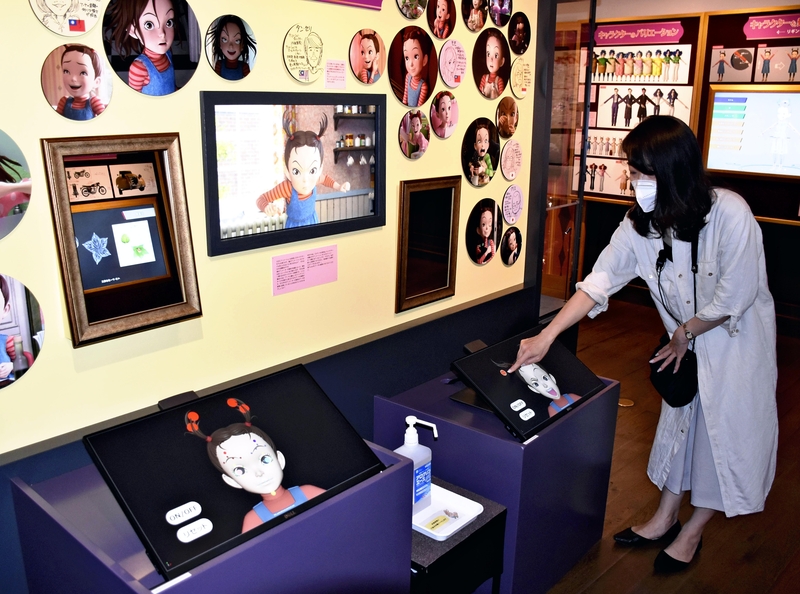
At the Ghibli Museum in Mitaka, Tokyo, a special exhibition related to Studio Ghibli's new animated film "Aya to Majo (Earwig and the Witch)," directed by Goro Miyazaki, is ongoing.
This is Ghibli's first feature-length film made entirely with three-dimensional computer graphics (3DCG), and the exhibition offers a backstage view of the making of the movie, while also allowing visitors to experience the process involved in the creation of the characters' facial expressions.
"Aya to Majo" tells the story of orphan girl Aya, or Earwig, who struggles after being taken in by a witch. Miyazaki also stepped in to plan and supervise the exhibition to enable visitors to gain an appreciation for the world of film.
The production process using 3DCG is a featured part of the exhibit.
Unlike conventional hand-drawn animations, 3DCG creations require the development of a framework for each character with the use of special software after the characters have been designed by hand. This is because it is necessary to make the movements of the characters look natural from any direction in the 3D setting.
The exhibition includes numerous pictures and videos of these processes, and also demonstrates how to design props and backgrounds.
There is even one corner where exhibition-goers can control the eyes, eyebrows and mouth of the Aya character via touch panel and enjoy creating various facial expressions.
Said the person in charge of the event: "3DCG is a new endeavor for Studio Ghibli, but the time and attention to detail that goes into the production is the same as before. I hope visitors will able to see how we have worked out the details."
The film was scheduled for release in April, but had to be postponed because of the declaration of a state of emergency amid the spread of the novel coronavirus. It is now set for release on Aug. 27. The exhibition runs through May of next year.
All admission to the Ghibli Museum is by advance reservation only. Tickets are 1,000 yen for adults, 700 yen for junior and senior high school students, 400 yen for elementary school students and 100 yen for children over 4.
Read more from The Japan News at https://japannews.yomiuri.co.jp/