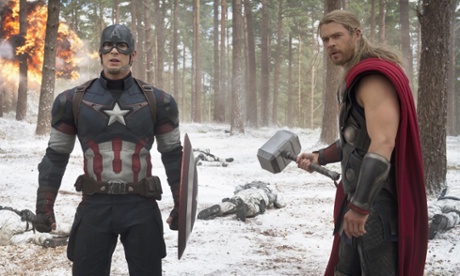
For all its city-smashing spectacle, one of the highlights of the new Avengers movie is a moment of subtle comedy. During a rare moment of downtime, the superhero pals have a go at lifting Thor’s hammer, Mjölnir – which, according to Norse lore, nobody but Thor can do. Iron Man, Hawkeye and co all strain and grunt unsuccessfully, but when Captain America tries, Mjölnir squeaks and budges just a little, and the confident smile on Thor’s face slips for a moment. When Captain America gives up, the smile returns, this time in the register of relief.
The mighty Mjölnir bestows upon its wielder the power to level mountains and rule Asgard, but as Thor tells his colleagues, only the “worthy” can lift it. In this respect, Mjölnir is an example of one of the world’s oldest story tropes – the weapon of awesome power only a chosen one can wield. Beyond Norse mythology, there are many similar examples: the Arthurian legend of Excalibur; epic Sanskrit poem the Ramayana, in which Rama earns the right to the hand of Sita by lifting and stringing Shiva’s bow; and Homer’s Odyssey, in which Penelope offers her hand to whoever can string Odysseus’s bow. All fail except Odysseus (in disguise), who celebrates by slaughtering his rivals. The movies are littered with similar MacGuffins, usually of a phallic nature. Think of Harry Potter and his wand (“the wand chooses the wizard”), or James Bond with his special gun that only he can fire, or even Emmet in The Lego Movie with his “Piece of Resistance”.
The reward for “worthiness” with all these heroes’ tests seems to be the right to use violence. But using violence tends to lead heroes into morally murky territory where that worthiness comes into question. It is a double-edged … er … hammer. That seems to be the thrust of the new Avengers movie: it is the group’s own superweapon, a rogue defence programme called Ultron, that threatens the world – a problem created by the Avengers’ desire for supremacy. The superhero team must then unleash untold violence to defeat Ultron and right their wrong, with considerable help from Thor and Mjölnir. At the same time, note how these superheroes take great care to reduce collateral damage at their battles, risking their own lives to evacuate and save innocent civilians, in a fantasy of perfected warfare.
The US, and to some extent the UK, has often adopted an Avengers-like stance, assuming a moral mandate to wield weaponry nobody else should have access to – such as nuclear weapons. The military lexicon is stuffed with mythology. Look at the currently Anglo-American nuclear missile system: Trident, formerly Poseidon. There is also a trident on the insignia of the US Naval Academy, while the mission to kill Osama bin Laden was called Operation Neptune Spear. In 2013, incidentally, the US Department of Veterans Affairs accepted the hammer of Thor as an official “emblem of belief” for the headstones of military graves.
Whether divinely chosen or self-appointed, heroes never find it easy to give these weapons up, it seems. Thor went through a lot to get his hammer, as anyone who saw the first Marvel movie will recall. It was essentially the story of a Norse god tragically separated from his favourite toy. In the original myths, Thor even dresses as a woman to retrieve Mjölnir when it is stolen by giants. The experience considerably broadened his understanding of masculinity, no doubt. If they are stuck coming up with a plot for Thor 3, it’s a thought.