A bit of Christmas cheer might be in the offing for the NHS in an extra £2bn in 2015-16 due to be announced in George Osborne’s autumn statement. The NHS desperately needs additional money to keep the show on the road. It is a sign of just how worried the government must be that, despite the deteriorating public finances, the chancellor appears to have been persuaded to find money he doesn’t really have for the NHS.
The latest performance reports from the organisations that oversee different bits of the NHS all paint a picture of a service under significant and growing strain. Six months into this financial year, more than three-quarters of all acute hospitals are not balancing their books and their net deficit is £714m. But the strain in England’s acute hospitals is not just about the money – those same performance reports present a deeply depressing picture of a health service that is struggling to deliver the quality of care all those who work in it aspire to.
Hospitals are failing to achieve the four-hour target in A&E departments, waiting times for in-patient care are increasing and there has been a steady decline in performance against the targets for cancer care. The financial pressures on the NHS next year are expected to be around £2bn greater than the budget. Against this backdrop, it is difficult to see how the NHS can get through without additional funding – hence the significance of the autumn statement.
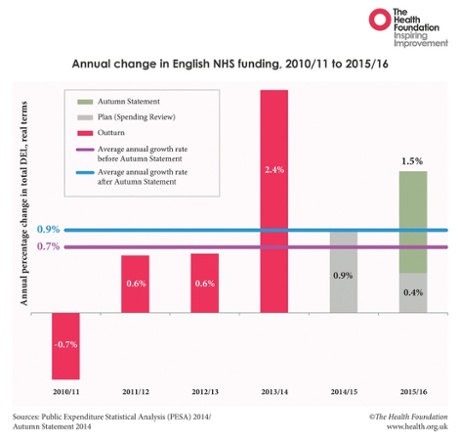
Of course, health is one of the few areas of that has been protected from the spending cuts this parliament. So how can the government department with one of the most generous public spending allocations end up needing a pre-election bailout? The immediate answer lies in what has happened to staffing – the NHS is trying to recruit more staff in the wake of the scandal at Mid-Staffordshire. Trying to recruit additional staff while holding down pay against the background of shortage of key skilled groups such as nurses, has led to a significant increase in temporary staff. Last year the NHS’s temporary staff bill went from an already large £3.5bn to a whopping £4.5bn. This is unsustainable. With morale falling and work-related stress increasing across the NHS, it’s difficult to see how the service can turn this around, and quickly.
The government’s own Health and Social Care Act is part of the story. When the NHS knew it was facing an unprecedented financial challenge in 2010, the plan was to start with some short-term, tactical actions such as reducing administrative costs and holding down pay. This was to run parallel with implementing more fundamental changes to the way care is delivered to unlock sustainable, efficiency savings. These including supporting people with long-term conditions better so they can remain at home, and avoiding long hospital stays for patients that are due where services to discharge in the community are not available. The Health and Social Care Act meant that rather than focusing on delivering these changes, NHS leaders have spent the past ew years having to restructure or abolish the organisations they work in and, and reapply for their jobs. Apart from the obvious distraction, a whole cadre of expertise has been lost in the changes.
The NHS’s new head, Simon Stevens, has just published the Five Year Forward View. This seeks to refocus the NHS on that key job of improving productivity and modernising care so it meets the needs of the 21st century. The good news is that it is almost impossible to find anyone in the NHS who doesn’t broadly agree with Stevens’s plan. The challenge is that it will take time, proper pump priming and more money, as most other OECD nations are finding which are attempting changes of this sort. If his plan delivers the most optimist assumption is that by the end of the decade the NHS won’t need £1.5bn more but an extra £8bn.
Osborne’s autumn statement injection of short-term cash should stave off a pre-election NHS crisis but whoever wins the general election next year faces a much bigger challenge – how to find the money the NHS needs given the huge cuts already planned for other public services, and a deficit reduction plan that looks to be off track. There has been much pre-election talk of tax cuts. The outlook for the NHS and the state of the deficit suggest we should all prepare for post-election debate about tax increases.
Are you a member of our online community? Sign up to the Healthcare Professionals Network – for free – to receive weekly email updates on policy and best practice in the sector, as well as exclusive offers.