The Autumn Statement not only offers little help to the "Just About Managing" classes, but their overall incomes are set to be squeezed even more severly over the course of this Parliament than previously thought thanks to Brexit, a new analysis by the Resolution Foundation think tank has found.
Using the latest average earnings and inflation forecasts from the Office for Budget Responsibilty Resolution calculate that the inflation adjusted incomes of the entire bottom third of the income distribution - the least well-off thirty per cent of households - will fall between 2015 and 2020.
This contrasts with the previous parliament when inflation-adjusted incomes of the bottom third actually saw growth of around 0.5 per cent.
The blue line in the chart below shows that the incomes of the bottom quarter of households were already set to see their incomes fall in this Parliament mainly due to George Osborne's major squeeze on working age welfare and tax credit benefits.
But despite Theresa May's pledges to help the "Jams" her government is proceeding with the vast majority of those cuts.
And weak wages and higher inflation due to a combination of Brexit and the slump in sterling since the referendum means that the position of this group (shown by the red line) is now even worse.
An even bigger squeeze for the Jams...
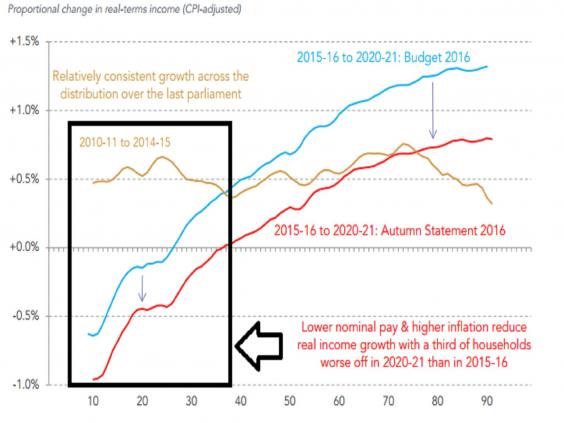
And rather than a quarter of households facing real income falls, the share facing a decline rises to a third.
The gold line shows income growth across the income distribution in the last Parliament, with all households seeing some modest overall growth despite the historically slow economic recovery from the banking crisis.
In the end wealthier households saw bigger real terms income falls between 2010 and 2015,
"The combination of lower growth, higher inflation and the government's decision to press ahead with big welfare cuts, means that households risk experiencing even slower income growth in this parliament than they saw in the aftermath of the financial crisis. But unlike the last parliament, it will be low and middle income households who feel the tightest squeeze this time round," said Torsten Bell, director of the Resolution Foundation.