Afternoon summary
- The Institute for Fiscal Studies has said that future spending cuts would be “on a colossal scale” under the government’s plans and that they would change the role of the state “beyond recognition”.
-
Jeremy Thorpe, the former Liberal leader, died this morning after a long battle with Parkinson’s Disease, his son Rupert has announced.
That’s all from me for today.
Thanks for the comments.
My comments about George Osborne’s row with the BBC over the book of doom and the Road to Wigan Pier (see 12.40pm) haven’t gone down well in Downing Street, I’m told.
The Number 10 argument is that talking about The Road to Wigan Pier was totally misleading and inaccurate because it conjured up an era of mass unemployment, starvation, destitution etc. This, obviously, is not part of the government’s long-term economic plan. Downing Street sources make the point - rightly - that the economy is growing and that employment is at a record high. The Office for Budget Responsibility is forecasting unemployment to fall even lower, and expects to be at around 5.3% by 2019. The view in Number 10 is that, while opponents are free to come out with this kind of scaremongering, it is not something anyone should expect from the national broadcaster.
It’s not really my job to defend the BBC, but I suppose someone has to, so here goes. You can read what the BBC’s Norman Smith actually said here. I’d make just two points.
1 - Spending cuts on the scale set out in the OBR report imply quite fundamental changes to what the state actually does for citizens. This is exactly the point that Paul Johnson, the IFS director, was making in his presentation this afternoon. (See 2.54pm.) But this is a very hard concept to explain to people. Most of us have only lived through a period where the government spending as a share of GDP has been in the 40% region, or above. It was the OBR that said that government plans could take us back to the level that applied in the 1930s. But how do you explain that to people quickly and vividly (which is the job of a reporter)? What single phrase sums up the 1930s? The Road to Wigan Pier is as good as any. True, it is also synonymous with the depression. But I don’t think that’s the point that Smith was trying to make, because it is also evocative of an era when the level of state support for people out of work was quite different from what it is now. And, in this respect, the allusion was fair; George Osborne does want to fundamentally change the role of welfare. The “book of doom” is also a striking phrase, but it is a reference to this term widely used in local government to describe the impact of cuts. It’s a way of saying the cuts will be worse than people expect. That’s the point the OBR (and the IFS today) have been making. So, essentially, Smith was just using colourful language to bring home the significance of what was implied within the OBR’s number-crunching.
2 - The tone was appropriate for that time, and that format. It was early morning, and Smith was having a conversation with a presenter, and it is quite normal for reporters to adopt a more colloquial tone in these exchanges than they would if they were presenting an item at the top of the 10 O’clock News. I take an interest in this, because the tone I adopt when blogging is not the same as the tone I would adopt when writing a story for the Guardian print edition. That does not make the reporting any less reliable; in fact, it can make it more vivid.
Updated
Jeremy Thorpe, the former Liberal leader who was tried and acquitted for conspiracy to murder in the late 1970s, has died, the BBC has reported.
Paul Johnson's presentation - Summary
And here are the key quotes from the opening presentation by Paul Johnson, the IFS director, summarising the main points from the IFS’s analysis.
-
Johnson said future spending cuts would be “on a colossal scale” under the government’s plans.
There is no spending dividend on the horizon. Far from it. There are huge cuts to come.
How do we get to this sunlit upland in which we have a budget surplus? Spending cuts on a colossal scale is how, taking total government spending to its lowest level as a proportion of national income since before the last war.
-
He said government’s plans implied the need for cuts that would change the role of the state “beyond recognition”.
The chancellor is right to point out that it has proved possible to implement substantial cuts over this parliament. One cannot just look at the scale of implied cuts going forward and say they are unachievable. But it is surely incumbent upon anyone set on taking the size of the state to its smallest in many generations to tell us what that means. How will these cuts be implemented? What will local government, the defence force, the transport system, look like in this world? Is this a fundamental reimagining of the role of the state?
One thing is for sure. If we move in anything like this direction, whilst continuing to protect health and pensions, the role and shape of the state will have changed beyond recognition. We think that on the plans set out yesterday by 2019-20 a third of all state spending will go just on health and state pensions, up from a quarter not long before the crisis. And that’s without any additional spending being allocated to the NHS.
-
He said the impression given by the spending announcements over the last few days was misleading.
Over the past few days you might have been forgiven for thinking that there was to be some kind of spending dividend
to come. More money announced for the NHS, much made of how transport and flood defence spending is to be allocated. That is not the story the numbers tell.
There is actually to be a slight increase in the speed of proposed spending cuts after 2015-16.
The IFS presentations are over.
Paul Johnson, the director, is now taking questions.
.@Independent asks @theIFS Paul Johnson if he supports mansion tax? A: Only deals with issue right at the top of council tax bands.#AS2014
— Maitland Political (@MaitlandPol) December 4, 2014
-
IFS says generally it is opposed to devolving corporation tax.
IFS: in principle corporation tax is not a good candidate for devolution
— Faisal Islam (@faisalislam) December 4, 2014
-
IFS says “Google tax” could make tax system more complicated.
IFS says so called 'Google tax' may add to complexity in tax system, points out its a "unilateral" UK move, tho broadly in line with OECD
— Matt Foster (@mlpfoster) December 4, 2014
All the presentations are now available on this page on the IFS’s website.
-
IFS says Exchequer is being very generous to some bequeathed pension pots.
Some bequeathed pension pots will now receive "astonishingly generous treatment" in which income is never taxed, say @theIFS.
— Adam Corlett (@adamcorlett) December 4, 2014
-
IFS says the OBR is assuming “modest delays” to universal credit.
OBR still assuming modest delays to Iain Duncan Smith's Universal Credit scheme, notes @TheIFS.
— Asa Bennett (@asabenn) December 4, 2014
- IFS says the universal credit work allowance has already been cut by 6%. (The work allowance is what people are allowed to earn before they start losing benefit.)
Universal Credit work allowances have now been cut by 6% in real terms, even before it's been introduced - @theIFS
— Adam Corlett (@adamcorlett) December 4, 2014
It seems that those in the audience do not have a high opinion of the universal credit implementation.
Everyone chuckled as soon as #UniversalCredit was mentioned. #IFS
— Federica Cocco (@federicacocco) December 4, 2014
-
IFS says the biggest gains have gone to higher income households.
In cash terms the biggest gains go to higher income households says #IFS re: changes to tax allowance.
— Federica Cocco (@federicacocco) December 4, 2014
Personal allowance increases are not well targeted at lower income households, say @theIFS
— Adam Corlett (@adamcorlett) December 4, 2014
Updated
-
IFS says stamp duty has just changed from being a very bad tax to merely a bad tax.
IFS on stamp duty reform: "the government has moved from a very bad tax to a bad tax"
— Sarah O'Connor (@sarahoconnor_) December 4, 2014
Stamp duty changes have transformed a very bad tax into a merely bad tax, say @theIFS, and no rationale for ignoring commercial property.
— Adam Corlett (@adamcorlett) December 4, 2014
-
IFS says spending will hit 35% as a proportion of GDP by 2019.
.@TheIFS projected downward revisions to spending show it will be 35% as a portion of GDP by 2019. #IFS #AS2014 pic.twitter.com/LGKnnLEVyX
— Maitland Political (@MaitlandPol) December 4, 2014
-
IFS says Osborne following the SNP’s lead on stamp duty reform.
#IFS shows chart with number of housing transactions by house price. Huge spikes where thresholds are. "It's dysfunctional" #stampduty
— Federica Cocco (@federicacocco) December 4, 2014
Bit of a boost for John Swinney there... IFS says Osbo's stamp duty changes "following broadly the Scottish government's lead"
— Matt Foster (@mlpfoster) December 4, 2014
-
IFS says the political parties all face difficult decisions ahead of the election.
#IFS: There are no easy choices here by any means. Political parties face difficult decisions ahead of #GE2015
— Federica Cocco (@federicacocco) December 4, 2014
* IFS says welfare cuts or tax increases worth £47bn would be needed to avoid departmental spending cuts.
.@TheIFS believe £47bn of welfare reductions or tax increases would be required to avoid departmental reductions #AS2014
— Andy Mayer (@mayerandrew) December 4, 2014
-
IFS says health and pensions will take up a third of state spending by the end of the decade.
Ifs says that by 2020 spending on state pension and Health service will account for third of all public spending - a huge rise
— Steven Swinford (@Steven_Swinford) December 4, 2014
Spending on health will be 19% of state spending by 2019. State pensions will account for 13.5% @TheIFS #AS2014
— Andy Mayer (@mayerandrew) December 4, 2014
Great chart from @theIFS showing the rising share of pub spending accounted for by health/pensions (tho not interest) pic.twitter.com/6jhBTuGycG
— Ed Conway (@EdConwaySky) December 4, 2014
Updated
-
IFS says departmental spending set to fall 22.2% over the decade.
IFS: By 2019/20 cumulative departmental spending set to be 22.2% lower than it was in 2010/11
— Matt Foster (@mlpfoster) December 4, 2014
-
IFS says unprotected budget set to fall by 41%.
#IFS: Protected budgets (NHS, education) are almost half of all departmental spending.
— Federica Cocco (@federicacocco) December 4, 2014
IFS says there'll have been 41% cut to non-protected areas of Govt spending (so not schools, NHS) by 2019/20 compared to 2010/11 levels
— Matt Foster (@mlpfoster) December 4, 2014
Osborne could have to cut more than 40% of unprotected departments, says @TheIFS pic.twitter.com/tMOEDLCmEn
— Asa Bennett (@asabenn) December 4, 2014
Updated
Apparently the IFS is using emoticons to help clarify its analysis.
I love the icons @TheIFS use in their analysis to let us know if it's good news or bad news #AS2014 pic.twitter.com/9gtL4892B4
— Emily Purser (@EmilyPurserSky) December 4, 2014
As soon as the slides are available on the website, I will post a link.
-
IFS says more than half the cuts are yet to come.
39% of the planned cuts will have been implemented by 2014/15. We're not even halfway there! #IFS
— Federica Cocco (@federicacocco) December 4, 2014
By one definition, we are only 23% of the way through planned spending cuts, or 39% by another. @theIFS
— Adam Corlett (@adamcorlett) December 4, 2014
Here’s a link to the full text of the opening remarks at the briefing from Paul Johnson, the IFS director.
Full remarks from Paul Johnson of @TheIFS about the Autumn Statement [pdf]: http://t.co/wNTR8B6yx4 #AS2014
— Ed Conway (@EdConwaySky) December 4, 2014
- IFS says under Osborne’s plans 88% of deficit reduction will come from cuts.
IFS says by end of period Osbo's prog to eliminate deficit will have been 88% from spending cuts, 12% from tax rises
— Matt Foster (@mlpfoster) December 4, 2014
-
IFS says Treasury’s post-graduate loan scheme will mean students start with an effective tax rate of 50%.
Postgraduate loans will mean those who take them face 50% tax rate on income up to £43,000 and 60% after that. BAD deal for brightest.
— Phillip Inman (@phillipinman) December 4, 2014
-
IFS says government saving less money than expected from some welfare reforms.
IFS says govt saving less money than expected from structural reforms to incapacity and disability benefits
— Matt Foster (@mlpfoster) December 4, 2014
-
IFS questions whether Osborne’s year-on-year spending increases are fully funded.
IFS: Some of Osbo's permanent giveaways funded by "what looked like temporary takeaways" in spite of HMT scorecard saying AS revenue neutral
— Matt Foster (@mlpfoster) December 4, 2014
IFS chastises Osborne for "fairly bad behaviour": paying for permanent giveaways with temporary takeaways
— Sarah O'Connor (@sarahoconnor_) December 4, 2014
Updated
-
IFS says stamp duty reform does not go far enough.
IFS: Stamp duty inefficient, but yesterday not the "substantial overhaul" of housing taxation UK "desperately" needs
— Matt Foster (@mlpfoster) December 4, 2014
-
IFS says next parliament will require spending cuts or tax rises worth £21bn.
To keep cuts at same pace in next parliament as they have been will require £21bn in welfare cuts or tax rises, says IFS
— Asa Bennett (@asabenn) December 4, 2014
Institute for Fiscal Studies briefing
The Institute for Fiscal Studies briefing has started.
-
IFS warns of cuts to come “on a colossal scale”.
The OBR had a 'book of doom'? The IFS gives them a run for their money, warning of "huge cuts to come" and cuts "on a colossal scale"
— Asa Bennett (@asabenn) December 4, 2014
Ifs expects cuts on a "colossal" scale, taking public spending to lowest level of national income for a "very very long time"
— Matt Foster (@mlpfoster) December 4, 2014
To keep cuts at same pace in next parliament as they have been will require £21bn in welfare cuts or tax rises, says IFS
— Asa Bennett (@asabenn) December 4, 2014
-
IFS warns cuts will change the state “beyond all recognition”.
IFS' Paul Johnson says cuts will change state "beyond all recognition".
— Asa Bennett (@asabenn) December 4, 2014
@TheIFS - "The role and shape of the state will have changed beyond recognition" with third of spending on health and pensions, not quarter
— Phillip Inman (@phillipinman) December 4, 2014
Updated
The Institute for Fiscal Studies briefing is due to start shortly.
This is from one of the attendees.
Now @TheIFS to hear their traditional detailed analysis of why #AS2014 is horrible for everyone, with scary graphs
— Andy Mayer (@mayerandrew) December 4, 2014
.@TheIFS tend to attract a large largely public sector economist audience of a scale that does not tend to suggest austerity is biting here
— Andy Mayer (@mayerandrew) December 4, 2014
Lunchtime summary
- George Osborne has attacked criticisms of his plans for further public spending cuts in the next parliament, accusing the BBC of hyperbolic coverage and conjuring up bogus images of the 1930s depression. Downing Street has backed the chancellor. But the BBC has rejected their claims, and defended their coverage as fair and balanced.
-
A Lords committee has suggested that Osborne’s claim in the autumn statement to have “halved the bill” Britain had to pay to the EU recently was misleading. Lord Harrison, a Labour peer and chair of the Lords EU committee on financial and economic affairs, said that he was writing to Osborne asking him to justify his claim that he had halved the £1.7bn bill Britain owed. He said:
What remains of concern to us is the claim by the chancellor that the UK payment was effectively halved because the EU rebate was applied. It is our view that the rebate was never in doubt, calling into question the factual accuracy of the chancellor’s statement.
No 10 backs Osborne's claim that the BBC's autumn statement coverage has been 'hyperbolic'
Downing Street said the prime minister agreed with George Osborne about the BBC’s coverage of the autumn statement being “hyperbolic”. (See 9am.) The prime minister’s spokesman said he had heard part of the autumn statement being described as a “book of doom” and as something taking Britain back to Road to Wigan Pier. The spokesman said:
The prime minister and the chancellor do think those are hyperbolic descriptions, which don’t help us have what is important here, which is a clear and sensible and measured debate about the decisions that both are being taken and need to be taken in the future.
It was the BBC’s Norman Smith who described the Office for Budget Responsibility report as “the book of doom”. This is what he said on the Today programme.
While there was a lot of enthusiasm on the Conservative benches ... when you sit down and read the Office of Budget Responsibility report, it read, frankly, like a book of doom. It is utterly terrifying. It is suggesting that spending will have to be hacked back to the levels of the 1930s in terms of as a proportion of GDP. And that is an extraordinary concept. You’re back to the land of Road to Wigan Pier. And the scale of cuts detailed in the book; it’s suggesting in the non-protected departments, unlike health and overseas aid, they are going to face cuts of roughly another third. They have already faced a third. So by 2020 they will have been cut back by nearly two thirds; you have to question whether that is achievable. And we’re told 60% of the cuts are yet to come.
Smith was talking in the first item after the news at the very start of the Today programme, at roughly 6.07am, a slot where reporters have got in trouble before during a live two-way.
(I’m with Norman on this one. Anyone who has to explain politics and make it interesting at that time of the morning is entitled to a little licence. And essentially all he was doing was doing was translating what the OBR is saying into rather more vivid language.)
Updated
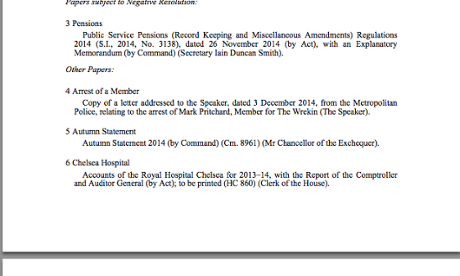
The Times’s Jules Mattsson points out that the arrest of Mark Pritchard is actually mentioned in today’s Commons Votes and Proceedings, a minute of Commons proceedings published every day and read by almost no one.
Mark Pritchard arrest been sitting in votes and proceedings document since yesterday http://t.co/ArYiFsyIyy
— Jules Mattsson (@julesmattsson) December 4, 2014
MPs are just starting a debate on the stamp duty reforms announced yesterday.
There was a hold-up at the start because David Gauke, the Treasury minister opening for the government, was not in the chamber.
This is from the Labour whips Twitter feed.
Shambles in @HouseofCommons as Government nearly loses business because no Treasury Minister turns up for Stamp Duty Ways and Means Motion
— Labour Whips (@labourwhips) December 4, 2014
Mark Pritchard, the Conservative MP, has arrested in relation to an allegation of rape, Sky News is reporting.
Conservative MP Mark Pritchard has been arrested following an allegation of rape http://t.co/B5PGl5Cz0m pic.twitter.com/WgR8x3eBed
— Sky News (@SkyNews) December 4, 2014
For the record, here are today’s YouGov GB polling figures.
Conservatives: 32% (no change from YouGov yesterday)
Labour: 31% (down 2)
Ukip: 17% (up 1)
Green: 7% (no change)
Lib Dems: 6% (down 1)
Conservative lead: 1 point
Government approval: -26 (no change)
According to Electoral Calculus, this would leave Labour the largest party, but 10 seats short of a majority. (But, as Peter Kellner pointed out in a good blog recently, this relies on some uniform swing assumptions which are probably unreliable.)
BBC rejects Osborne's claim that its autumn statement coverage has been 'hyperbolic'
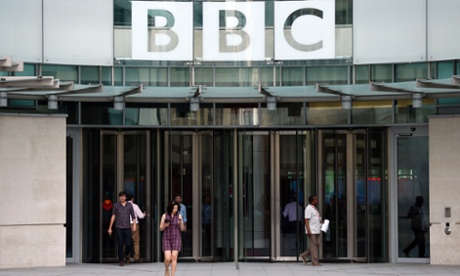
The BBC has hit back at George Osborne. (See 9am.) It has said that it’s autumn statement coverage has been “fair and balanced” and that it will continue to ask him difficult questions.
This is from a BBC spokesperson.
We’re satisfied our coverage has been fair and balanced and we’ll continue to ask ministers the questions our audience want answered.
Updated
Hague says coalition parties can't yet agree on English votes for English laws
William Hague, the leader of the Commons, told MPs at business questions that the Tories and the Lib Dems had not yet reached an agreement on “English votes for English laws”.
Hague is chairing a cabinet committee drawing up plans, and he told MPs he hoped to publish plans “shortly”.
I have reached agreement within the coalition on the publication of the command paper and on the format of the command paper, and shortly hope to reach agreement on the contents of the command paper ... We will then be able to discuss, once we’ve published the command paper, how we debate it in parliament and what the format and structure of any debate might be.
In October Hague said that he wanted to stage a vote on this before the end of November. Obviously, that deadline has already been missed.
IFS director says private sector wage growth will make future spending cuts harder
As promised earlier, here are some quotes from the Today programme’s interview with Paul Johnson, the Institute for Fiscal Studies director, at about 6.30am.
-
Johnson said the planned cuts would take public spending to a lower level than it had been for generations.
It is no good us saying ‘This is a very big number, you can’t do it.’ The chancellor has quite reasonably pointed out people said back in 2010 what was intended over this parliament was very big and very challenging. He’d say we’ve managed to deliver those cuts and we’ve more than delivered those cuts.
Actually, to do more than that again takes us to a level of public spending below where it has been for generations.
-
He said private sector wage growth would make it much harder to cut public spending again over the next five years.
Even if it has not been too difficult over this period, that doesn’t mean it won’t be difficult over the next period.
Apart from anything else, they have done the relatively easier things first. And, of course, we’ve actually had a relatively easy environment for doing it. Private sector wages have been very weak, which has made it relatively easy to keep public sector wages down. If private sector wages start to grow, as we hope they will, it will be much harder to keep public sector wages down.
- He said that the government’s spending plans implied that, in some departments, spending would be cut by 50% per head or more over the whole of this decade.
-
He said there was a big gap between Labour’s plans for the next five years and the Conservatives’. Labour’s involved far fewer cuts, but more debt.
Clegg rejects claims the Lib Dems are ashamed of being linked to autumn statement
Here are the main points from Nick Clegg’s LBC phone-in.
-
Clegg rejected claims that his decision not to attend the Commons yesterday meant he was trying to distance himself from the autumn statement. The Lib Dems were proud of it, owned it and co-authored it, he said.
It’s not propped up. Far from it. I’ve steered it. Ed Balls thinks I somehow want to deny the fact that I am a co-author of yesterday’s statement. I don’t. The stamp duty changes is something that my party has been banging on about for years now. Clearly that needed reform ...
So poor Ed Balls somehow thinks I’m sheepish or ashamed of what this government has done. Do you know what? Far from it. I’m proud, I own it, we co-author it, it is a Liberal Democrat autumn statement just as much as anything else and this economic recovery would not be happening without the Liberal Democrats.
- He said he would like to spent more Wednesday away from the House of Commons instead of attending prime minister’s questions. He liked being able to talk to ordinary people instead, he said.
- He said Lib Dem economic plans were different from Labour’s and the Conservatives’ because they wanted to borrow less than Labour and cut less than the Conservatives.
- He said he saw his future in British politics, not EU politics.
-
He said that government would within days be announcing that the number of people starting apprenticeships since 2010 has reached 2m.
Clegg says Gordon Brown was “an unusually complex politician”. He says he only got to know him in the coalition talks after the election. He was capable of “real statesmanlike thinking”. He had “a gift for looking at the big picture”, but in the next instance he could also be very petty.
If Brown had heeded Vince Cable’s warnings about the economy, the crisis would not have been so serve, he says.
Ed Balls's morning interviews - Summary
Here are the main points from Ed Balls’ morning interviews.
I’ve taken the quotes from the Press Association and from PoliticsHome.
-
Balls accused Osborne of proposing “fantasy tax cuts”.
Not only is the chancellor cutting spending hugely, he is promising £7bn of unfunded, fantasy tax cuts and hoping that he is going to dupe the electorate. Nothing I will say to you today or before the election is going to be uncosted, unfunded and unpaid for. All our choices will add up. I am not going to play that fantasy politics. I am not going magic tax cuts up, I will leave that to George Osborne.
- He said he thought the Tories would raise VAT if they won the election.
-
He said wages needed to rise to help pay off the deficit.
Unless we have action to deal with that problem of living standards and wages to make people better off, we are going to have tougher times in the public finances and on public services too.
- He said a future Labour government would have to take “very difficult” spending decisions.
-
He explained what he would have announced in the autumn statement if he had been chancellor.
I have just said I will support the stamp duty change but I would have raised the National Minimum Wage; I would have increased free childcare for working parents to 25 hours paid for by a rise on the bank levy; a compulsory guaranteed job for young people; we would have had more support for the business investment bank to lend to small businesses. These are things which we would do to ease that cost of living crisis and that will help us get the deficit down. None of that was there.
Asked if he fancies a future career in the EU, Clegg says he is firmly rooted in British politics and intends to continue.
Clegg says he told George Osborne in advance that he would not be in the Commons for the autumn statement.
Q: Was he disappointed?
I don’t know, says Clegg.
Clegg says he is proud of the autumn statement
LBC play a question, recorded earlier, from Ed Balls.
Balls says Nick Clegg was not there for the autumn statement. Does he think that, if he does not turn up, people will think he was not responsible for the decisions? And Vince Cable is writing to the OBC asking for an alternative costing of future spending plans. If Cable is not happy with government plans, why is he still in the cabinet?
Clegg says has been attending budgets and autumn statement for five years.
Everything in it was agreed with the Lib Dems.
But, faced with a choice of listening to Ed Balls or talking to normal people, he chose to listen to normal people in Cornwall yesterday.
Q: So why don’t you miss all these occasions?
That’s a good question, says Clegg.
He says he has not just propped up the government. He has helped to steer it.
The government is days away from announcing the two millionth new apprentice, he says.
He is not ashamed of the government’s programme. He is proud of it, and co-owns it, he says.
He says he, Danny Alexander and Vince Cable proudly back what this goverment has done.
But, looking ahead, they have a different view.
Q: Do you agree with Labour?
Clegg says the Lib Dems would borrow less than Labour and cut less than the Conservatives.
On Call Clegg, Clegg says the economy is in a much stronger position than it was in 2010.
Labour are also accusing the Lib Dems of hypocrisy. (See 9am.) This is from Alex Belardinelli, Ed Balls’ spin doctor.
One thing Osborne is right on - Lib Dems agree policies with Tories in private, then try to differentiate in public: https://t.co/LLtw5QlhqZ
— Alex Belardinelli (@abelardinelli) December 4, 2014
Nick Clegg's Call Clegg phone-in
Nick Clegg is hosting his LBC phone-in.
I will be mostly focusing on what he has to say about the autumn statement.
George Osborne says the BBC's cuts coverage is 'totally hyperbolic' and 'nonsense'
Here are the main points from George Osborne’s morning interviews.
-
Osborne said the BBC’s coverage of the prospect of further spending cuts was “totally hyperbolic” and “nonsense”.
When I woke up this morning and turned on the Today programme, I felt like I was listening to a rewind of a tape from 2010, and you had BBC correspondents saying Britain is returning to a George Orwell world of The Road to Wigan Pier. That is just such nonsense. I would have thought the BBC would have learnt from the last four years that its totally hyperbolic coverage of spending cuts has not been matched by what’s actually happened ...
What I reject is the totally hyperbolic BBC coverage of spending reductions. I had all that when you were interviewing me four years ago. And has the world fallen in? No it hasn’t.
-
He accused the Lib Dems of hypocrisy.
George Osborne tells @EamonnHolmes about Lib Dems: "In private they sign up to these policies and then in public they slag them off"
— Sophy Ridge (@SophyRidgeSky) December 4, 2014
- He rejected suggestions that the stamp duty tax cut risked creating a house price boom. He also said he had given the Bank of England powers to tackle the dangers of a house price bubble.
-
He claimed that ordinary people would end up paying Labour’s mansion tax (which will be levied on homes worth more than £2m.)
We all know that if the Labour party introduce a new homes tax, it will soon be applied to most people listening to this programme.
- He said, under his plans, further spending cuts would come from welfare.
- He said the next election would be a choice between higher taxes and higher borrowing under Labour, or the country living within its means.
Britain has got a choice. You either have much higher taxes to pay for your government and your welfare bill, or you borrow a lot more and risk the economy going into a crisis, or you live within your means.
This is a choice families face every single day. We are facing up to that choice as a nation. People are going to have their own choice at the general election - do they want to go back to the chaos or do they want to go on the course to prosperity?
George Osborne's Today interview - Verdict from the Twitter commentariat
It’s over. And the main line - in fact, probably the only line - was George Osborne’s decision to attack the BBC for its coverage of future spending cuts. (See 8.21am.)
The Twitter commentariat isn’t impressed. These posts are all from political journalists.
Osborne says he doesn’t like today’s BBC budget coverage. I think it’s the best it’s ever been. Focusing on failures on debt & delayed cuts.
— Fraser Nelson (@FraserNelson) December 4, 2014
Public services (courtesy of OBR) as George Osborne accuses the BBC of hyperbolic coverage about spending cuts. https://t.co/YzrmoSrtmi
— Patrick Wintour (@patrickwintour) December 4, 2014
"If you listen to the BBC's line of questioning..." Osborne still on the attack on #r4today. Oddly shirty on day of broadly good coverage.
— Tom Newton Dunn (@tnewtondunn) December 4, 2014
Shirty Osborne's BBC attack based on irritation with suggestion £30bn more cuts will be hard. Of course they will be, fallacy to pretend not
— Tom Newton Dunn (@tnewtondunn) December 4, 2014
Has Iain Duncan Smith been giving media training to Cabinet colleagues? Osborne reaching IDS-style levels of radio grumpiness on @BBCr4today
— Isabel Hardman (@IsabelHardman) December 4, 2014
this interview is why Osborne would make a crappy PM. He just can't sound interested in selling his ideas publicly #r4today
— josh lowe (@JeyyLowe) December 4, 2014
Osborne goes on the attack against "hyperbolic BBC coverage" of cuts ... He doesn't sound in a great mood.
— Faisal Islam (@faisalislam) December 4, 2014
Uh oh, Osborne losing it a bit now, slamming BBC for "totally hyperbolic" coverage of spending cuts. Lashing out at media never wise
— Isabel Oakeshott (@IsabelOakeshott) December 4, 2014
Osborne very tetchy on @BBCr4today. Never likes scrutiny, never holds press conferences
— Kevin Maguire (@Kevin_Maguire) December 4, 2014
Osborne sounds furious at "totally hyperbolic BBC coverage of spending cuts". Beeb should brace itself for more austerity... #r4today
— George Eaton (@georgeeaton) December 4, 2014
Osborne didn't need to make that exchange so bad tempered. Surprisingly poor, defensive performance after good start
— Isabel Oakeshott (@IsabelOakeshott) December 4, 2014
Q: Are you still promising £7bn in tax cuts?
Yes, says Osborne.
Q: Will you change the triple lock on pensions?
No, says Osborne. That will stay in the next parliament. Pensioners are some of the poorest people in the country. They rely on fixed incomes.
Q: So where will the cuts come from?
Osborne says working-age benefits will be frozen. And the benefits cap could come down to £23,000. He says he has shown that you can reduce the cost of public services while improving their quality.
Q: The public spending cuts after 2015 will be “staggering”.
Osborne says when he turned on the Today programme this morning, he thought he had gone back in time four years. There were hyperbolic reports of the impact of spending reductions, suggesting they were going to take Britain back to a George Orwell world. He says he had all this four years ago. But these forecasts did not materialise.
The alternative, having a country without control of its debts, is not an option he wants.
Q: But do you accept the IFS estimate that some departments could lose 50%.
Osborne says those estimates assume that there will be no further welfare cuts.
Q: But you have not achieved your welfare savings.
Osborne says he has achieved welfare savings worth £20bn. Normally he is being attacked for welfare cuts, he says.
He says he wants savings on welfare, like freezing working age benefits.
The poor would suffer most if the economy went back into crisis, he says.
Q: Isn’t a mansion tax fairer? People would pay a certain amount every year.
No, says Osborne. It hits the cash poor. And it would require millions of homes to be revalued.
He says he has demonstrated that a sensible reform can lead to people buying big homes paying more tax.
Labour’s “homes tax” would be “anti-aspirational”, he says.
Q: If you are short of money, why are you giving away £800m (through the stamp duty reform) when you did not have to.
Osborne says this is a good reform, coming into effect today. It will encourage aspiration.
He has a plan that will support business confidence, he says.
Q: Are you sure that house prices won’t just rise as a result?
Osborne says he does not want a house price boom.
It would not be worth keeping a bad stamp duty tax system in place just to control house prices.
George Osborne's Today interview
John Humphrys is interviewing George Osborne.
Q: You promised to balance the books, and you are not going to.
Osborne says Humphrys is being unfair. He says he promised to get the deficit under control.
Q: You attacked Alistair Darling for his plan. But all you have achieved is what he proposed.
Osborne says Bentley Motors have announced 300 new jobs today. The economy was in trouble under Labour. Now it is doing well. But he is the first to say that there is more to do.
Q: If everything is going so well, why are tax receipts not better.
Osborne says the economy collapsed. When you have a massive economic crisis, it has consequences for years to come.
Balls accuses Osborne of offering 'fantasy tax cuts'
Ed Balls has accused George Osborne of offering ‘fantasy tax cuts’ this morning. This is what he told Today.
Not only is the chancellor cutting spending hugely, he is promising £7bn of unfunded, fantasy tax cuts and hoping that he is going to dupe the electorate. Nothing I will say to you today or before the election is going to be uncosted, unfunded and unpaid for. All our choices will add up. I am not going to play that fantasy politics. I am not going magic tax cuts up, I will leave that to George Osborne.
He has also said he thinks the Tories will raise VAT.
I will post a full summary of his morning interviews later.
Apparently George Osborne will be addressing the Today programme from a Bentley factory.
George Osborne is in a Bentley factory doing his morning media round. Skilled jobs up north but is posh cars right image?
— Paul Waugh (@paulwaugh) December 4, 2014
Paul Johnson, the director of the Institute for Fiscal Studies, will present his full verdict on the autumn statement at 1pm, but he gave a flavour of what he thinks in an interview on the Today programme at 6.30am.
IFS: we are only 40 per cent of the way through spending cuts....next few years will be "gruesome" it says.
— Jim Pickard (@PickardJE) December 4, 2014
.@TheIFS also says cuts to come to non protected areas - police, defence etc - could be 50% more per head under #AutumnStatement plans
— Robin Brant (@robindbrant) December 4, 2014
I will post full quotes from Johnson later.
This is what the newspaper front pages are saying about the autumn statement.
The Guardian is the most critical.
Thursday's Guardian front page: Lean, mean and extreme #tomorrowspaperstoday #bbcpapers #AutumnStatement pic.twitter.com/t5FWxo8Vww
— Nick Sutton (@suttonnick) December 3, 2014
The other “broadsheets” present a mixed picture.
Thursday's Independent front page Osborne’s autumn understatement #tomorrowspaperstoday #bbcpapers #AutumnStatement pic.twitter.com/J9LRU0cm7k
— Nick Sutton (@suttonnick) December 3, 2014
Thursday's FT front page: Banks and big business under fire as Osborne shifts to poll position #tomorrowspaperstoday pic.twitter.com/z5H53DmzQX
— Nick Sutton (@suttonnick) December 3, 2014
Thursday's Times front page: Gambling the house #tomorrowspaperstoday #bbcpapers pic.twitter.com/VtZIoBfHcB
— Nick Sutton (@suttonnick) December 3, 2014
Thursday's Telegraph front page: Osborne's grand designs #tomorrowspaperstoday #bbcpapers #AutumnStatement pic.twitter.com/OZA95Ms6xD
— Nick Sutton (@suttonnick) December 3, 2014
But the rightwing tabloids are enthusiastic.
Thursday's Daily Mail front page: George's Stamp Duty bonanza #tomorrowspaperstoday #bbcpapers #AutumnStatement pic.twitter.com/ok9jK1qrf3
— Nick Sutton (@suttonnick) December 3, 2014
Thursday's Sun front page: Ho Ho Homes #tomorrowspaperstoday #bbcpapers #AutumnStatement pic.twitter.com/0W1YPk3qsU
— Nick Sutton (@suttonnick) December 3, 2014
Thursday's Daily Express front page: Cash boost for middle Britain #tomorrowspaperstoday #bbcpapers #AutumnStatement pic.twitter.com/0YOkMx0x3k
— Nick Sutton (@suttonnick) December 3, 2014
George Osborne’s stamp duty cut was the big surprise in the autumn statement yesterday afternoon, but today attention is starting to focus more on what his plans mean for public spending in the next parliament. The BBC news bulletins are leading on this theme, and it is also highlighted in the Guardian’s splash.
The chancellor, George Osborne, set out dramatic plans to move Britain from the red into the black that will see public spending as a percentage of GDP fall to its lowest level since the 1930s and could require cuts in non-protected departments such as police, local government and justice amounting to a further £60bn by 2019-20.
The plans, according to the Treasury spending watchdog, the Office of Budget Responsibility, also presume the loss of a further one million public sector jobs by 2020, a renewed public sector pay squeeze and a further freeze on tax credits.
The scale of the implied spending cuts required to drive the country into a surplus of £23bn by 2019-20 in part prompted the Liberal Democrat business secretary, Vince Cable, to write two weeks ago to ask the OBR to distinguish in its forecasts between the spending plans agreed by the coalition up to 2015-16 and any spending projections after that date which could only be an assumption about tax and spending policy.
I will be concentrating today on reaction to the autumn statement. Osborne and Ed Balls, the shadow chancellor, have both been giving interviews already this morning and Osborne will be on the Today programme shortly. I will be covering that in detail.
Here’s the agenda for the day.
8.10am: George Osborne is interviewed on the Today programme.
9am: Nick Clegg hosts his Call Clegg phone-in.
9.15am: Danny Alexander, the chief secretary to the Treasury, announces the government’s response to the oil and gas fiscal review at a press conference in Aberdeen.
9.30am: The Institute for Economic Affairs and the TaxPayers’ Alliance hold an autumn statement briefing.
10.10am: Theresa May, the home secretary, gives evidence to the Lords extradition law committee.
1pm: The Institute for Fiscal Studies holds its autumn statement briefing.
If you want to follow me on Twitter, I’m on @AndrewSparrow.