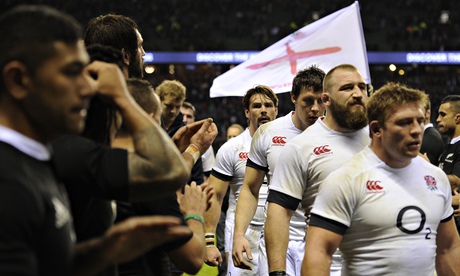
The autumn series is nearly upon us and no doubt November will be a memorable rugby month. It – or rather, as it turned out, the first weekend of December 2012 certainly was for Stuart Lancaster when England beat the New Zealand All Blacks and became serious contenders for the World Cup of 2015.
That said, England could do with a couple of displays that reinforce those two-year old credentials. The southern hemisphere remain ahead of the European game in all departments, especially the conversion of chances into points and the maintenance of high speed.
Everybody seems to be having a go at Australia for their handling of the Di Patston-Ewen McKenzie-Kurtley Beale affair, but Australia where it really matters are comfortable with high-tempo rugby. In fact, the delight with which we look at trouble in the camp of a southern foe tends to obscure the fact that the game in these northern parts is not exactly a model of smoothness.
By now in the history of modern rugby union, France should be a global powerhouse. They are, it might be argued, since they have been to three of the seven finals of the World Cup, the tournament that represents the game at its most commercially evolved and professionally played. And yet at this very moment the sports newspaper L’Equipe is conducting a survey among their readers: Are we still seduced by the French rugby team?
No rugby club has ever been as advanced and nakedly ambitious as Toulon, double champions of Europe and the defending champions of the Top 14. They set the agenda and are pulling Clermont and Toulouse with them, followed jealously by the likes of Montpellier and Racing Métro 92. France, slightly hobbled by a television deal that was supposed to fund the accelerated development but that was judged a little too quick for its own good by the lawyers, is still galloping into rugby’s future.
Unfortunately for those once seduced by the allure of days out at the old Parc des Princes or the Stade de France, it has all come at the expense of the French national team. Philippe Saint-André, an architect when coach of Toulon of the very system that puts club before country, now deals as coach of France with players who play like strangers at an antiquated pace with barely concealed lack of devotion. It is never beyond the bounds of possibility that France will be stirred next year by the World Cup, but perhaps we should expect little from them against Fiji, Australia and Argentina in the weeks ahead.
Wales are the complete opposite. There is no game that seduces below the level of Wales. Playing for Wales is everything. And Warren Gatland, coach of Wales, wants that point to come over loud and clear.
When Jonathan Davies, while playing for his rich and powerful French club, Clermont, injured his shoulder early in the game against Sale in the European Champions Cup, it left the centre, according to his club coach Franck Azéma, out of contention for at least three weeks. Not so, was the counter from the Welsh camp. There had been no dislocation of the joint. Who was to say that Davies would not be available for Wales’s first encounter, against on Australia on Saturday?
Wales, doggedly committed to a fourth fixture at the end of the month, may have to hand Davies back to Clermont before that final outing against South Africa – it lies outside the International Board’s Test window – but until then they will not allow any club official to make pronouncements on behalf of any player now in their charge, now in their camp. Davies, it is to be imagined, has an extremely sore shoulder and is highly unlikely to play, but Warren, and only Warren, will make the call.
Perhaps we should not be surprised if the reason for Davies’s absence is given in terms that stress the miraculous work of the Welsh medical staff in having him ready in time to face the Wallabies, but also explain that the selectors (Warren) have decided instead to have a look at the combination in midfield of Jamie Roberts and George North. It will be sort of killing two birds with one stone: not your concern, Franck; and how might George go at 13?
The work of Gatland in making Wales competitive and successful since his first game as coach in 2008 could, like the House of Lancaster, do with a little autumnal boost. The game in Wales is in need of a little tonic and to beat Fiji and one of either Australia, South Africa and New Zealand would do wonders. On the other hand, the best Welsh work comes in the Six Nations. November is a tricky month.
The coach who might enjoy the month more is Vern Cotter, about to launch his first campaign on home soil. Scotland play Argentina, New Zealand and Tonga. The last should be the given, except, of course, it was defeat to Tonga that brought the time of Andy Robinson to an end. Argentina can be beaten, Cotter will be saying; New Zealand probably not, he’ll be fearing. Tonga simply must be taken.
A return of two from three would more than suffice, and there is the admirable example of Glasgow this season to allow him to dream of blending a high-tempo forward game – never a problem for Scotland – with a more effective three-quarter style, which has not been a strong point for years now. Will the 21-year-old centre Mark Bennett become the totem of a more positive Scotland? It’s exposing him to a lot of responsibility. But somebody, surely, has to have a happy November.
Ireland have South Africa, Georgia and Australia. That is, they put an admirable piece of missionary work between the money-spinners. It seems they have a crisis at prop, now that Nathan White is the latest to miss out through injury, after the withdrawal of Mike Ross and Marty Moore.
It also appears, by way of contrast, that a solid tight-head prop is no longer as indispensable as he once was. Such an observation applies not so much to White necessarily, but to Dan Cole for England and Adam Jones for Wales. It seems the game is now one strange breed down in its overall mission to offer a home to differing shapes and sizes. Adam, the wonderful Jones, at the age of 33, has been cast adrift, a victim of the new laws that have made the scrummage a safer place to be for non-specialists.
The mysteries of the front row proved ultimately too arcane for rugby’s image-makers. We should be braced for lots of burly ball-handlers to be taking up space in midfield. It all depends on how much such burliness presses your buttons.
Joe Marler and David Wilson of England are very good at midfield exposure. They may become the catalysts of England’s timely advance against New Zealand, South Africa, Samoa and Australia. Or perhaps the space should be given to whichever of his promising and daring centre combinations Lancaster would like to blood. Props and untested centres vying for involvement in the short days of November. Perhaps the touring month will be claimed by the teams that come this way tried and tested and more certain of what they can and cannot do.