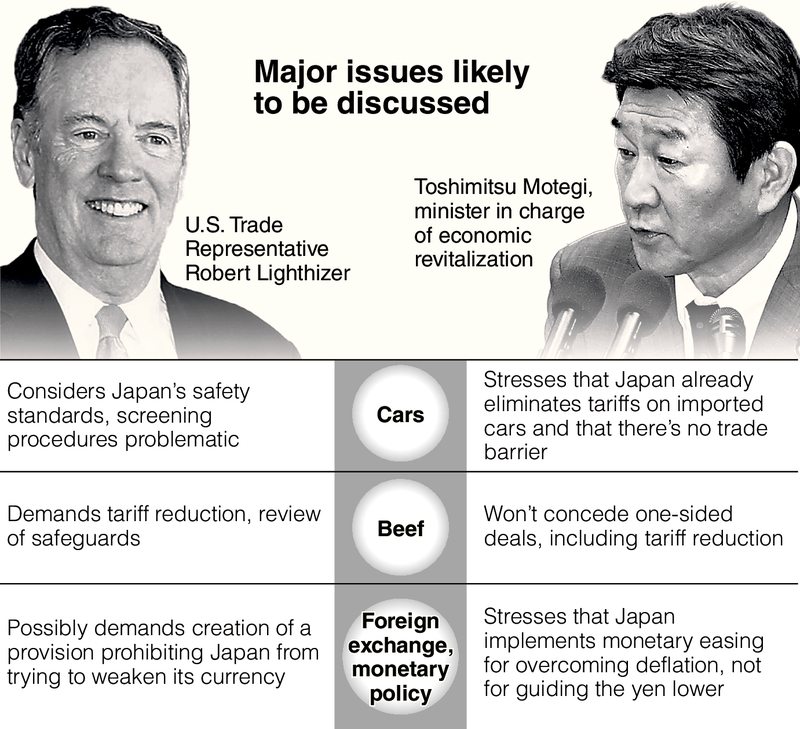
PALM BEACH, Fla. -- An expansion of American-made exports including automobiles and agricultural products will likely be on the agenda of a new framework for discussing trade issues between Japan and the United States that was agreed upon during recent bilateral talks.
Although Japan's stance is not to make concessions to the United States beyond the agreement reached under the Trans-Pacific Partnership free trade pact, it is unclear to what extent the country can fend off U.S. demands.
==
53.5 billion dollars deficit
"Japan sends us millions and millions of cars, and we tax them virtually not at all. And we don't send so much product because we have [Japan's] trade barriers and lots of other things," U.S. President Donald Trump said at a press conference after the bilateral meeting with Prime Minister Shinzo Abe on Wednesday afternoon, showing dissatisfaction with the current situation regarding U.S. auto exports to Japan.
The value of U.S. auto exports to Japan in 2017 was 2.4 billion dollars, while it imported 55.9 billion dollars worth of Japanese cars -- a deficit of 53.5 billion dollars.
In February, the Trump administration submitted its first Economic Report to U.S. Congress. It noted that the "United States has expressed strong concerns with the overall lack of access to Japan's automotive market for U.S. automotive companies," claiming that Japan's "unique safety and other standards," "hindrances to the development of distribution service networks" and so on are acting as "nontariff barriers," hampering U.S. auto exports to Japan.
With the conclusion of negotiations on an economic partnership agreement between Japan and the European Union, the EU's 10 percent tariff on automobiles from Japan will be scrapped in the eighth year of the pact's implementation. This has seemingly made the United States feel uneasy.
However, Japan has already eliminated tariffs on imported cars, and it has been pointed out that U.S. automakers do not undertake sufficient sales strategies to meet Japanese consumers' needs, such as introducing fuel-efficient compact models.
Sales of European cars are increasing in Japan. Meanwhile, major Japanese automakers such as Toyota Motor Corp. and Nissan Motor Co. are manufacturing cars in the United States.
Japan is expected to tenaciously stress these points during discussions under the new framework, but it is hard to predict what kind of demands will be made by the United States.
==
U.S. may lose ground
Beef will likely be the focus regarding agricultural products. According to the U.S. Meat Export Federation, U.S. beef exports in 2017 reached 7.27 billion dollars, with 1.89 billion dollars -- the largest share -- exported to Japan.
Japan currently imposes a 38.5 percent tariff on beef from the United States. Meanwhile, tariffs on beef from the TPP member country of Australia to Japan will gradually be lowered to 9 percent if the TPP takes effect.
For this reason, the U.S. livestock industry and others that fight against overwhelming odds in a price war are strongly demanding Trump start negotiations on an FTA with Japan. The U.S. livestock industry has a big political influence, and the Japanese side has tightened its guard against U.S. moves. A Japanese government source was quoted as saying, "We may be pressured to open up our market more than what was agreed under the TPP [if bilateral negotiations took place with the United States]."
In August last year, Japan imposed -- but later lifted -- emergency import restrictions on frozen beef from the United States and other countries. The United States may call on Japan to review or abolish its system for such restrictions.
According to a source accompanying Abe, the prime minister apparently told Trump during their summit that he "has no intention of discussing anything more than what was agreed under the TPP in the agricultural sector."
With the House of Councillors election set for next summer in Japan, Abe apparently wants to avoid making concessions over agriculture.
The United States has taken a firm stance in renegotiating the North American Free Trade Agreement with Mexico and Canada. The Japanese government seems to be waiting and carefully seeing what the United States will do first.
Read more from The Japan News at https://japannews.yomiuri.co.jp/