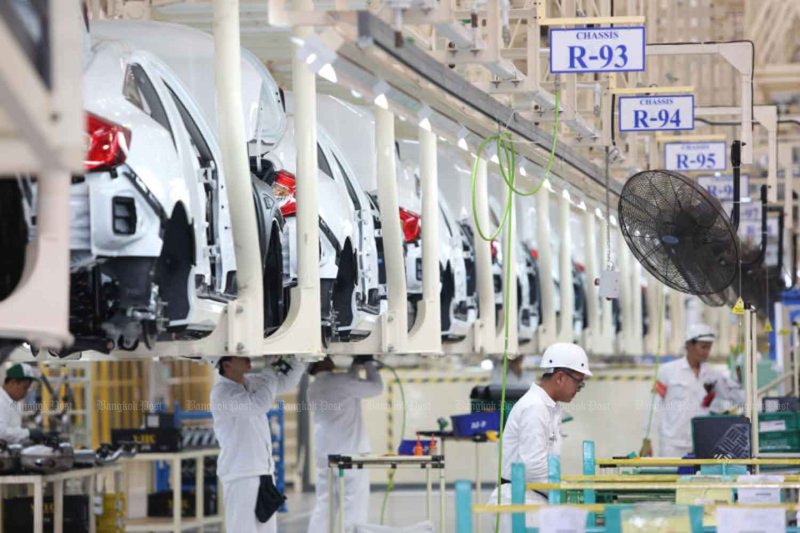
Thailand's automotive industry has faced a downturn in the first five months of 2026, with car production falling by 1.13% year-on-year to 587,759 units, according to the Federation of Thai Industries (FTI).
The decline has been largely attributed to the US–Israeli war with Iran, which has disrupted global trade routes and directly affected Thailand's vehicle exports.
In May alone, production dropped by 17.9% year-on-year, totalling 114,214 units.
The FTI said the closure of the Strait of Hormuz -- a critical shipping lane -- has severely hindered Thailand's car exports to the Middle East, its third-largest market after Asia and Australia.
Demand for pickup trucks in the region remains strong, but logistical barriers have caused a steep decline in shipments.
"This marks the first time export-oriented car production has fallen below domestic output," said Surapong Paisitpatanapong, advisor and spokesman for the FTI's Automotive Industry Club.
Car production for export fell by 36.2% year-on-year in May, with passenger car output down 22.6% and pickup truck production plunging 38.7%.
Exports to the Middle East fell sharply, dropping 66.1% year-on-year in May to 59,434 units, according to the club.
Oceania, including Australia, also saw a decline of 37.1%, partly due to the growing presence of Chinese battery electric vehicle (BEV) brands and Australia's strict carbon policies aimed at achieving climate neutrality by 2040.
Overall, Thailand's car exports from January to May fell 8.53% year-on-year to 333,618 units.
While exports have declined, domestic sales have shown resilience.
Production for the local market rose by 12.7% in May, and overall domestic sales between January and May climbed 14.1% year-on-year to 288,242 units.
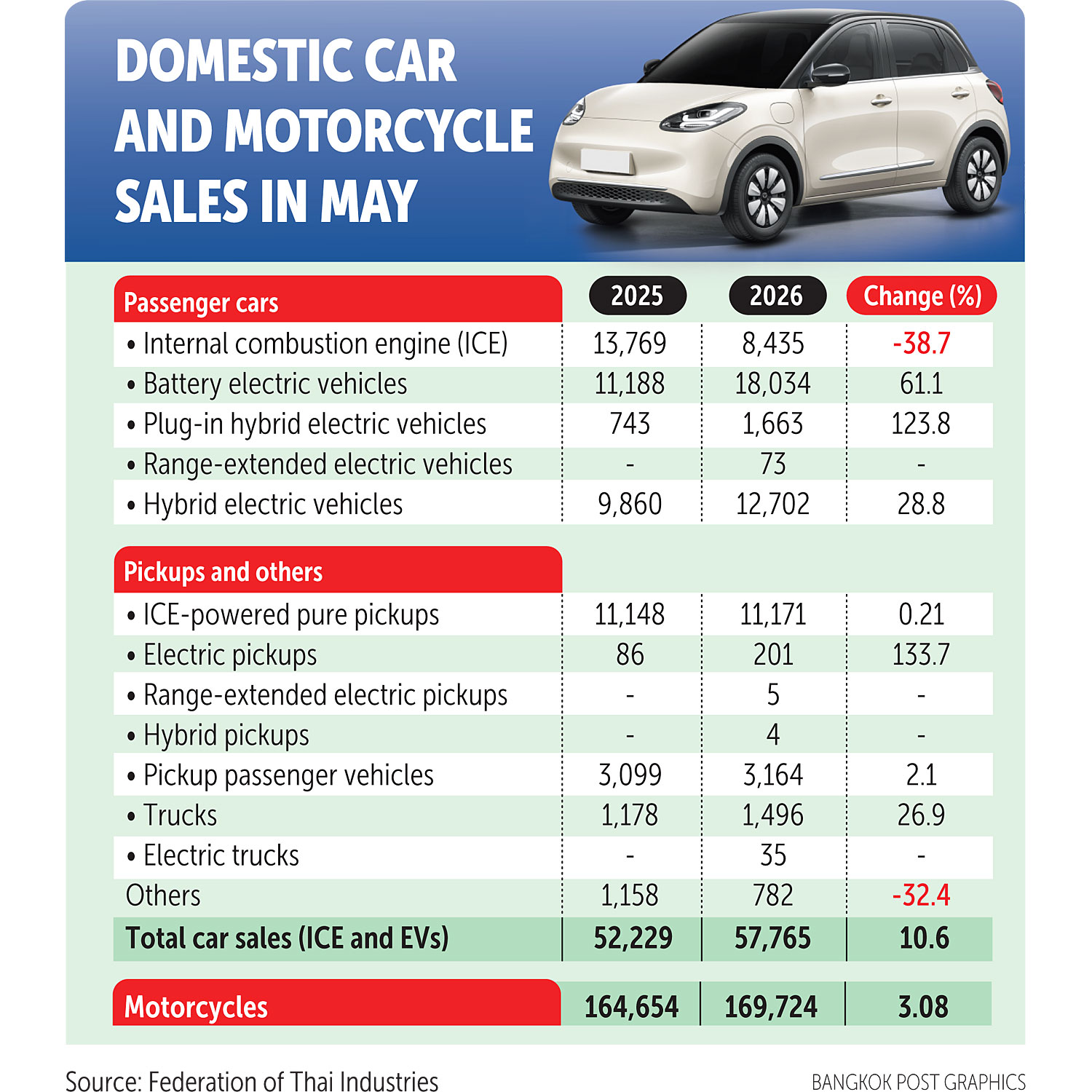
In May alone, sales increased by 10.6% to 57,765 units, driven by strong demand for BEVs and sport utility vehicles. Rising global crude oil prices have further boosted interest in energy-efficient models.
Despite these challenges, Mr Surapong expressed cautious optimism.
He highlighted government stimulus measures, noting that the government has also revised its GDP growth forecast for 2026 to 2.3%.
However, he warned that high household debt and the global slowdown triggered by the Middle East conflict remain pressing concerns for the automotive sector.