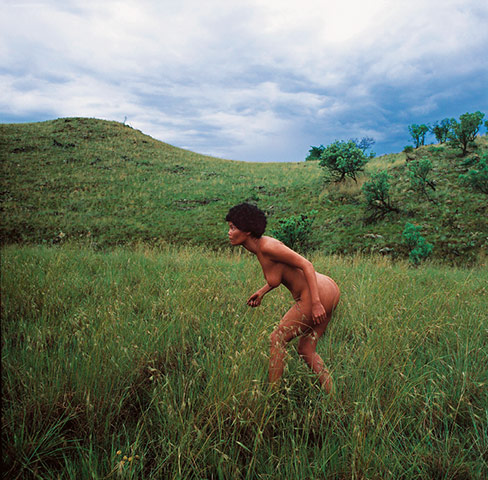
Ciao Bella, Ms Cast, Venus Baartman, 2001
Tracey Rose, a mixed-race South African woman, plays with notions of personal and national identity in her work. Here, she adopts the role of Saartjie Baartman, the famous Hottentot Venus, who was exhibited – and ridiculed – in Paris and London as a scientific curiosity in the early 19th century. Using herself as her main subject, her work comments on colonialism and racism in western art. Photograph: Courtesy the artist and The Project, New York
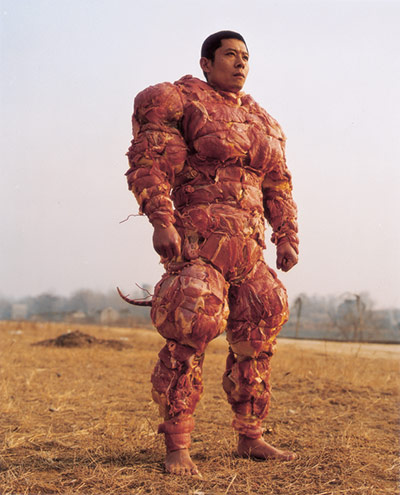
Homeland, 2001
Still photographs from a performance entitled Homeland, these images are by turns disturbing in their physical intensity and politically confrontational. Zhang, a Chinese performance artist, covers his body in pieces of raw meat until he resembles a flayed superhero or mythical beast, often burrowing into the arid ground. The original performance took place in his native Shandong province, where farmers have abandoned the land to go to the cities in search of work. The self-portrait, then, is a kind of collective portrait, but work like this may test the viewer’s patience for self-indulgence as much as it tests the state’s tolerance for political art Photograph: ©Zhang Huan
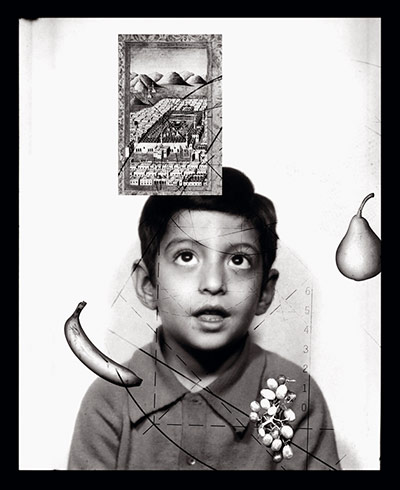
Memory Of Memories 1, 2001
Memory and exile are the themes of Anas Al-Shaikh’s self-portraits. His childhood in Saudi Arabia is a constant motif, remembered in family portraits that are then overlaid with other symbols, both real and imagined. In one image, a photo of destroyed Iraqi military equipment is placed over a snapshot of Al-Shaikh as a boy with his friends. In another, fruits float around his face as he gazes at a mythical cityscape: homeland as dreamland Photograph: Courtesy the artist
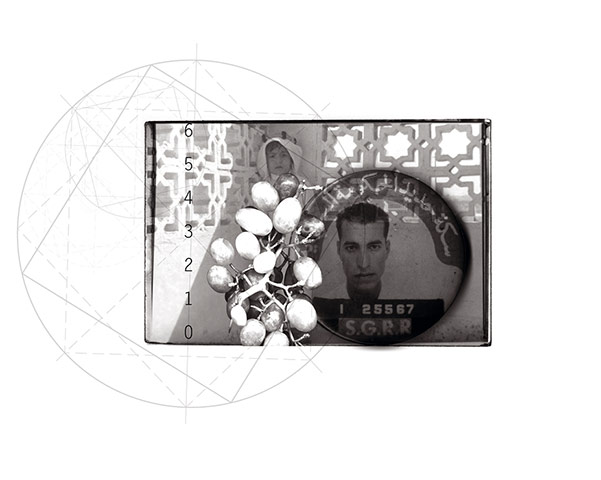
Memory Of Memories 3, 2001
Photograph: Courtesy the artist
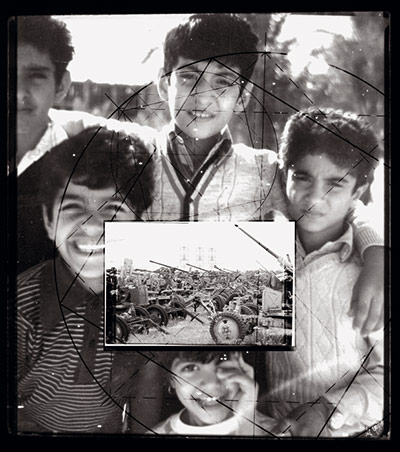
Memory Of Memories 6, 2001
Photograph: Courtesy the artist
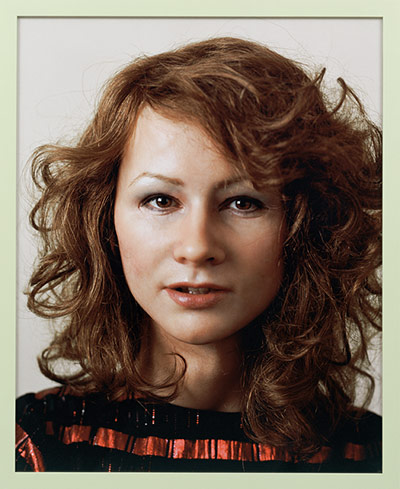
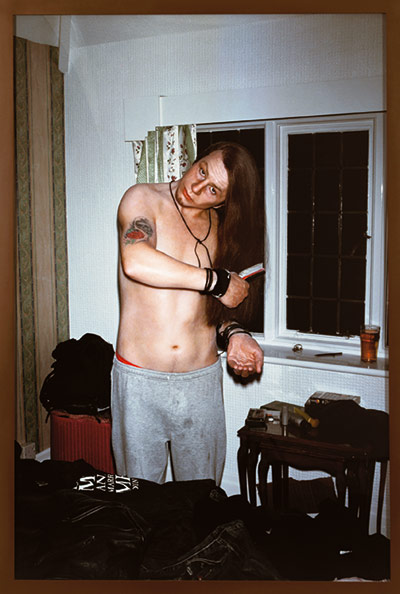
Self-portrait As My Sister, Jane Wearing, 2003
British artist Gillian Wearing used photographs of her family to make masks of their faces, which she then wore for each self-portrait. Only her own eyes remain uncovered in each instance. Again, identity is at the root of this work, but the photographs seem to say as much about the changing nature of photographic portraiture – the settings, the poses, the shift from the formal to the snapshot – as they do about Wearing’s relationship with her family. Again, the self-portrait is turned into a process that disguises rather than reveals Photograph: Courtesy Maureen Paley, London
Self-portrait As My Brother Richard Wearing, 2003 Photograph: Courtesy Maureen Paley, London
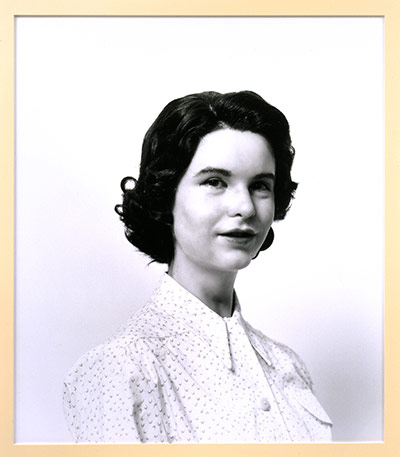
Self-portrait As My Mother Jean Gregory, 2003 Photograph: Courtesy Maureen Paley, London
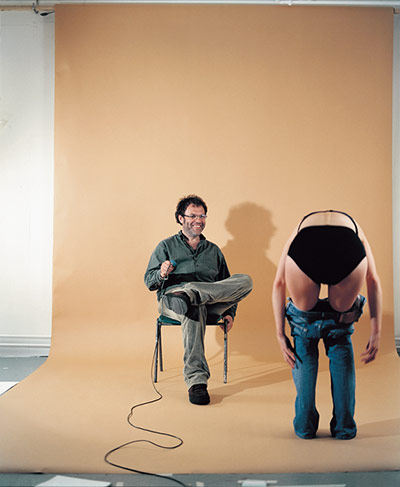
Strip, No. 3, Critic, 1999
The dread term “gender relations” underlies this series of self-portraits by British artist Jemima Stehli. She invited leading members of the art world to take a shot of her as she performed a striptease. They could press the shutter at any moment to halt the spectacle. She was – metaphorically – in their hands. Some look uncomfortable, some relaxed, some seem to be enjoying the thrill of the exchange. Only the critic Matthew Collings (No. 3) grasps the absurdity of the situation – laughing as she removes her jeans Photograph: Courtesy the artist
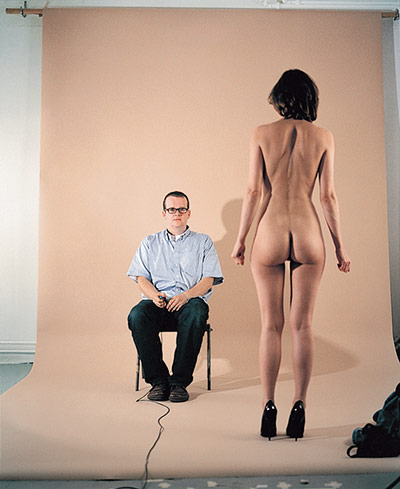
Strip, No. 4, Curator, 1999 Photograph: Courtesy the artist
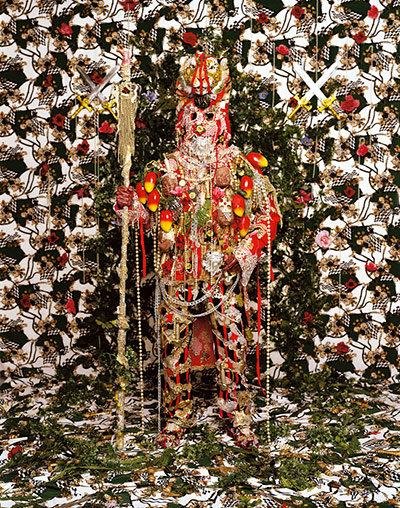
Tyger, Tyger, 2007
British-Guyanese artist Hew Locke is best known for his complex sculptures and installations made from the detritus of mass production. This life-size photograph, Tyger, Tyger, is loaded with symbols and references, from Blake’s poem of the same name to the uniforms of British soldiers in the Napoleonic wars to a carved piece of art in the Victoria & Albert collection, entitled Tipu’s Tiger, that depicts a British officer being eaten by an Indian tiger. Taken for a series entitled How Do You Want Me?, the self-portrait is brimming with information, even as it completely conceals Locke’s face and body Photograph: Courtesy the artist and Hales Gallery, London