The hills are alive in Austria this summer – and anyone who has seen the The Sound of Music, which celebrates its 50th anniversary this year with a host of special events, will know just how achingly beautiful those snow-capped peaks soaring above the green valleys and blue lakes can be. But though the land of Mozart, Beethoven and Strauss is indeed alive with the sound of music, it is also alive with hikers and cyclists who discover in Austria the best of both worlds: wide-open spaces you feel like you are losing yourself in, but always guided by a peerless network of trails and paths.
For easy riders
There are those dedicated cyclists who love nothing more than grinding up a steep hill in the lowest gear, pushing their aching muscles to the limit of human endurance. Good luck to them. Most of us would rather load our mountain bikes on to the glacier cable car up the Kitzsteinhorn, disembark at the Alpincenter at 2,450m high, with its spectacular views of the surrounding peaks, and then free-wheel all the way down on one of three new trails from beginner to expert. Also in the Zell am See-Kaprun resort, you can cycle round beautiful Lake Zell – just dive in if you get too warm.
Cycling is so easy in Austria, and the Danube Cycle Path is perhaps Europe’s most famous. Go with the flow by starting in Upper Austria, and it’s all downhill from there to Vienna – literally rather than metaphorically, as the valleys, baroque monasteries and picturesque towns only seem to get more beautiful along the way.
Another great route is along the River Drau, from Eastern Tirol to Carinthia, which is known as the “Austrian Riviera” for its gorgeous beaches and secluded valleys framed by dramatic peaks.
Find more information on cycling in Austria
Enter a competition to win a three-night break for two in Austria
For trailblazers
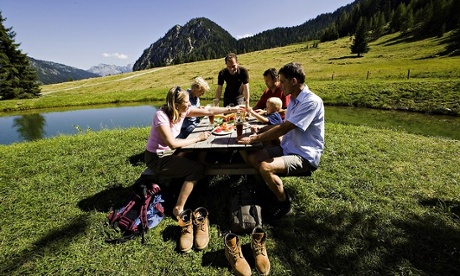
The Austrian Alps offer thousands of miles of well-maintained hiking trails for all levels of ability. Whether you want to saunter through gentle pastures amid rolling hills to a crystal-clear bathing lake, or scale rugged peaks past astonishing sights such as the 380-metre-high Krimmler Falls or the Eisriesenwelt Werfen ice caves, the world’s largest, you’ll find the signage clear and uniform across all regions. There are red-and-white marks on trees or rocks, and signposts where paths cross, so that even beginners can feel confident on self-guided walks.
Bring the kids, too. You’ll find plenty of paths with interactive stations, educational trails, and even routes suitable for a stroller.
Combine a morning hike with an afternoon at Millstätter See, Carinthia’s second largest lake. Bordered by tree-lined hills on its southern shores, the wide, flat beaches along the lake are ideal for families. Kids will enjoy tubing in the warm summer waters, alongside many other water sports like waterskiing, sailing, windsurfing, scuba diving and parasailing.
And if you fancy a glorious mountaintop view without the climb, Austria’s other life as a winter ski paradise comes in handy: cable cars and chairlifts still operate in summer to speed you in comfort up to scenic summit platforms. All of the gain, with none of the pain.
Find out more about discovering Austria on foot
For culture vultures
Music hums in the heart of every Austrian. You’ll find it everywhere, from concert halls to tiny family restaurants, but nowhere more so than in the region of Vorarlberg. Lake Constance has inspired generations of musicians, poets, artists and dreamers, and it now provides a spectacular backdrop for the Bregenz Festival, held every July and August.
As the sun sets across the water, you can marvel at the Brobdingnagian sets built on the world’s largest floating stage. Previous years have included a vast statue modelled on a painting of the murdered French revolutionary leader Marat – a gigantic blue eye to rival Sauron’s – and a vast book that dwarfed the performers on the stage of its pages, all overlooked by a grim skeleton. What extraordinary fantasy will this year’s production of Turandot inspire? “Nessun Dorma” indeed – music lovers are sleepless with anticipation.
Modern culture is also well alive and well in Vorarlberg. Manu Delago is a young percussionist from Tirol who now lives in London, from where he embraces a variety of musical styles and plays with Björk. The Vorarlberg Museum has recently undergone a spectacular renovation that combines old and new, and the Kunsthaus Bregenz is home to a world-beating selection of contemporary art.
The food culture in Vorarlberg is superb, too, combining traditional techniques with modern inspiration. Take the Cheese Trail leading to alpine dairies, farms, artisans and cheese merchants, and be sure not to miss the Käsekeller in Lingenau, where you’ll see robots shifting cheeses the size of truck wheels – the perfect blend of old and new.