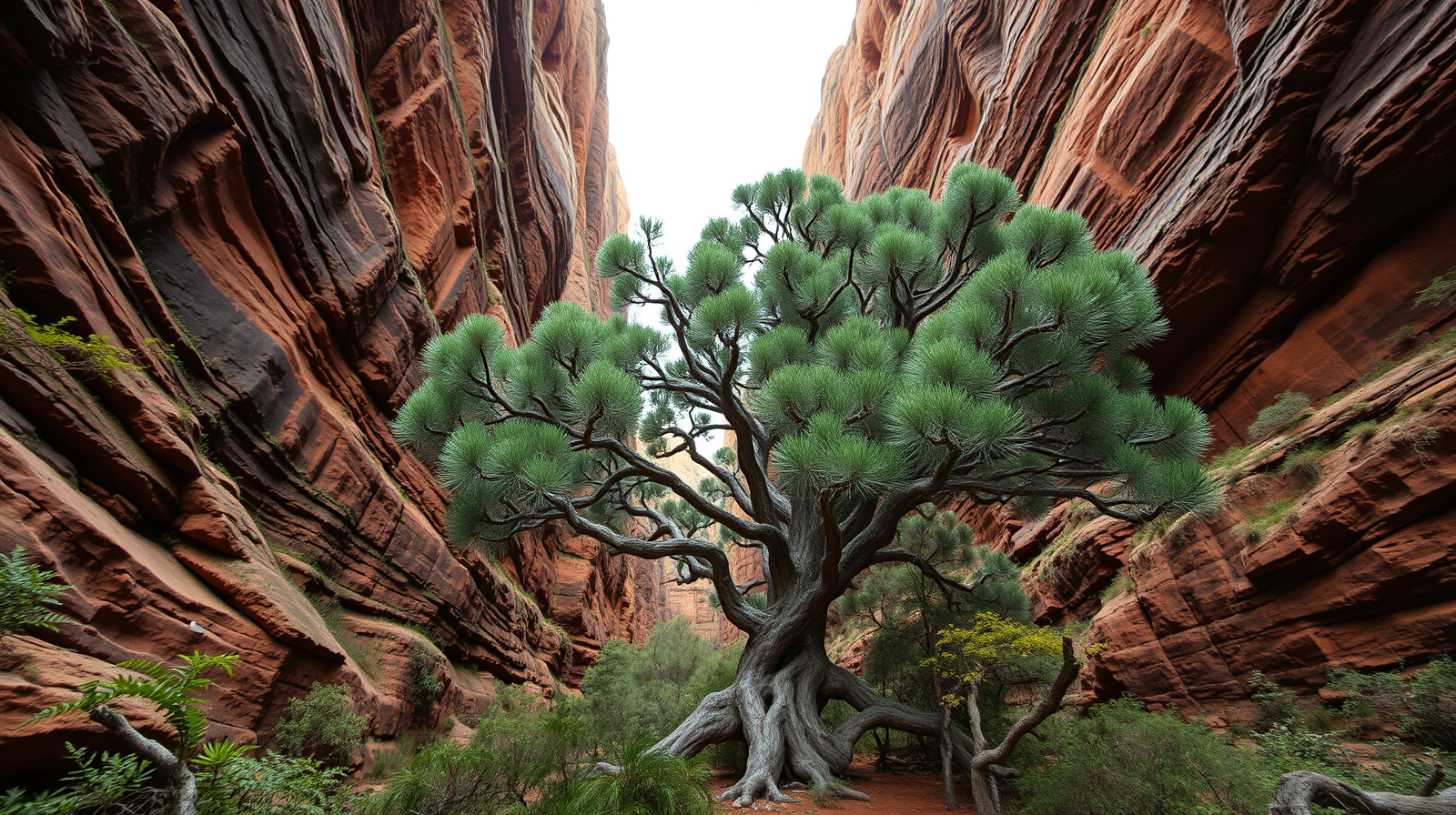
A tree species known only from fossils dating back roughly 90 million years has turned out to be very much alive. In 1994, a New South Wales park ranger rappelled into a narrow sandstone canyon in the Wollemi National Park and stumbled upon a small grove of strange-looking conifers. Botanists soon confirmed something extraordinary: the trees belonged to a species long believed extinct, last appearing in the fossil record around 2 million years ago. Named the Wollemi pine, this living fossil now survives in just one wild canyon, with fewer than a hundred mature trees left on the entire planet, and its precise location remains one of Australia's most carefully guarded conservation secrets.
Get breaking news anytime, anywhere. Download the TOI app now!
Dinosaur tree discovery in a remote Australian canyon
The Wollemi pine, scientifically called Wollemia nobilis, belongs to the Araucariaceae family, a group of conifers that has existed for roughly 200 million years. Fossil evidence specifically tied to this species dates back about 91 million years, meaning its ancestors were already growing on Earth while dinosaurs walked through ancient forests. According to NSW National Parks , the species was thought to have disappeared roughly 2 million years ago, until the chance 1994 discovery of a small living population in a remote rainforest canyon of the Greater Blue Mountains changed everything scientists believed about its fate.
How the Wollemi pine survived for 90 million years
The canyon where the trees grow is cool, narrow and shielded by steep sandstone walls, creating a stable microclimate that has barely changed since the last ice age. In these protected conditions, Wollemi pines can grow up to 40 metres tall, with distinctive bubbly reddish bark and fern like foliage that closely resembles ancient leaf imprints found in rock. Mature trees commonly produce multiple trunks from a single root system through a survival strategy called coppicing, with some individual trees capable of producing up to 40 trunks. While a single trunk may live for up to 450 years, some root systems are believed to be far older, possibly stretching back thousands of years.
Why the location of the dinosaur tree canyon stays secret
Unlike most botanical discoveries, the exact coordinates of the wild Wollemi pine grove have deliberately never been made public. Officials say this secrecy exists purely to protect an extremely fragile population rather than to add mystery to the story. Even small disturbances, such as mud on a hiking boot or tyres, can introduce Phytophthora cinnamomi, a destructive water mould already widespread across Australian bushland that poses one of the biggest threats to the species' survival. Trampled seedlings, damaged roots and introduced weeds could be equally devastating to a population this small, which is why visits to the site remain tightly restricted to authorised researchers only.
Genetic research reveals the dinosaur tree's hidden vulnerability
Genome sequencing has shown that Wollemi pines carry remarkably little genetic diversity, a finding that points to a severe population bottleneck sometime between 10,000 and 26,000 years ago. With 26 chromosomes and over 12 billion base pairs, far more than the human genome, the species nonetheless lacks the genetic variation needed to adapt quickly to new diseases, prolonged drought or shifting climate conditions. Researchers studying the genome also discovered that genes which would normally help the tree resist disease are suppressed by its own RNA, a tradeoff linked to the development of its unusually wide needles compared to other conifers.
Bushfires threaten the last wild dinosaur trees
The fragility of this single wild population became starkly clear during the 2019 and 2020 Black Summer bushfires, when wildfires burned through more than 10 million hectares across Australia and came dangerously close to wiping out the species entirely. Emergency responders deployed irrigation systems, aerial water bombing and remote area firefighters specifically to protect the canyon, ultimately saving the last wild trees, though the fires still caused significant losses among seedlings and damaged several mature individuals.
Conservation efforts protect the dinosaur tree's future
To reduce pressure on the wild population and prevent total extinction in case of a future disaster, conservationists began propagating the Wollemi pine for public sale in 2005. Cuttings have since been distributed to botanic gardens and research collections around the world, including London's Kew Gardens , where young trees are carefully monitored as part of an international effort to safeguard the species outside its original canyon. This approach allows people anywhere to grow their own piece of prehistoric history while the secretive wild grove remains shielded from human contact.
A living reminder of how fragile survival can be
The story of the Wollemi pine illustrates just how easily a species can vanish from scientific records without actually disappearing from the planet, provided it finds a small enough, sheltered enough refuge to hide in. Sitting roughly 150 kilometres from a city of more than five million people, with commercial flights regularly passing overhead, this ancient lineage older than Tyrannosaurus rex has spent the entirety of human history growing quietly in a canyon almost nobody is permitted to find, a fragile survivor whose continued existence now depends entirely on staying hidden. Ninety million years of survival, and the final threat came from a muddy boot. That the tree outlasted dinosaurs, ice ages, and continental drift only to be endangered by a water mould carried on human footwear is the kind of irony that conservation biology keeps producing, and keeps having to take seriously.