Here’s an end-of-year suggestion for Australian television: reflect on its own ratings while streaming tears down its ancient and massive LCD face, with occasional pauses for blubbering ad breaks.
Viewing figures for 2014 suggest many people are now treating their television set as a framed minimalist photograph, in this case a depressing close-up of some soil at night. What were once guaranteed hits are now proving about as popular as a wasp at an orgy.
Reassuringly, however, reality TV was 2014’s biggest loser (not so fun when the finger’s pointing at you, hey). And there’d be no need to construct that escape pod you’re working on if it weren’t for the fact that most channels have more of the same planned for 2015.
Big Brother, The Big Adventure and Beauty and the Geek all rated poorly, suggesting reality can no longer rely on being a fad to win viewers. Apparently we do actually care about content, and for some reason, tanned strangers locked in a house arguing about groceries for three months just doesn’t cut it.
My suggestion for Big Brother 2015 would be to explore the horror movie potential the show has never capitalised on. There are so many cameras everywhere – just pop a vengeful spirit in that sealed Gold Coast castle and you’ve got yourself all the footage you need for a live-to-air Paranormal Activity.
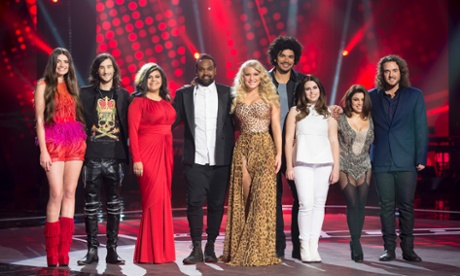
Australian X Factor also lost about 25% of its viewers, while The Voice finale was down 17%. Just 1.66 million metropolitan viewers tuned in to see Blue Mountains blonde Anja Nissen win the singing contest compared to two million in 2013 — and the year before that, 2.6 million.
None of us should be alarmed by this, of course, any more than if I typed the sentence: “Usage of the new and highly addictive substance methy-crackabis has dropped by 20%”. I hear methy-crackabis is extremely bad for you.
On the flipside, thought-provoking content saw SBS rewarded with a ratings boost. First Contact was a particular talking point. Educational and confronting, its success hints at a viewing public that is tiring of televisual “reality” (whacky personalities trapped in places, doing tasks) and would rather learn something from actual reality.
Not that TV seems to be able to save itself: 2014 saw repeated evenings where not a single channel rated over one million viewers – it’s not just reality TV that’s suffering, but the whole apparatus of scheduled television. Are we surprised?
Streaming services and smart devices mean you can control when you watch your favourite shows and where: on public transport, at the gym, in the middle of a freeway you’ve accidentally stumbled on to because you weren’t looking. This distracted style of ambulating that treats the pavement like some sort of stretched sofa really needs its own name: iWalking, perhaps?
And the zombie-like shuffle of people smashing an entire season of The Walking Dead in the middle of a pedestrian crossing is something we’ll have to get used to. Television when we want it is too hard to resist. Future generations will consider scheduled TV as ridiculous as ovens that only switch on at a specified, national eating time. “Oh no! I missed my toast. I’ll have to wait until 11pm when it next pops up!”
The most compelling viewing will be watching what TV networks do in reaction to 2014’s writing on the wall. As Netflix prepares for its March 2015 Australian launch, Channel Nine has teamed up with Fairfax to release its streaming service Stan, and Seven is also launching Presto.
What am I going to do? Find lots of ways to describe a switched-off television I guess. Bugger. And I already used up that one about soil at night.
More from the year in review:
• Australian music in 2014: the year its pop stars conquered the world
• A year of culture in lists