There are two central challenges to reflecting on the past year in Australian theatre. The first is the terrain-dependent nature of the form itself, which locks its moments to specific dark rooms and appointed hours, ensuring that even the most dedicated reviewer with unlimited frequent flyer points could not possibly grasp every blossom of its flowering.
Whisperings of theatrical greatness in Perth, for example, rarely reach the east coast in time for flights to be booked, while experimental beauty in Brisbane – or, god help us, regions like Albury and Wollongong – scarcely receives due attention before the stern economy of short seasons vanish productions to air.
In Australian theatrical culture, the greatest recommendation of a production is not posters blistered with stars, so much as the question, spoken aloud: “but will it tour?”
Sometimes, of course, the traveling critic is logistically unlucky: this year I was in Melbourne when the superbly received – and by all accounts hilarious – Sisters Grimm show Calpurnia Descending was produced by the Sydney Theatre Company, and in Sydney when it repeated its success at Melbourne’s Malthouse. Brothers Wreck at Sydney’s Belvoir was similarly acclaimed and yet geographically unavailable.
The second challenge actually results from a broader Australian cultural attempt to address the first: a festival circuit that has developed so that our spread cities and isolated continent can enjoy and benefit from international pollination. That circuit has so successfully fertilised the local arts community in terms of influence, exposure, adaptability and even personnel that it becomes difficult to determine beyond a collection of clumsy stereotypes what “Australian” theatre even is.
Take, among some of the best “local” performances of the year, the example of New Zealand’s radical mime-clown, Trygve Wakenshaw. Wakenshaw’s hilarious Squidboy appeared on the Perth fringe, yet his companion show Kraken was in development on Australian soil with an Australian production company as he toured to the Adelaide fringe festival. By the time Squidboy played at the Melbourne International Comedy festival, Kraken was finished, brilliant, completely sold out and undoubtably influencing an entire generation of Australian performers to consider the theatrical possibilities of murdering unicorns and vomiting birds.
Similarly, some of the freshest performances of the year came from the demanding improvisational roles of a troupe of local Perth actors in You Once Said Yes – a work devised by a British company, but made site-specific to the streets of Northbridge in Perth.
Many of my personal highlights of the Australian theatrical year were international acts; Jonathan Holloway’s excellent direction of the Perth festival delivered American Denis O’Hare’s faultless one-man-and-double-bassist rendition of Homer’s An Iliad in the gardens of University of West Australia as well as the great theatre-maker Robert Wilson’s controversial clowning take on Samuel Beckett’s Krapp’s Last Tape.
At the Adelaide festival, Dutch theatre-maker Ivo Van Hove’s Shakespeare marathon, Roman Tragedies, earned kill-for-a-ticket status for its 24-news-cycle reporting of tragic collapse, despite (or because of) its six-hour duration. At Sydney festival, British performer Rob Drummond’s Bullet Catch – a participatory magic show about a trick with a notorious fatality rate – was quiet, disquieting and profoundly moving.
But the festivals also delivered some of the best locally-themed theatre amid the internationalisation on offer. At the Melbourne festival, Scott Rankin’s epic take on colonialism and Aboriginal genocide in Hipbone Sticking Out had moments of explosive, genuine originality – but Margaret Harvey’s indigenous urban horror story, My Lover’s Bones, delivered chills with precision and not a single cliché.
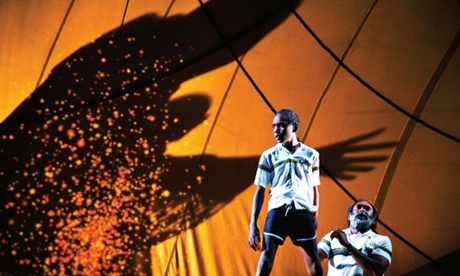
Off the festival circuit, the Australian canon got a most honourable outing in the spectacle of Matt Lutton’s production of Night on Bald Mountain at Melbourne’s Malthouse, with Melita Jurisic and Peter Carroll distinguishing themselves with two of the finest stage performances of the year.
For sheer star power in performance, there is little competition for cabaret diva Yana Alana, aka Sarah Ward, whose hilarious Between the Cracks won its creator a Helpmann even as she remains loyal to the fringe and cabaret circuit that continues to nurture Australia’s most creative and innovative practice. Catching Alana/Ward in the Moira Finucane’s Glory Box at the Adelaide fringe was an unexpected treat as delightful as Finucane’s infamous and unmissable drag striptrease – and her milk act (don’t ask, just see the show).
It is, of course, the delight of Australian theatre that the shows that do have the shortest life in the strangest places offer some of the best practice and transformative experiences. Of perhaps a hundred shows across the country watched by this critic this year, a standout would have to be David Williams’s Quiet Faith, staged at the old Vitalstatistix hall in Port Adelaide.
Still in development, it’s a verbatim work for two voices with impeccable sound and set design, and considers the relationship of Christian faith to social justice. Miles from an urban centre, on for a mere handful of nights, it was, like any visit to the theatre in this country, entirely worth taking the chance on the trip.