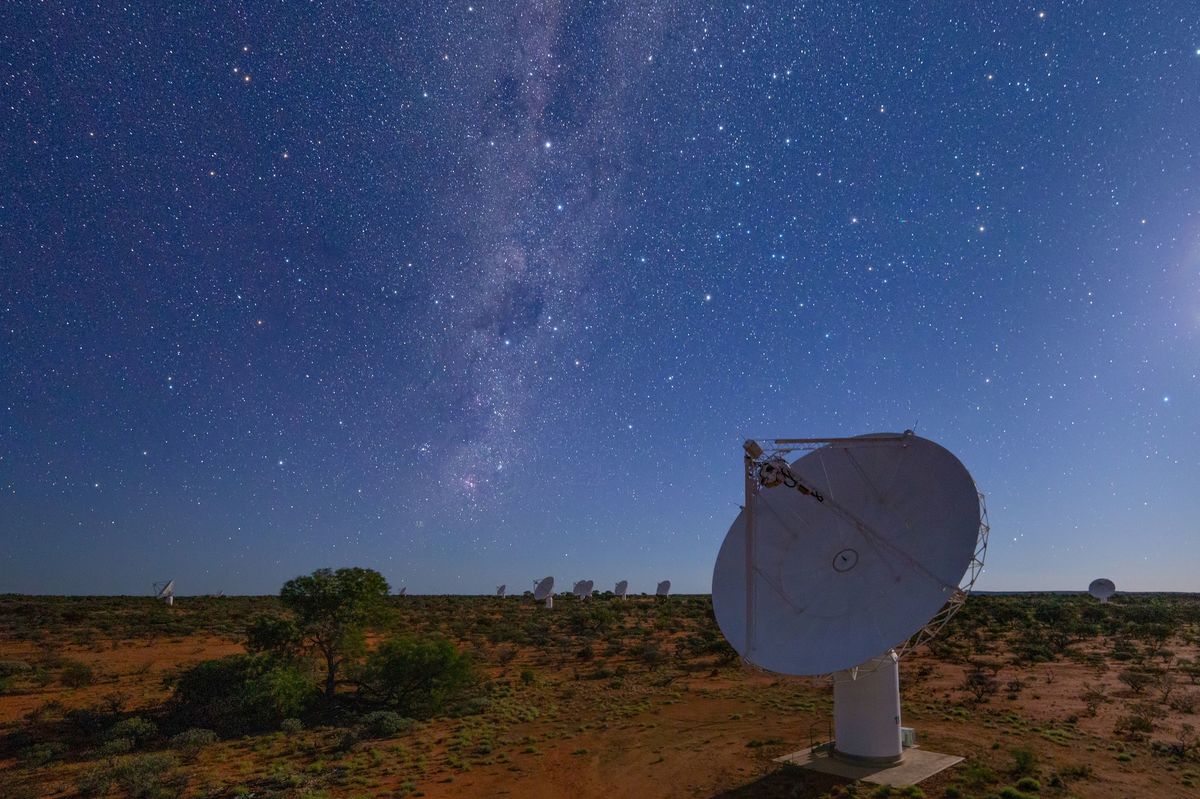
A powerful new telescope in outback Australia has mapped vast areas of the universe in record-breaking time, revealing a million new galaxies and opening the way to new discoveries, the country's national science agency said on Tuesday.
The A$188 million ($138 million) radio telescope, dubbed the Australian Square Kilometre Array Pathfinder (ASKAP), was able to map about three million galaxies in just 300 hours. Comparable surveys of the sky have taken as long as 10 years.
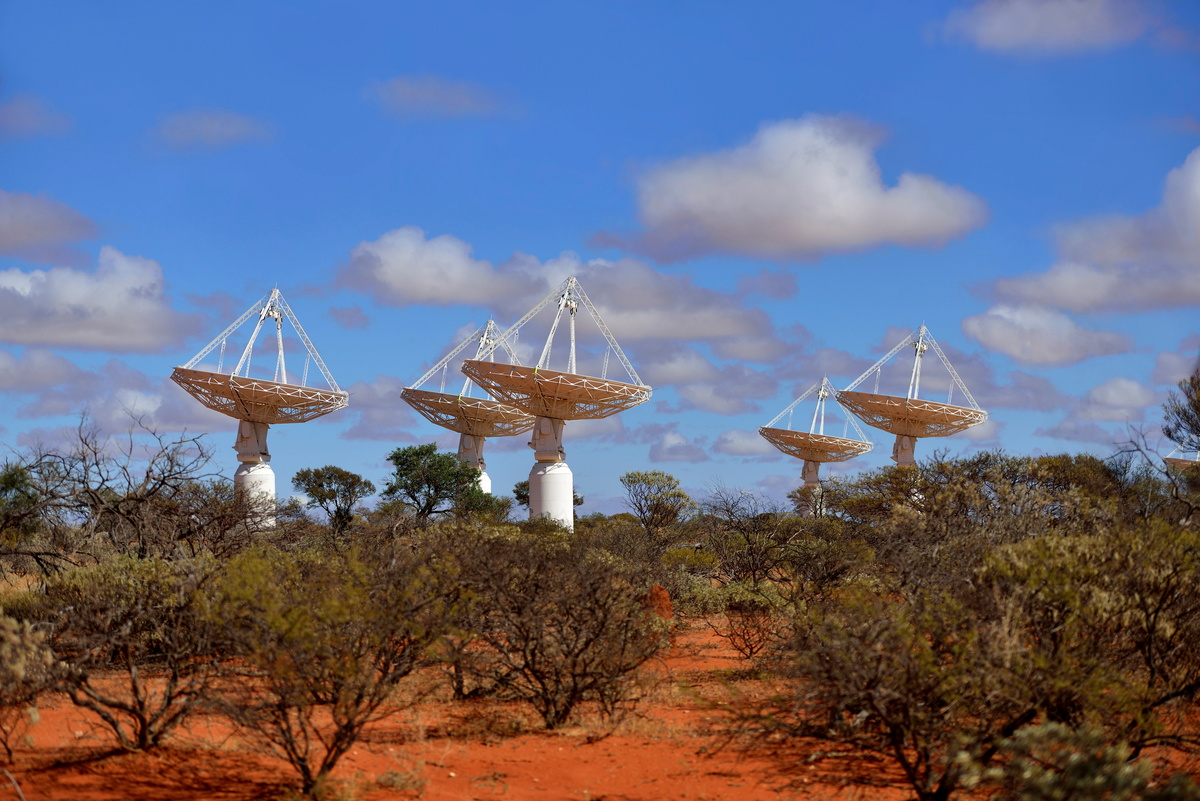
"It's really a game changer," said astronomer David McConnell, who led the Commonwealth Scientific and Industrial Research Organisation (CSIRO) study of the southern sky at the Murchison Radioastronomy Observatory in Western Australia.
What makes this telescope unique is its wide field of view, using receivers designed by CSIRO, which allow it to take panoramic pictures of the sky in sharper detail than before.
The telescope only needed to combine 903 images to map the sky, compared with other all-sky radio surveys that require tens of thousands of images.
"It is more sensitive than previous surveys that have covered the whole sky like this, so we do see more objects than have been seen in the past," McConnell told Reuters.
Having a telescope that can survey the sky in a few weeks or months means the process can be repeated again and again in a relatively short space of time, allowing astronomers to systematically spot and track changes.
"Even with this first pass we've got right now, compared with previous images, we've already found some unusual objects," McConnell said, including some unusual stars that undergo violent outbursts.
He said data gathered in this survey would allow astronomers to find out more about star formation and how galaxies and black holes evolve through statistical analyses.
The initial results were published on Tuesday in the Publications of the Astronomical Society of Australia.
($1 = 1.3580 Australian dollars)
(Reporting by Sonali Paul; Editing by Lincoln Feast.)