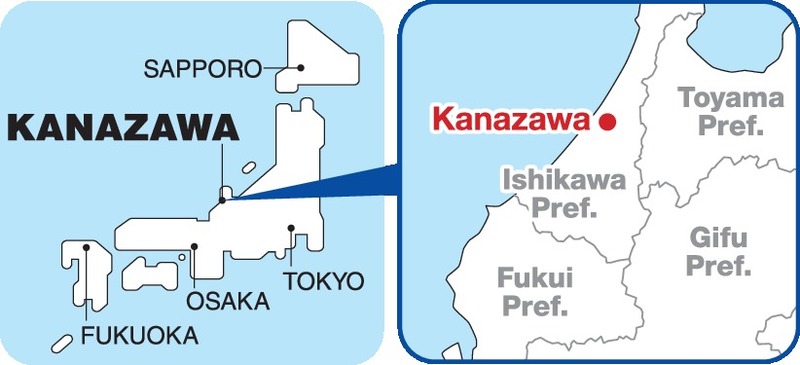
KANAZAWA -- An Australian woman in Nonoichi, Ishikawa Prefecture, is working hard to learn the skills needed to make "hinoki-zaiku" -- traditional crafts made of Japanese cypress -- that have been passed down in areas around the foot of Mt. Haku for about 400 years.
Susan Maree, 26, who lives in the Inari area of the city, has taken on the challenge even though only three certified craftsmen remain to teach hinoki-zaiku skills due to the graying of the local population.
"I want to work to preserve the tradition," said Maree.
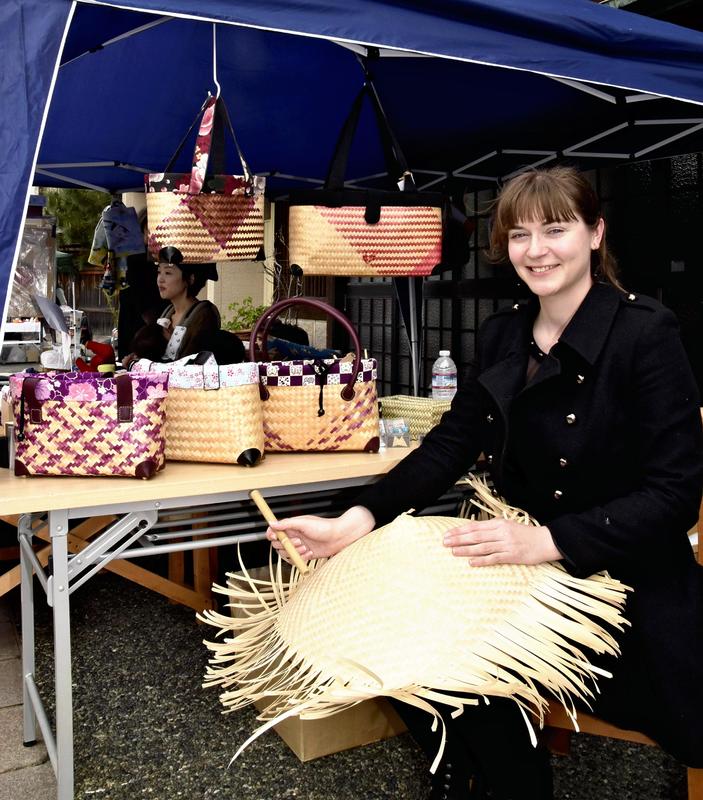
On April 21, Maree demonstrated how to make hinoki-zaiku products in one corner of a market held in a shopping street in the Yasuecho area of Kanazawa.
Using the fingers of both hands, she quickly wove together thin, belt-like strips of cypress wood to make a type of hat called "hinokigasa." Passing shoppers stopped to peer curiously at Maree, drawn by the skillful movements of her hands.
Maree came to Japan in 2015 as an exchange student at the University of Kitakyushu. She felt comfortable around Japanese people, drawn by their generally reserved nature, which she says resembles her own shy personality. She decided to make Japan her home.
In 2016, she got a job at a machinery manufacturer in Hakusan in the prefecture through a referral from her home-stay family in Kanazawa.
Her life took a fateful turn in June 2017 when she visited an exhibition in Kanazawa and met Hisayo Katsuki, now 69, a traditional craftswoman certified by the prefectural government.
Maree was transfixed by the skill with which Katsuki nimbly maneuvered her fingertips to create a series of stitches with the cypress wood strips.
"[Her movements] were so delicate and beautiful. I thought, I must have finally found the real 'Japan,'" said Maree.
She soon apprenticed to Katsuki and began learning the basics of the craft, such as how to move her fingers. Her skills improved rapidly, partly because she had long had a passion for fancywork. Maree also learned about the declining fortunes of hinoki-zaiku crafts as fewer people enter the trade.
Hinoki-zaiku crafts are said to date back to early in the Edo period (1603-1867), when a Buddhist priest visited the Fukaze area of Oguchi, a now-defunct village at the foot of Mt. Haku, and taught the villagers there how to make hinokigasa hats.
A trade union for hinokigasa hat makers was established early in the Showa era (1926-1989), after which production of the crafts increased. Even after the traditional production areas were submerged in 1975 due to the construction of the Tedorigawa Dam, craftspeople moved to the Tsurugi area of Hakusan and continued to make the products.
However, an aging local population, shrinking demand for the goods and other factors have caused the number of hinoki-zaiku craftspeople to gradually decline. Today, only three certified hinoki-zaiku craftspeople remain.
Maree had studied about the Aborigines people of Australia and the loss of their culture. Realizing that the hinoki-zaiku tradition would be lost unless someone stepped in to preserve it, she finally decided that she herself would carry the torch.
Hinoki-zaiku products are usually noted for the unadorned beauty of the wood grain. However, Maree has added new features to the traditional ones. She uses material dyed in colors such as blue and red, and has expanded beyond hats to make products like bags and flower baskets.
Maree currently sells her goods at events, and she also posts photos of her new products on Instagram in an effort to attract young people.
"I'll work to preserve the tradition, and I hope that young people will come to think of hinoki-zaiku as fashion items," said Maree. She continues to work tirelessly to preserve the culture of hinoki-zaiku.
Read more from The Japan News at https://japannews.yomiuri.co.jp/