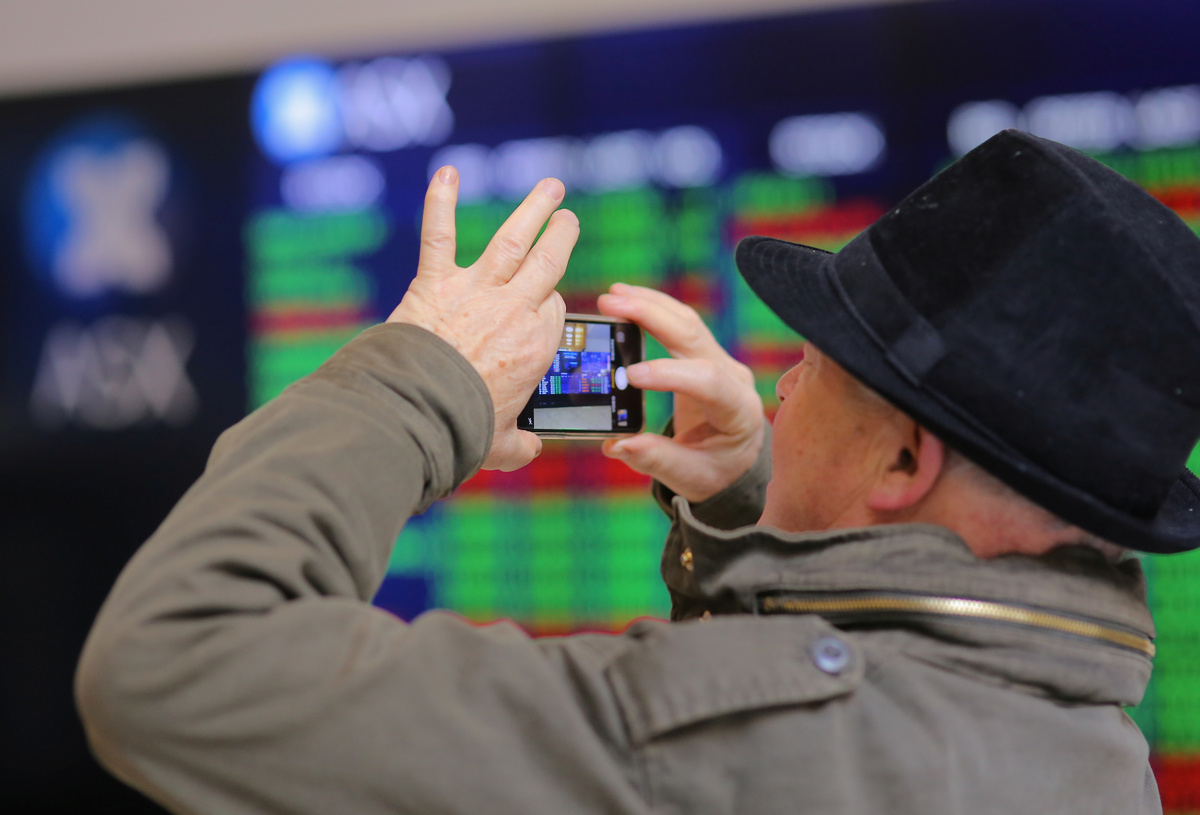
Australian shares fell more than 3.5% on Wednesday and slipped back into bear territory as doubts set in whether expected stimulus measures would be adequate enough to soften the economic blows from the coronavirus outbreak.
The S&P/ASX 200 index <.AXJO> fell 213.7 points, or 3.6%, to 5,725.90, its lowest close since January 2019, after a 3.1% bounce in the previous session.
With Wednesday's drop, the index has declined 20.4% since scaling a record high on Feb. 20, sliding into bear market territory which signals a drawn-out period of negative investor sentiment.
To cushion the economic impact of the epidemic, Australia announced a A$2.4 billion ($1.56 billion) health package earlier in the day, which proposes setting up fever clinics and offering cost-free facilities for medical consultations.
However, worries over severely impacted supply chains and negative consumer sentiment persisted as tourism shrinks and people increasingly stay inside.
"The proposed stimulus is regarded as fairly good, but at this stage it is not a real positive for the market and it is more about reducing (virus) concerns among the people," said Doug Symes, senior client adviser at Novus Capital.
Heavyweight financials <.AXFJ> fell 5.3%, with all the "Big Four" banks in the red.
Top lender Commonwealth Bank of Australia <CBA.AX> gave up all of its gains from the previous session to end 6.6% lower. Second-largest bank Westpac Banking Corp <WBC.AX> shed 5.3%, while National Australia Bank <NAB.AX> was down 6.3%.
In a bid to restore confidence, the central bank deputy governor said Australian banks were well capitalised to withstand the disruption caused to financial markets from the virus outbreak.
The mining sub-index <.AXMM>, which holds significant weightage on the benchmark, was the second-biggest decliner. Global miners BHP Group <BHP.AX> and Rio Tinto <RIO.AX> lost 2.5% and 1.1%, respectively.
The energy sector <.AXEJ> declined 3.4%, with heavyweights Woodside Petroleum <WPL.AX> and Santos <STO.AX> shedding 4.6% and 5.3%, respectively.
Gold stocks <.AXGD> also fell despite an uptick in bullion prices, with most miners of the safe-haven commodity closing sharply lower.
Newcrest Mining <NCM.AX> dropped 8.6% after the country's largest listed gold miner cut full-year gold production forecast.
In New Zealand, the benchmark S&P/NZX 50 index <.NZ50> erased early gains to finish 0.2% lower at 10,873.60, its lowest close since Nov. 18, 2019.
NZ-listed shares of Australian lender Westpac Banking Corp <WBC.NZ> slipped 3.3%, while Fisher & Paykel Healthcare Corp <FPH.NZ> ended 0.7% lower.
(Reporting by Sameer Manekar in Bengaluru; additional reporting by A K Pranav; Editing by Subhranshu Sahu)