The women's game is either more competitive than it's ever been or utter rubbish. If there is a middle ground in the debate it is not immediately obvious on the evidence of this week.
When Maria Sharapova beat Jamie Hampton in 64 minutes on the morning of the fourth day of the Australian Open, she recorded the 20th 6-0 bagel and 32nd 6-1 set score in the women's singles. Of the 82 completed matches to that point, 61 results came in straight sets.
On day one, there were four bagels and 11 scores of 6-1; when the first round was completed on day two, there were a further 11 and 14; in the more competitive second round, on day three, there were still three bagels and seven scores of 6-1.
The players insist that the depth has never been greater, that players all the way down the rankings in the top 100 are capable of an upset. And they do happen.
But the very best in the women's game are still a long way better than the also-rans. Hampton, to be fair to her, is ranked 144th in the world, Sharapova fourth – and obviously it was a no-contest.
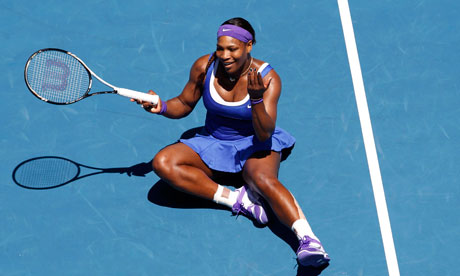
As was the 12th seed Serena Williams's 6-0, 6-4 stroll on Thursday morning – against the 49th-ranked Barbora Zahlavova Strycova. Williams, of course, has that seeding through inactivity and is still, in many people's estimation, the best player in the world. The official No1, Caroline Wozniacki, is yet to win a slam title, an albatross she is determine to strangle in Melbourne.
Williams has long been scornful of the rankings and has spent a lot of time away from the Tour injured, recovering or just out shopping – and it has done little to damage her standing, or her tennis for that matter. Wherever she is seeded or ranked, it doesn't change the argument: the game is top heavy and predictable at least until towards the end of the first week in big tournaments.
On the men's side, there have been a few one-sided contests but there were also more intense struggles on the first three days, 15 matches going the full five sets over the first three days, and 20 lasting into the fourth set.
Has there been a match in the women's singles to match the intensity and drama of Bernard Tomic's five-setter over more than four hours against the experienced 22nd seed Fernando Verdasco? Teenager Tomic, ranked 38th in the world, then backed it up with a win over the big-serving American Sam Querrey, over four absorbing sets.
And even his 21-year-old compatriot Greg Jones, ranked 198, pushed the 13th seed Alexandr Dolgopolov to five sets (albeit three of them were won 6-1). Staying with the Aussies, there was the gutsy losing performance in four sets of the Sydney teenager James Duckworth (250th) against Janko Tipsarevic (9). In case we forget, Tipsarevic was one of only six players to beat Novak Djokovic last year.
John McEnroe would point to these numbers as evidence of the disparity between men's and women's tennis, despite a narrowing in prize money. He may have a point. But nobody could argue that, at the business of big tourmanents, it has the uncertainty that makes for great sport.
Last year four different players won the slam titles. Depth or lottery?
Murray looking good
For a little while on day four, Andy Murray was the fourth sexiest male player in tennis. Until the votes started rolling in properly, the Scot trailed only Andy Roddick, Bernard Tomic and Rafael Nadal in the Herald Sun's riveting survey of fans at Melbourne Park.
Early in the running, Murray was ahead of Roger Federer, Lleyton Hewitt, Marcos Baghdatis, Cedrik-Marcel Stebe, Tommy Haas and Novak Djokovic. However, once voters rushed to acclaim their favourites, the picture changed somewhat.
Towards the end of the day, Murray had inexplicably slipped to ninth. The only approval he was looking for about that time was Ivan Lendl's, as he finished off the challenge of Edouard Roger-Vasselin in three sets on Hisense Arena.
French without the tears
Jo-Wilfried Tsonga dealt Andy Murray a serious first-round blow here in 2008 – since when the Scot has taken sweet revenge on French players in all parts. It was Murray's only loss to Tsonga in six meetings – and he has won 37 of 39 matches against French opposition since, the latest to fall being Edouard Roger-Vasselin, whose father was born in London but game fashioned in Boulogne-Billancourt. ERV was out of his depth in Thursday's second round.
Tsonga, meanwhile, lies in wait again. He should be Murray's last hurdle before the semi-finals, where a replay of the 2011 final is in prospect against Novak Djokovic.
Tsonga, who won handily on Thursday against the Brazilian Ricardo Mello, 7-5, 6-4, 6-4, said Murray got him off to the perfect start here four years ago, when he went on to reach the final against Djokovic. "Maybe it was because of my win against Murray in the first round," he said. "After that, I didn't play a top player before the quarter-finals."
Last year, Tsonga was carrying injuries. This year, he says, "I'm in good shape. I don't have any injuries."