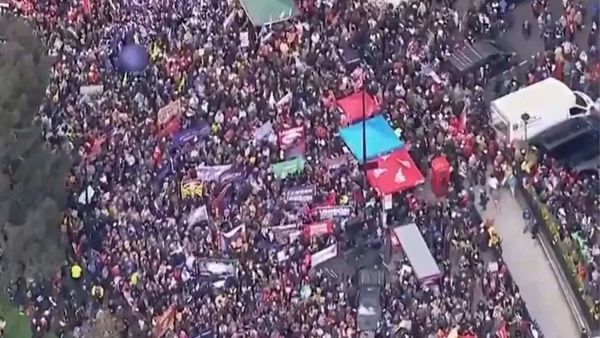
As the sun sets on the first full day of campaigning ..
I will take my leave. Big ups first of all to this week’s dawn shift, Ms Bridie Jabour, for services to wrangling the #ausvotes wall of sound. Big ups to our crack road team of Lenore Taylor, Gabrielle Chan and of course my partner in live blog crime, Mike Bowers. Politics Live salutes you. Final ups to the readers. As per usual, you rock.
Now, let’s wrap Monday.

-
Malcolm Turnbull opened his campaign at first light in Brisbane’s marginal seats, campaigning on the jobs and growth message from last week’s budget.
-
Bill Shorten went north, to Cairns, and his theme was education. Shorten had an announcement as well as a theme. Some of the money reserved for needs based funding for schools (the so called Gonski funding) would fund new scholarships for Indigenous teachers.
-
Opinion polls suggest the contest is tight as the election cycle opens – all the major polls are variants of 50/50 on the two party preferred measure.
-
Asylum boats featured in the margins of day one. Labor’s candidate for the seat of Melbourne wasn’t exactly enthused by Labor’s policies on offshore processing and boat turnbacks. Shorten declared Labor was not for turning on turnbacks. It was a small ‘g’ gaffe that to my mind served the interests of Labor’s local campaign in Melbourne and Labor’s national campaign. Perhaps I’m being too cynical. Perhaps all that just happened spontaneously.
- Speaking of boats the immigration minister remembered he’d forgotten last week to tell us that a boat had been intercepted near Cocos Island. Peter Dutton remembered that today and took the opportunity to remind voters that Labor was absolutely hopeless on border protection. A reporter took the opportunity to ask Dutton why he kept saying the government had stopped the boats when the boats kept on turning up.
- Former Liberal MP Dennis Jensen thought he’d run as an independent but he didn’t think he’d resign from the Liberal party and he thought he might give the Liberal party his preferences. He also thought superannuation was not money stashed under a bed, and branch stackers should be imprisoned.
Just while I remember, you don’t have to wait for the evening summary on the blog. If you’d like a campaign catch-up sent to your inbox every afternoon, you can sign up here. Do it. What have you got to lose?
Have a lovely evening. We’ll be back, live and surround sound, from the moment your alarm clock rings tomorrow.
Still catching up on pictures.

The thoughts of Dennis Jensen, new independent. People should know that superannuation isn’t money put under a mattress. (Hard to imagine how he lost preselection really). Jensen goes on to say he isn’t intending to resign from the Liberal party, they will have to take action against him. He adds the Liberal party machine is a totalitarian operation. Then he says he will likely give the Liberal party preferences.
Dennis Jensen:
You will see that this is a very real campaign that I am in to win.
Dennis Jensen says he will run as an independent: adds branch stackers should be jailed
Just because, really.

Over in WA, Dennis Jensen says he’s making a stand against the faceless men and women of the Liberal party by running as an independent. He wants branch stackers to be jailed. There are a number of other thoughts coming.
Updated
Sorry just a quick plunge into the thread. Lots of good conversation happening down there today, thank you for it.
Welcome to Bega, Julie Bishop. As for the candidate.
Bega man Sam Alcock reckons @JulieBishopMP's all right. Local candidate Peter Hendy not so much @australian #auspol pic.twitter.com/0FuqWjtVLH
— Rachel Baxendale (@rachelbaxendale) May 9, 2016
Good to see everyone out on the trail settling calmly into their routine. This is Fairfax photographer, Alex Ellinghausen.
1. Get on plane.
— ellinghausen (@ellinghausen) May 9, 2016
2. Get on bus.
3. Shoot.
4. Get on bus.
5. Get on plane.
Repeat steps 1-5
Welcome to Election2016 pic.twitter.com/tUJY0qnTOg
Dennis Jensen's office is "not entirely sure" why Sky thinks he'll stand as an independent. But he is holding a press conference at 2.30pm.
— Calla Wahlquist (@callapilla) May 9, 2016
My colleague Calla Wahlquist is hot on the trail of breaking developments out west.
Oh goodness I thought I’d posted on this but I haven’t: Sky News is reporting the former WA Liberal Dennis Jensen will stand as an independent in this campaign. Not exactly surprising. He’s been working up to this act of defiance since the bruising preselection battle he lost in the run up to the campaign. But mildly interesting.
Other goodies to liven up your campaign afternoon. Our regular Behind the Lines podcast asks the big question: how are we all going to survive this eight week campaign? Bridie Jabour, Gabrielle Jackson and Kristina Keneally attempt to fill in the blanks. Listen in.
The essential puzzle of Bill Shorten
This afternoon we’ve launched a piece which I’d describe at the sum of three years and several weeks intensive work. It’s an essay from me on Labor and Bill Shorten.
I wanted to cover several things: his incredible good luck, his approach to leadership (recessed), Labor’s policy shift during this term in opposition, his networks and power relationships. But the more I got into the piece the more I realised this was actually an essay about political leadership.
Shorten in this term in office has stepped outside the Messiah mode of Australian political leadership. He’s consistently prioritised party unity over decisiveness. He has attempted to stitch a fractured party back together, and his approach has been, genuinely, unexpected. On the way up Shorten was an assiduous self-mythologiser, presenting himself as the next big thing. But as leader it’s been all about the group.
And here’s where I take up the story in the essay.
A couple of biggish questions follow.
But viewed in another way, his recessed character is disconcerting. Shorten’s leadership style, for me, points to an essential puzzle about the man. Does Bill Shorten lead in the way he does because he genuinely believes that’s the durable model; that consensus is the only way to save politics from its worst excesses of ego and intrigue? Or is enlightened fusion, or leadership by serial conciliation, or whatever you want to call it, a convenient way to lead when the leader doesn’t actually stand for anything?
Some Labor colleagues do wonder whether policies the party will take to the coming election have come together because of Shorten, in the sense of reflecting his core values, or in a strange way, in spite of him, emerging almost by default from colleagues pitching ideas into a vacuum, with Shorten sitting like a blank canvas at the top of the table, calculating and calibrating wins and losses among colleagues, maintaining a mental spread sheet to make sure everyone gets a little bit of something.
Because he keeps it low key and collaborative, colleagues point to a tendency where Shorten seems to agree with everyone, which can be disconcerting when ideas are contested: where will he land, what does he really think? Leadership like that is highly pragmatic but it can be porous and directionless as well, and there has been an intermittent sense over this past term of Shorten minimising himself to the point of fading from view, a kind of vanishing in plain sight.
But the success of his model does pose a question that resonates well beyond him and his fate on 2 July. It’s a question for all of us who have a stake in politics and who have weathered the storms of the past several years with an increasing sense of agitation.
Is this “go as group” approach to political leadership what actually needs to happen to end the destructive turbulence that has infected Australia’s political system? Do we all need to make our peace with it, because if we don’t, if we cling stubbornly to our own puffed up mythologies about leadership and project them onto our politicians, are we in danger of missing the real insight: that politics isn’t about omniscience and cult of personality and the genius of great men of history, it’s about institutions. Institutional leadership is actually durable leadership.
In our lust for great stories of great leadership over the past 20 years of Australian political history, have we missed the real story? Is the real story leaders who are in symmetry with their own institutions are the people who will be permitted to remain first among equals at the cabinet table long enough to prevail – and leave a legacy?
It’s a big chunky piece. If you’d like to read it in full, you can find it here.
Earlier today I shared our resident numbers man, Ben Raue’s thoughts on the ten seats to watch this election. One of those seats was Cowan in WA. Like magic, today, the local member, Liberal Luke Simpkins, was able to announce today “more than $207,000” for CCTV cameras at the Kingsway Regional Sporting Complex in Madeley. You know it’s an election campaign when the funding for CCTV cameras starts hitting the deck.
"Well of course there will be minor new announcements .."
Sticking with Adelaide, I also like this from earlier today. This is from 5AA. How on earth are you going to pad out your campaign for 55 days Simon Birmingham?
Make sure you read through til the end.
Q: Senator Birmingham, could I put a question to you with regard to what sorts of ammunition the Coalition or the federal government has in the bank to sustain a campaign of this length? We’ve already heard your position on education, defence, obviously taxation as well, I imagine there’s a statement coming on health, but what is left in terms of big ticket items to be rolled out in the course of this election campaign?
Simon Birmingham:
Well the last thing Australia needs at this time is for election campaigning as usual, just as the budget last week wasn’t really a budget as usual. It’s not about a long, whole shopping list of promises and items that can be giveaways along the way, it really is about …
Q: But that’s not because you don’t want that sort of campaign, it’s surely just because those things have already been announced?
Simon Birmingham:
Well no it’s because we face an economy that’s in transition that’s facing real challenges as to how we’ll get strong economic growth into the future and that needs determination to keep taxes low and to focus on ensuring that Australian businesses are best positioned to grow into the future. And it’s because we face of course continued budget deficits that occurred when the Rudd government blew all of Australia’s savings and left us in a position with ongoing deficit and debt problems. And that means there’s not money to give away, there aren’t lots of random promises that can be made. But we do have to have a really strong and focused commitment to growing the economy, and that’s why the type of tax measures we’ve outlined which ..
Q: But that’s all been in the budget so will there be anything new on that front?
Simon Birmingham:
Well of course there’ll be minor, new announcements over the course of the campaign, there always are. But people shouldn’t expect this to be a giveaway campaign.
Some hours ago I said I would review what the treasurer Scott Morrison said on the hustings in Adelaide earlier today and get back to you.
He said nothing at all out of the ordinary, but I did like the nonchalance of just happening to be in Adelaide. First line, first answer. Just passing through (to all the marginal seats I mention).
Q: Treasurer can you tell us why you have picked South Australia for your first big appearance of the campaign?
Scott Morrison:
Well, we’re all going to different parts of the country today obviously. On Saturday, I was at a chocolate factory in Penrith, I’d been in Queanbeyan prior to that and been at a real estate business in Brisbane and all of these businesses I think demonstrate the same thing. They’re all in that zone of $2m to $10m. They’re family businesses. They’re investing for their future. They’re putting people on. This is another example here in South Australia, particularly in the high-tech manufacturing area. Our defence industry plan is to ensure high-tech future jobs for South Australia in particular. But that benefit will go well beyond South Australia’s borders ...
Q: Obviously it is no coincidence though that you are starting your campaign here in the seat of Hindmarsh, which is obviously going to be a very tight race. Are you confident you can hold onto your seat here?
Scott Morrison:
Matt Williams has done an extraordinary job in a very short period of time. He’s a key part of our team as a Coalition, as part of the Turnbull government. Matt has been one of the driving forces behind the campaign to ensure that we secured the defence industry plan here, particularly for the submarines to be built here in South Australia. He has been a constant advocate on issues like that. But not just on the submarines. He’s also been a great advocate on the future of high-tech manufacturing here in South Australia. So that’s why I’m very pleased to be here with Matt Williams who understands that this is where the jobs come from. When Terry invests and when Austin runs a really great shop, and the workers and everyone else work together, they all benefit. A tax cut for small and medium-sized businesses affects everyone who works in those businesses. There are 100,000 businesses between $2 and $10m in turnover a year, employing 2.2 million Australians. The average size of those businesses has 22 employees. Bill Shorten thinks that’s a big multinational that doesn’t deserve a tax cut. He could not be more out of touch with what’s happening on the shop floor of this work site.
More on the theme of all kinds of wrong.
The country needs sortin - not Shorten! #AustraliaNeedsSortinNotShorten #auspol #politas
— Andrew Nikolic (@andrewnikolic) May 9, 2016
All kinds of wrong.
original unphotoshopped image pic.twitter.com/ZbppaTlRFs
— Quietly Confident (@jonkudelka) May 9, 2016

Hello all from Cairns. Just following up Pat Dodson’s intervention, Labor’s position on constitutional recognition versus treaties, according to a spokesperson, is constitutional recognition should happen first, but Labor is open to a treaty in the event communities want it.
Yes, Shorten campaign also on the move. No more public events today. Happy (early) days.
I’m told Malcolm Turnbull has finished his public events in Brisbane (with the obvious caveat, all things liable to change without notice.) Not sure yet about Shorten, in any case, we might get a minute or two to exhale and regroup.
A reader in the thread very kindly directs me to a news story on the Victorian government treaty discussion, which Pat Dodson flagged in the press conference with Bill Shorten just before. This story dates from February.
The Victorian government will begin talks to work out Australia’s first treaty with Indigenous people within weeks. A meeting with First Nations representatives, convened by the State government earlier this month, firmly rejected Constitutional recognition in favour of self-determination and a treaty. The treaty would be a legal document over Aboriginal affairs and services and addressing past injustices. It would be the first such agreement in Australia and follow similar arrangements with First Peoples in Canada, the US and New Zealand.
Now I’m not sure Labor’s policy position is pro-treaty. We’ll do some leg work.
That’s a wrap on the doorstop.
This really is kind of disconcerting.
Big Bill. Little Bill. #politiclive @murpharoo pic.twitter.com/D84xop9O3F
— Gabrielle Chan (@gabriellechan) May 9, 2016
That treaty intervention was slightly left field. I’ll see if I can chase up particulars of the Victorian scheme, which I don’t know anything about.
Questions roll on.
Labor’s NBN policy is confusing to me at this point of the campaign. Several weeks ago, Shorten said Labor wouldn’t rip up the government’s NBN but add to it. Then, in the budget in reply address last week, Shorten said Labor would deliver a first rate fibre NBN, which did seem to contradict the line from several weeks back.
Clearly a few of us are scratching our heads about that one. Shorten’s answer today doesn’t do anything at all to clear up the confusion. It’ll be good. Don’t you worry about that.
Q: A first-rate fibre NBN, can I ask what that means, is it fibre to the premises right the way through the system and do you have any modelling you can point to that will tell us how much that will cost?
Bill Shorten:
We’ll be announcing our NBN policy in coming weeks but it will be a good NBN policy.
A treaty and constitutional recognition of Indigenous people are not mutually exclusive, says Pat Dodson
Shorten and Dodson are asked about native title legislation, and Dodson is then asked about a treaty.
Pat Dodson:
We know treaty is a big discussion in the community, we know constitutional recognition is a big discussion in the community. They’re not mutually exclusive matters. There is a process through the Referendum Council that’s pursuing further consultations with Aboriginal and Torres Strait Islander peoples what about they want to see in the constitution or what are their basic preferences.
I think the question of settlement agreement we’ve seen in the state of Victoria, the state government engaging with the Indigenous people there around the notion of treaty and we’ll be looking at that closely and seeing how it might be something that people want to aspire to in other jurisdictions.
The costing of the scholarships policy is, by the by, $4.8m over four years.
Shorten is asked about his previous support for cutting taxes. He says it is a question of priorities.
Bill Shorten:
Wouldn’t it be nice to reduce taxation for people? Sure. But the point is this country can’t afford to give a $50bn handout to large companies and not properly fund our schools.
Q: Will your candidate be reprimanded?
Bill Shorten:
Our policy is clear. If we’re going to talk about party discipline, I want to see if Mr Turnbull has rescued some of his ministers from lower spots on the ticket. I’m interested that Tony Abbott has to campaign like the leader of a political party because he thinks Malcolm Turnbull isn’t tough enough.
(Didn’t look all that prime ministerial at the Manly ferry this morning, looked a bit bereft .. but anyhow ..)
Into questions now.
Q: Malcolm Turnbull says the treasury have modelled that for every one dollar of corporate tax they’ll cut will yield a $4 economic benefit. Would you dispute that? What would you say your counter proposal would drive in terms of growth?
Bill Shorten:
Mr Turnbull can keep flogging his $50bn tax cut to multinationals all over Australia. I’m going to keep saying the best investment we can get in terms of taxpayer money is the education of our kids. I don’t need to have some sort of spurious debate with Mr Turnbull about the value of education, just ask every parent in Australia.
A couple on boats and internal divisions.
Q: Labor’s candidate for the seat of Melbourne has contradicted Labor’s position on asylum seeker policies, outlining concerns about boat turnbacks and offshore detention. Is she out of line?
Bill Shorten:
Labor’s policy is clear. We will not put the people smugglers back into business. We will not allow policy which sees the mass drowning of vulnerable people seeking to come to this country.
Q: Is that trying to win the seat from the Greens?
Bill Shorten:
Unlike Mr Turnbull who has great trouble leading his party, I debated the issues upfront at the July national conference last year. Labor’s policy is clear. It is a difficult issue but one thing I will never do is make sure that the people smugglers get back into business.
Australians should be reassured – and people smugglers and the criminal syndicates on notice. Whatever happens after July 2, they’re not back in business.
To back that in one step further, Shorten notes Labor is not for turning on turnbacks.
Shorten is flanked by Labor’s WA Senate canidate Pat Dodson.
Pat Dodson:
Today, as you know, education is a vital component to anyone that’s trying to navigate their pathways through our society. We need to be computer literate, we need to understand a whole range of things. Labor is laying that foundation down and committing itself entirely to making sure that all children, all kids around the country, get a fair go and get a fair access to the opportunities.
Bill Shorten:
I want to make Australia the number one educational centre in our region when it comes to our schools and Labor has positive plans to back that in. But talking about positive plans, by contrast, Mr Turnbull, I believe, disappointed Australia yesterday. Certainly millions of parents who pay their taxes to Canberra.
There wasn’t one mention of schools in Mr Turnbull’s pitch to be re-elected prime minister. There is no plan for schools except cuts.
Bill Shorten addresses reporters in Cairns: scholarships for Indigenous teachers
The Labor leader has finished squatting with the kiddies in the classroom and is now out talking to journalists. He’s slicing Labor’s Gonski school funding package.
Bill Shorten:
I’m really pleased today to be announcing at this remarkable school that as part of our Gonski school funding package which we’ve announced that specifically we commit to 400 scholarships for Indigenous Australians to learn to become teachers.
'Anthony Albanese, with the begging bowl out'
During that press conference the Greens leader was asked about preference arrangements in Grayndler.
Q: Anthony Albanese accuses you of doing a deal where you go neutral on the Liberal party in key seats in return for getting their preferences in seats like this?
Richard Di Natale:
That sounds a lot like Anthony Albanese going to the Liberal party saying: “Please preference us.” That’s what that sounds like to me like. He’s appealing to the Liberal party rank-and-file saying: “Just be careful about what they’re going to do. Please preference the Labor party ahead of the Greens.”
It is Anthony Albanese with the begging bowl out for Liberal preferences. As I said, we won’t be preferencing the Liberal party ahead of the Labor party in one seat. Our local branches will make decisions about whether they recommend preferences or not and in the end let have a debate about issues that matter.
Updated
From the view up north to the view in the Sydney seat of Grayndler.
Greens leader Richard Di Natale has kicked off the first day of campaigning in the Sydney’s inner suburb of Petersham, alongside the Greens candidate for Grayndler Jim Casey. Casey’s campaign is a direct challenge to the long serving Anthony Albanese, and is a focus for the Greens to try and pick up an extra seat in the House of Representative. He’s been a firefighter for years and was the state secretary of the Fire Brigades Employees Union in NSW.
Greens leader Richard Di Natale is with the Greens Grayndler candidate Jim Casey in Petersham this morning pic.twitter.com/1o3RtMQ8gp
— Paul Farrell (@FarrellPF) May 9, 2016
In a press conference punctuated by the occasional plane landing at Sydney Airport (“you get used to it,” Casey says) Di Natale and Casey set out the Greens case as the party of difference - climate change and asylum seeker policy featured strongly in their pitch to voters: “We’ve been talking to young families here about their concerns about the budget,” said Di Natale. “We had no mention at all about the big challenge of this generation... Dangerous global warning. We’re hearing from people right across the country that they are so frustrated. What we’ve seen is a budget that ignores the key challenges that lay before us”.
Di Natale says Albanese is a “decent bloke” - but it’s the substance, not the rhetoric. He says the Greens haven’t voted to lock up ting kids on Manus and Nauru.
Big sky, big Bill, the view from north Queensland.
Campaign, this lunchtime

Been a brisk few hours, let’s take stock.
-
Malcolm Turnbull has kicked off his campaign in marginal seats in Brisbane, emphasising the budget themes of youth employment and business tax relief.
-
Bill Shorten has pitched further north, taking his campaign to Cairns. We expect school funding to be the focus of Labor’s message today.
First stop, Cairns West state school. #politicslive @murpharoo pic.twitter.com/8Nh8MizxgK
— Gabrielle Chan (@gabriellechan) May 9, 2016
- Greens leader Richard Di Natale says jobs will go in the coal industry, but he says the Greens have a transition plan to help workers.
- Immigration minister Peter Dutton has confirmed an asylum boat was sent back to Sri Lanka last week, and used the opportunity to remind voters that Labor is hopeless on border protection.
As a prime minister once famously said ... moving forward.
Updated
While that Dutton update was in play the treasurer was campaigning in South Australia.
Treasurer @ScottMorrisonMP visits a small business in the SA seat of Hindmarsh spruiking company tax cuts #auspols https://t.co/fJ3EFYHbhQ
— Sky News Australia (@SkyNewsAust) May 9, 2016
I’ll try and get back to what he said, but first, I’ll post a summary so we can take stock of where we are.
How can I put this politely? Don't push your luck.
I think we need a few quick thoughts in the wake of that outing from Peter Dutton on the boat arrival. Let’s cut to the chase.
Nothing in election campaigns happens in a vacuum. The Coalition has a history when it comes to boats and election campaigns. The Coalition sees border protection as a traditional area of political strength, so we’ve seen since the Howard era efforts to amplify this particular issue during election campaigns, efforts which have extended beyond brutal intra-day politics to over-egging. Many of us were here, and we haven’t forgotten.
So when Peter Dutton chooses to wait to tell us about a new boat arrival until days after the incident, we have that history in the back of our mind, particularly when the new case study is unfurled in order to remind voters that Labor is weak on border protection. We’ve seen this show before. We can almost recite it by heart.
So here’s what’s reasonable about that last fifteen minutes.
Transparency is reasonable. It’s good to know that a boat arrived, and what happened to the people on board. It’s perfectly reasonable for the Coalition to campaign on its record on border protection, of course they will do that, and the policy will be popular with the people it is always popular with and the people who are horrified about what the Australian government does with people who seek protection under the refugee convention will continue to be horrified. It’s also perfectly reasonable for Dutton to point out that Labor has divisions on asylum policy. Labor does have divisions on asylum policy – anyone who watched the party’s debate at the national conference and the reaction in the wake of the PNG Supreme Court decision knows that full well. So by all means, go for it.
But a bit of free advice.
Things that look tricky sometimes are tricky. Voters aren’t thick. They do notice.
Q: One final question. You mentioned before three boats in this calendar year. Do you include the vessel that arrived at Cocos Island as a turnback or an arrival?
Peter Dutton:
We count them as not a successful people smuggling venture. That’s in accord with the way that Operation Sovereign Borders has operated from day one.
Q: There were reports another detainee on Nauru had tried to self-harm, I think it was last week, had been arrested for doing so. Do you have any update on that?
Peter Dutton:
I don’t have any update on that. You would have to refer it to Nauru.
How can you say you've stopped the boats when the boats have kept arriving?
Q: Moments ago, you said that you’d stopped the boats. How can you say with any conviction when a boat literally arrived a week ago?
Peter Dutton:
I don’t know how long you’ve been following Operation Sovereign Borders for, but there have been a number of attempts and if we don’t have a successful attempt, that is, if the boat doesn’t arrive, then we do have success in turning those boats around, or sending people back to their country of of origin, and that was the case in relation to the latest venture. It’s been the case in relation to a number of boats before. And it will be the case in the future, if we get boat arrivals, they will be turned around where it’s safe to do so. Those people will not be settled in our country and people should hear this message very, very clearly. Please don’t accept the word of con agents that are masquerading as these people smugglers, that if you pay your money will you come to Australia. You will not. And that is the definite stance of this government and it is not going to change.
Q: Given the government’s now in caretaker mode, has Labor been informed of this update prior to your announcement today?
Peter Dutton:
No and there’s no requirement to under the caretaker convention.
Dutton also makes it clear that the fate of people on Manus Island (in the wake of the recent PNG Supreme Court decision) will not be determined within the timing of the election, most likely.
Q: With regards to Manus Island you mentioned that negotiations are under way with the PNG government [in the wake of the Supreme Court’s decision]. Do you know how long... ?
Peter Dutton:
I think it will take a couple of months to sort through the legal issue.
Q: Not before the election then?
Peter Dutton:
I wouldn’t expect so, but there are a number of issues raised out of the discussions last week and those discussions will continue.
We make announcements at any appropriate time
On the question of today’s timing.
Q: If we had reported this last week on TripleJ, would you be holding this conference right now?
Peter Dutton:
Yes – and as we’ve done before, there is, at the appropriate time, a public announcement made. But bear in mind that there are, in some of these cases ... there are difficult transfers and judgments that need to be made. This is an operation that involves military personnel as well as our own Border Force staff. And we make an announcement in relation to these matters at an appropriate time when it’s operationally sensible to do so.
Dutton pushes past his own time lapse to note that Labor candidates are standing up the Labor leader Bill Shorten, on Labor’s border protection policy. Fairfax reports that the ALP candidate for the seat of Melbourne Sophie Ismail has said the following on offshore detention and turnbacks.
I have concerns about turnbacks, I don’t think they should be on the table. When people arrive by boat, and 90 per cent of them are genuine refugees, turning them back to places not signed up to the refugee convention is a problem. I think the PNG ruling obviously casts doubt on the whole situation, it’s time to review the Pacific Solution and move towards a decent and humane approach that fully complies with out international legal obligations. These people [on Manus Island] need to be processed immediately and resettled. Their indefinite detention in unsafe conditions is clearly in breach of a number of our obligations and has to end. I have grave concerns about the ability of Manus and Nauru to provide safety for these people.
Peter Dutton, in response to this.
Mr Shorten wants people to believe, as Kevin Rudd did, at the commencement of the 2007 campaign, that if elected, Labor would just continue the policies which had been successful in stopping the boats. And what has been demonstrated both in terms of sitting members and Labor candidates, Labor is split and divided when it comes to border protection. This is the problem that Labor’s got, because in opposition they promised they’ll stop the boats and in government, they undo the policies because of internal pressures.
The boats, the boats
The immigration minister Peter Dutton has an update on the government’s operation sovereign borders policy. A vessel arrived last week near Cocos Island and twelve people on the boat we were returned to Sri Lanka on 6 May. Dutton is telling us this today on May 9, not when it happened on May 6 – anyone guess why?
The government on day one has sent its two most senior people after the prime minister to South Australia, and to the NSW marginal seat of Eden Monaro.
Scott Morrison is in SA and Julie Bishop is zipping down the south coast. Tells you a little something about the contest.
Mike Bowers, suffering for our blog art.
Now we are at grove juice in electorate of bonnet - with hats @murpharoo #ausvotes pic.twitter.com/nfHomGEaQg
— Lenore Taylor (@lenoretaylor) May 9, 2016
Guardian Australia’s numbers man Ben Raue has produced a piece today nominating the ten seats to watch.
Ben’s list?
Banks, New South Wales.
- Banks covers suburbs on the north shore of the Georges river in southern Sydney. Labor’s Daryl Melham held Banks for more than 20 years but lost in 2013 to Liberal candidate David Coleman.
- Coleman holds Banks by 2.8%, which is well within reach for Labor, but this area is trending towards the Liberal party. The Liberal vote is quite strong along the riverside and both state seats bucked the trend towards Labor at the 2015 state election.
Bass, Tasmania.
- Bass covers Launceston and the north-eastern corner of Tasmania. It is one of three marginal Liberal seats in central and northern Tasmania. The Liberal MP Andrew Nikolic holds Bass by a 4% margin. No MP has been re-elected in Bass since 2001 and Nikolic will have a fight on his hands to win a second term.
Bonner, Queensland.
- Bonner covers the eastern suburbs of Brisbane, including Manly, Wynnum and Mount Gravatt. The Liberal National MP Ross Vasta holds Bonner by a 3.7% margin. Vasta won the seat when it was created in 2004, lost it in 2007 and won it back in 2010.
Brisbane, Queensland.
- Brisbane covers the central suburbs of Brisbane on the north side of the river, including the Brisbane CBD, Fortitude Valley, Paddington, Clayfield and Kelvin Grove.
-
The LNP’s Teresa Gambaro won the seat in 2010 and she’ll be retiring in 2016. Labor’s Pat O’Neil will be facing off against the LNP’s Trevor Evans. Evans will be defending a 4.3% margin.
Corangamite, Victoria.
- Corangamite covers rural areas to the south-west of Geelong, including Colac, Queenscliff, Torquay, Ocean Grove and the southern suburbs of Geelong.
- The Liberal MP Sarah Henderson won this seat in 2013 with a 3.9% margin. This seat was traditionally safer for the Liberal party but trended towards Labor in the 2000s before Labor won the seat in 2007.
Cowan, Western Australia.
- Cowan is a Liberal seat in the northern suburbs of Perth, covering Wanneroo, Ballajura, Girrawheen and Beechboro.
- The Liberal MP Luke Simpkins won Cowan in 2007. Over four elections, Simpkins has increased the Liberal vote in Cowan by 13.4% but a redistribution shifted Cowan into more Labor-friendly areas, cutting his margin to 4.5%.
- Polls suggest a large swing to Labor in Western Australia, so it would be hoping to win back Cowan.
Deakin, Victoria.
- Deakin covers parts of Melbourne’s eastern suburbs, including Nunawading, Ringwood and Croydon.
- The Liberal MP Michael Sukkar won Deakin in 2013 with a 3.2% margin. Deakin is the most marginal Liberal seat in Melbourne and Labor would be hoping to regain it if it is on track to form government.
Macarthur, New South Wales.
- Macarthur covers most of the Campbelltown area in south-western Sydney and is held by the Liberal MP Russell Matheson, who was first elected in 2010.
- The redistribution removed most of the Liberal-leaning Camden and Wollondilly areas, drawing Macarthur into Labor-friendly Campbelltown. This change cut the Liberal margin from 11.4% to 3.3%.
- The Liberal party has held Macarthur for 20 years but Labor now has a strong chance of winning it back.
Mayo, South Australia
- Mayo covers the Adelaide Hills, the Fleurieu peninsula and Kangaroo Island. The Liberal MP Jamie Briggs holds Mayo by a 12.5% margin.
- This seat looks safe on paper but the Nick Xenophon Team has identified Mayo as a key target. Xenophon polled 28.3% of the Senate vote in Mayo at the 2013 election. Briggs could be in trouble if the NXT candidate can overtake Labor and benefit from Labor and Greens preferences.
New England, New South Wales.
- New England is shaping up as a fierce contest between the sitting Nationals MP and deputy prime minister, Barnaby Joyce, and his predecessor, the independent candidate Tony Windsor.
- Windsor retired in 2013 and Joyce was easily elected without serious opposition. Windsor had won New England with relative ease against weaker Nationals opponents before 2013.
- Both candidates have won New England easily in the past but never in a tight contest.
- Windsor’s popularity was once high but hasn’t been tested in an election since his decision to support the Gillard government in 2010. Joyce will be a much stronger opponent than Windsor has faced in the past.
Updated
Meanwhile, in Brisvegas.
It's only 10:40am and we're at stop #3 for day one #ausvotes in the electorate Bonner with local MP Ross Vasta. pic.twitter.com/tXmQPpacts
— Alice Workman (@workmanalice) May 9, 2016
Greens leader says jobs will go in the coal industry: "The coal industry is in structural decline"
The Greens leader Richard Di Natale has been interviewed on the ABC this morning. Here’s a taste of that.
Q: We heard the prime minister questioned on the climate change policy. That is a key issue for you. You were up in Newcastle for the launch of this campaign at a protest. One of the stories today is the closure of a coal-fired power station at Port Augusta. Should Australians who are concerned about the future of the planet be celebrating that?
Richard Di Natale:
There is a few things in that, Joe. The first thing to say is it is remarkable you have got a prime minister who said he wouldn’t lead a party as committed to climate change as he was delivering the sort of response in an election campaign Tony Abbott would have been proud of, totally misunderstanding the Paris agreement which was an agreement that allowed individual countries to specify their emissions targets. Neither of the old parties is prepared to talk about the great big new coal mines they support, opening up the Adani mine and so on, which is why we were in Newcastle yesterday. We need to have a transition away from coal-fired power. We have a plan to do that through a Renew Australia pathway, tens of thousands of job sin the renewable energy sector but working through the transition.
Q: That doesn’t appear to be happening in Port Augusta. Many people will be losing their jobs and do not have jobs to go to. But on that first question, closures of these coal mines, the closures we have to have as part of this process?
Richard Di Natale:
Absolutely they are. We need to phase out dirty coal-fired power generation and replace it with renewables. But you have to manage the transition. We have a plan to look after the coal workers through those transitions. There is work to be done through the rehabilitation of existing mine sites, the same sort of skills required there but the alternative training pathway into the renewable sector. You have two old parties with no plans to manage that transition. That’s the great tragedy here. There is an economic necessity to do it, to create those jobs ...
Q: Is that a tough message for you to sell as we head into this campaign, there are people losing their jobs in PortAugusta, is that a tough messag efor you to sell, that these are the closures we have to have?
Richard Di Natale:
Not at all because they are happening already. With coal exports, a massive reduction in the number of jobs. Over 10,000 jobs lost in Queensland over the last couple of years because the coal industry is in structural decline. People are already experiencing this dislocation. The question is who will manage it and who will create jobs in the new clean economy. Neither of the old parties want to talk about it. Coal is one of those issues they are completely ignoring, they are leaving the workers in the lurch. What they are doing through this coal boom they both support is signing the death warrant of the Great Barrier Reef, signing the death warrant of those precious Tasmanian forests. That impact of not acting, along withholding us back in making that clean energy transition.
Q: The two parties put their climate policies forward, Labor is pushing for the broad-based ETS, Labor 45% and Liberal by 28% over 2030?
Richard Di Natale:
There is no question Labor’s plan is better than the Liberals’ Direct Action. It won’t meet the emissions targets necessary to tackle global warming. We need to do more. We have both parties taking a billion dollars out of the Australian Renewable Energy Agency. They have joined together to slash the Renewable Energy Target. They want to subsidise the fossil fuel industry to the tune of tens of billions of dollars. They both take donations from the fossil fuel sector. That is holding the country back in making the economic transition we need.
The Australian’s Sarah Martin spliced together feedback from people at the Turnbull event this morning.
.@australian asked people at YMCA in Petrie what they thought of @TurnbullMalcolm's youth intern program #ausvotes pic.twitter.com/UAJwzMmadB
— Sarah Martin (@msmarto) May 9, 2016
The Bill bus is currently warming its engines in Cairns. It will roll there today, then the plan is to drive on through regional Queensland. Sometimes the leader will be on the Bill bus, sometimes it will be shadow ministers, sometimes candidates.
Hope everyone has a good mix tape.
Bill Shorten’s massive head on a massive bus. pic.twitter.com/2v7AuEztnV
— Mark Di Stefano (@MarkDiStef) May 9, 2016
It’s too early of course to make any significant analytical calls at all, but it’s interesting to see the government open not with any big interviews, or with a big flashy policy launch, but with selling the budget. It’s one of the consequences of calling the election in such proximity to the budget: you still have to sell the budget. If we were in a normal cycle the government would spend weeks doing just that. As we are in an election, you can open the election by doing what you were always going to do, sell the budget.
But as I noted yesterday, these periods are becoming indistinguishable from each other. It all now feels like a permanent campaign. Every day is campaign day. It’s just election campaigns have more bells and whistles and more infrastructure.
Petrie, currently held by Luke Howarth, is the Coalition’s most marginal seat.
I breezed over the prime minister’s opening pitch at the start of that press conference. Here it was, for the record.

Malcolm Turnbull:
The member for Petrie is doing a fantastic job. His re-election is of vital importance to the future of the nation because Luke is committed to the national economic plan for jobs and growth. We have been talking about jobs here this morning and recognising the fantastic work that HELP is doing [to get] young people into employment.
We recognise this issue of youth employment, youth unemployment, is a very challenging one, very complex. So in our national economic plan, as set out in the budget, we have a new program called Path - prepare, trial and hire. We have been discussing that with the team here. They are as excited about it as we are. That will enable job-active workers, job-active organisations like HELP to give young people the skills, a bit of hand-holding as some of you were saying, a little bit of confidence, little bit of training and find them internships so they get that experience of work, the experience of getting to work, working with others, building up their confidence that enables them to go on and realise their dreams.
It is great to be here in Brisbane. This morning as you know some of you were there, we were at the markets and we were there talking about other aspects of our national economic plan for growth and jobs. We are talking about business, small businesses. Most of those businesses there are family-owned businesses, many of them I would say most of them, would be benefitting immediately from our enterprise tax cut, if not in the first year then certainly in the second year. These are businesses that are founded on the hard work and the enterprise of business men and women, small business men and women. We are backing them.
They are in that big hall in the markets, many businesses who Bill Shorten does not want to support, does not want to support for a tax cut, does not want to support in the way we are doing. Of course we discussed another aspect of our national economic plan there which is opening up these big markets in Asia. Export trade deals particularly in China are really energising the export market for fruit and vegetables, soft commodities and services and many other things too but right here in Queensland, we were talking to merchants there who were sending melons and every other form of fruit and vegetable up north into Asia, taking advantage of those great deals.
Supporting jobs and growth right across the country. That’s our commitment. We are excited by it. We can see the enthusiasm for the growth that will bring, and the wonderful opportunities that will bring for all Australians including the young people here today with us.
It is wonderful to be here, Luke, with you in North Lakes and congratulations for the great work you are doing as the federal member.
Watch the microphones, kids.

The prime minister told the young folks: “Don’t be nervous, I’m nervous too with all those microphones.”
Updated
I should have mentioned the prime minister’s press conference took place in the marginal seat of Petrie.

So my snap verdict on the prime minister’s first press conference on the first day of campaigning: high on wattage, low on substance.
Q: Yesterday you gave quite a detailed pitch for re-election or your first election, I suppose. You didn’t once mention climate change. Was that deliberate?
Malcolm Turnbull:
It was intended to be a10-minute address, went a little bit longer as politicians often do. But climate change is very important. We have a good climate change policy. We are meeting our targets. We are meeting our 2020 targets. We will exceed them, in fact. We are well on track to meet our 2030 targets. Our plan is clear, it’s part of a global agreement reached in Paris with all the nations of the world.
It’s costed. What Bill Shorten is proposing are a set of measures which will dramatically increase the cost on all Australians. Some of his measures he does not know how much it will cost. His renewables target is extraordinarily high. He has no costings on that at all. His emissions target is a unilateral near-doubling of the level agreed to in Paris.
What Mr Shorten has overlooked is not just the economic interests of Australians but the global objective. Everything changed in Paris at the Paris climate change conference. What happened there was remarkable. All of the nations in the world agreed to emissions targets for 2030. Each of them exerted some leverage on the other. So for a person who wants to be - an opposition leader who wants to be prime minister to say that Australia would unilaterally nearly double its target abandons all leverage we would have. The way these targets will rise in the future - I believe they will - is by mutual agreement. So one nation will say “We’ll go up a bit more if you go up a bit more”. That is the way these agreements are put together.
For Australia to go out on its own and nearly double its target would achieve - would impose a huge cost on Australians and would abandon the leverage we have to get a stronger global response. He has failed to understand that we have moved from ideology in the climate change debate to one of practical negotiation and outcomes. What we achieved in Paris was a good practical outcome and I believe those targets will increase overtime. But unless everybody increases together, it will be quite ineffective. What he is proposing is bad for the Australian economy. It’s bad for jobs and growth. It achieves nothing in terms of the global climate change objective.
(Apart from the prime minister’s observations on a big and possibly impossible renewables push without a costing in Labor’s climate policy, which is correct, the rest of what he’s just said is nonsense, not to put too fine a point on it. Couple of things. The Direct Action policy is funded by taxpayers. Taxpayers pay the cost of abatement under the Coalition’s policy. That’s the reality. They do it through their taxes. Labor is proposing a least cost market mechanism to achieve abatement. That’s what emissions trading is: a market mechanism, not ideology. On the international arguments – is Turnbull really saying Australia will have more leverage in the international climate negotiations if it has a low ball position? Just think about that for a few minutes. It’s nonsense. The reason Paris was a success was because countries, particularly China and America, came to the table with a level of ambition that was hitherto absent. That’s how progress gets made, if people come with a disposition to make progress.)
Last question.
Q: Won’t these internships mean fewer paid jobs for these young people?
Malcolm Turnbull:
Absolutely not.
Q: Tony Abbott says this morning he is happy to help out in any way you’d like him to in this campaign. What is it you’d like him to do?
Malcolm Turnbull widens the smile to full wattage.
He is committed to our national economic plan and he is backing it as all our members are and we look forward to every member and every candidate on our team backing our national economic plan because they know that’s the way for more jobs and more growth.
(Take that Tony, you and your brochures in Manly.)
"If you want to have less of something, increase the tax"
Someone has told the prime minister to pump up his delivery, or perhaps the prime minister is pumped all by himself. Smiley face. Bouncing on the balls of his feet. You almost expect someone to yell “hell’s yeah.”
Turnbull is asked about the impact of the company tax cut.
Malcolm Turnbull:
Cutting business taxes, we are cutting taxes for unincorporated businesses as well, always drives investment and employment. Because you increase the return on investment. If you want to have more of something, lower the tax on it. If you want to have less of something, increase the tax. Bill Shorten wants to have less investment in Australia, can you believe that? He wants Australians to invest less and if they invest less, they’ll employ less. That’s why he is putting up the tax on capital gains, that’s why he is seeking to ban negative gearing.
(For the record Labor is not seeking to ban negative gearing.)
After a burst of jobs, growths and melons we have questions.
Q: Today’s Newspoll shows fewer than one in five voters feel better off as a result of the budget. Do you accept you have a job ahead of you to convince voters your plan is good for them?
Malcolm Turnbull:
We have an election on 2 July, we have eight weeks, we will be talking about our national economic plan every single day. Jobs and growth. Confidence. Australia, its future.
That’s what this election is about.
Malcolm Turnbull addresses reporters in Brisbane
The prime minister’s bus has stopped off in Brisbane for a media conference. Malcolm Turnbull is talking about youth jobs. And melons. He’s flanked by a bunch of young folks.
Perhaps it takes a very sad live blogger to be interested in campaign corflutes, but readers know full well I am a sad live blogger. The Coalition has gone with blue (shocked, we are not) with a splash of yellow.
Backdrop for the Turnbull campaign #ausvotes pic.twitter.com/D5UPUo68Px
— Adam Todd (@_AdamTodd) May 8, 2016
I’ve discovered over the years corflutes are a good barometer of how a campaign is travelling. An enduring image of campaigning for me was one of John Howard’s media advisers in 2007 struggling to unfurl the signage in western Sydney – but it kept getting blown over. Corflute as harbinger. Yes, you do have to be me to be interested in that. Fair cop.
"Our nation is not some second rate hick nation"
The local reporters are giving Joyce a hard time for flying to Canberra for yesterday’s calling of the election announcement, then flying back home to Tamworth for campaigning today.
Q: Do you think flying there and back to Canberra was a waste of taxpayers’ money?
Barnaby Joyce:
It is vitally important people clearly understand that to go with the election as the deputy prime minister, it is understandable the deputy prime minister should be with the prime minister at the start of the campaign.
Our nation is not some second rate hick nation. We are a great nation and we will respect it by making sure the proper process happens in how you start an election campaign and where the people make the choice.
The deputy prime minister Barnaby Joyce is speaking to reporters at the Tamworth airport. He’s had to interrupt his press conference briefly because of aircraft noise. Here’s the pitch.
Barnaby Joyce:
I’m looking forward to going into the campaign as the deputy prime minister. I’m looking forward to clearly spelling out our plan and how we will deliver jobs. It is not just rhetoric. We can show you the jobs at the processing factories in Tamworth, the new jobs coming into the area. We can show you the new houses being built, the new dams being built. We can show you the railway lines we will be laying and how this is going to take our economy forward. We can show you our plans for northern Australia. We can show you how we have an economic plan to get on top of the financial situation over the next four years and driving the deficit down to $6bn.
(In case you are interested, the deficit figure cited by Joyce is for 2019-20. By the time we get there we’ll be in another campaign. But who is counting.)
Now the parliament has been dissolved, we are officially in the caretaker period. What’s that you ask? Take it away House of Representatives Practice, Sixth Edition.
By convention, governments ensure that important decisions are not made during the period immediately prior to a general election which would bind an incoming government and limit its freedom of action.
The conventions require a government to avoid implementing major policy initiatives, making appointments of significance or entering into major contracts or undertakings during the caretaker period, and also to avoid involving departmental employees in election activities.
The ministry, cabinet or cabinet committees may meet, if necessary, for the normal business of government, but the matters considered are constrained by the conventions. Normally efforts are made to clear necessary business prior to the caretaker period.
The ‘caretaker’ period applies formally from the dissolution of the House until the election results are clear, or in the event of a change of government, until the new government is appointed. However, it is also accepted that care should be exercised in the period between the announcement of the election and dissolution.
Other practices applying to the election period, usually regarded as being part of the caretaker conventions, are aimed at ensuring that departments avoid partisanship during an election campaign and that government resources are not directed to supporting a particular political party. They address matters such as the nature of requests that ministers may make of their departments, procedures for consultation by the opposition with departmental officers, travel by ministers and their opposition counterparts and the continuation of government advertising campaigns.
The government made an enormous number of appointments in the last week of the parliament, including a new governor for the Reserve Bank of Australia, which is arguably against the spirit of the caretaker convention. But no-one is in a position to point any fingers on this score. Both sides of politics take the same approach.
Hai.


Updated
Just a humble backbencher, doing the do.
Meanwhile in Sydney... former PM Tony Abbott stands in the rain handing out at Manly wharf #ausvotes pic.twitter.com/TqLJkXzOfw
— Alice Workman (@workmanalice) May 8, 2016
If you think Australian politics is a quick way to madness, remember things could we worse.
Are you ready for a cabinet meeting!? pic.twitter.com/FuwSNx5VRL
— andrew kaczynski (@BuzzFeedAndrew) May 8, 2016
Official secretary to the GG reading out the proclamation to dissolve parliament #ausvotes2016 pic.twitter.com/Z83IZCeFDc
— Jennifer Rajca (@jrajca) May 8, 2016
Politics has already departed Canberra for the contest but as we speak, the parliament is being dissolved downstairs.
Signing of the proclamation to dissolve parliament #ausvotes2016 pic.twitter.com/VEF5odXL09
— Jennifer Rajca (@jrajca) May 8, 2016
The proclamation for the double dissolution is being read now.
The market Turnbull visited this morning was a great pit stop favourite of the former prime minister Tony Abbott. They are a political bunch of fruit and veg merchants in Brisbane. Abbott would routinely get a rock star greeting in that venue.
Now speaking of Abbott.
Day one of the election campaign for former prime minister Tony Abbott #Election2016 pic.twitter.com/ekmfnUKl9j
— Bevan Shields (@BevanShields) May 8, 2016
"We want you as prime minister forever"
While Gabi travels north, I’m in Brisbane. Aah, the campaign trail, where politicians look at things and have brief conversations with regular people. Done well it provides useful images for the television news. One stumble, or vocal opponent or unfortunate photographic juxtaposition, and the images become the “gaffe” of the day.
Malcolm Turnbull’s first foray (one morning down, only one afternoon and 54 more days to go) went smoothly. He looked at lots of fruit and veg (especially watermelons and bananas) and chatted with produce wholesalers about his company tax plans, export opportunities, his own university job at a fruit market and - at their behest, interestingly - Senate reform.
Trailing behind as part of an eye-catching media contingent in yellow floor vests it is impossible to catch every word, but you get the gist.
Turnbull’s opening question was often “How’s business?”, his follow-up response usually involved the company tax cut plan. “We are backing business. We are right behind you….that’s what our company tax cut is all about” and variations of words to that effect.
It was a message generally well received as he toured the Brisbane Markets in the marginal Labor electorate of Moreton (held for the ALP by Graham Perrett on a margin of 1.6%) with the Liberal National’s candidate Nic Monsour, brother in law of former Queensland premier Campbell Newman.
Ian Bensted of the wholesale fruit company says Turnbull had asked him how business was. “I told him the company tax cut was a pretty good place to start.”
Turnbull tells salesman Ethan Kelly, 24, at JE Tipper (who does “everything from bananas through to custard apples”) about his university job, during a short chat surrounded by television cameras. It was, Kelly declares, the best thing that has happened to him, at least the best thing “that I can talk about on film”.
Turnbull returns to his youthful fruit experience in a later chat around a large bin full of watermelons - one of which he is persuaded to sample by a fellow called Alfie. “I started work with a banana merchant and ended up working for a watermelon guy…carting watermelons on and off trucks certainly builds your arms up”, he said.
Along the way he meets John Hunter, brandishing a photo of himself with Turnbull from a visit Turnbull made to the markets in 2013. “I said back then, you can sign it for me when you come back as prime minister,” Hunter said. “And he just did.”
There is discussion of the the opportunities for produce exports to China “as that Chinese middle class grows they will want to know exactly where everything they eat is coming from” Turnbull says, and the benefits for exporters from the government’s new free trade agreements.
In between the selfies and photo opportunities, Turnbull is twice praised for the reforms to Senate voting. Gary Lower, chairman of the Brismark wholesalers organisation said he agreed that “they needed to flush that Senate out…to let the parties get on with what they need to do” and David Weeks, co-owner of wholesaler Lind and Sons, said “we want a country that can make decisions, whether they are right or wrong, just get on with things, and of we don’t like them, then in three years we can elect the other guy.”
And then Turnbull encounters Brad Siemon, the owner of Consolidated Fruit, who responds to Turnbull’s “we’re backing business…we are right behind you” lines by declaring “we want you as prime minister forever”.
Onwards to the northern Brisbane seat of Petrie, the coalition’s most marginal, held by Luke Howarth by a slim 0.5%. But the coalition team has probably already seen the image it is hoping makes it onto Monday night’s news.
My colleague Gabrielle Chan is travelling north with Bill Shorten for the first few days.
I gather Labor will focus on school education once the campaign touches down in Cairns later this morning.
Good morning folks
Thanks to Bridie for battling the wall of sound, which is quite a task, and welcome good people of Politics Live to the first full day of campaigning in election 2016, it’s delightful to be with you. Let’s open today by standing very still: let’s indulge ourselves for a minute by taking stock and looking through the noise to make an observation or two about day one.
Today the campaigns are warming up for the battle ahead. Think of today as a collective stress test – do our systems work, does our sequencing work, are our rapid response operations in place, are we on the right programs with the right messages on time? Campaign headquarters have sprung into position over the weekend – the Coalition in Canberra, and Labor in Melbourne. The respective spokespeople for the campaigns: Mathias Cormann for the Coalition, and Penny Wong for Labor, have occupied the ABC’s flagship AM program to try and frame the contest. The first election ads hit the television last night. The first emails soliciting funds for the respective campaigns hit inboxes shortly after the leaders made their opening pitches yesterday. Malcolm Turnbull is already in Brisbane and Bill Shorten is bound for north Queensland and the regional seats up there.
Yesterday’s campaign opening was a complete anti-climax, it was bizarrely subdued in fact, very different to any other opening I’ve seen in the past twenty years. But today’s opening is one of the smoothest morning openings of any campaign in recent memory. Normally the first few days run very rough while systems are put in place, not this morning – it’s all snapped into position. Perhaps there is fur flying behind the scenes in the CHQ’s but it’s not obvious at this point from the vantage point of the voter.
Speaking of fur flying today’s comments thread is open for your voluble business. Magic Mike, (who readers can see is chasing the prime minister in BrisVegas this morning), is up and about on the twits – he’s @mpbowers and I’m @murpharoo. If you speak Facebook you can join my daily forum here. And if you want a behind-the-scenes look at the day and the looming campaign, give Mike a follow on Instagram. You can find him here.
Onwards into Monday.
Updated
It is 8.30am and my morning as support act is drawing to a close. It is now time for the main event, Katharine Murphy is taking the live blog for the rest of the day. Thanks to those who joined in the early hours.
Both of the leaders are in Queensland today, the first official day of the campaign. This alone tells us that Queensland is a crucial battleground but why? Here is a very good explainer from Ben Raue about why Queensland matters.
The LNP holds six seats in Queensland on margins of less than 6%, and four more on margins of 6-7%. Winning those 10 seats would bring Labor halfway to government.
A little bird has told me Tony Abbott is campaigning in his electorate in Manly this morning.
Anthony Albanese is now on the wireless on Radio National declaring Labor as the “underdogs” going into the election campaign despite the polls being so close.
He is offering an early critique of the government’s campaign performance.
This is a government in its first term, it’s a government that changed leaders and had a popular leader come in, there was a great sense of relief when Tony Abbott was deposed.
He was going to talk to the Australian people like adults, I listened to Julie Bishop’s interview, it was as if like other senior members, she was reading off cue cards.
If they continue to act like ‘automans’, selecting Mathias Cormann [to go out on radio interviews first] is a brave move, he’s on message sure, but will anyone listen to him being on message for eight weeks?
Albanese also gives the opposition a very thorough pat on the back.
Our task is to put up the alternative and we have been doing that, voters are rewarding Labor for being brave, we’ve been putting out costed policies, much more so than any Opposition in the past 20 years.
Why are we having this early election? Because the government doesn’t have an agenda, it doesn’t have purpose.
He says it is “nonsense” that Labor wouldn’t work with government to get anything through the Senate.
Malcolm Turnbull is touring an old Tony Abbott-favourite - the markets. He is in Rocklea in Brisbane and looks very excited to be there. Guardian Australia’s photographer-at-large Mike Bowers is by his side.

There is unwritten law about not eating in front of cameras, but Turnbull seems pretty relaxed about that.

On Malcolm Turnbull’s trail: “we need to pay some bills first!”
Owner of consolidated fruit brad Siemon with @TurnbullMalcolm at Brisbane markets @bkjabour @murpharoo pic.twitter.com/e828RR3ssM
— Lenore Taylor (@lenoretaylor) May 8, 2016
Deputy Liberal leader and foreign minister Julie Bishop is on Radio National being asked about the lack of the so-called “budget bounce” – the jump in the polls governments are supposed to get after delivering a budget.
How does the Coalition escape the image of being for “the big end of town”?
The fact is we have an economic plan that will boost jobs and growth across economy, that will be good for low income earners, for families, for small businesses
But most people feel the plan is not good for them, how does the Coalition change that?
We keep explaining details of the plan.
The Coalition is in the doldrums with voters – when he was installed he was the best thing the Coalition had going, his popularity was stratospheric. This was partly based on what were perceived as his social values, so why isn’t he talking about those?
Malcolm has a long term vision for future of Australia, he is looking ahead where jobs and economy will grow, and that reflects Malcolm Turnbull’s life story which is inspiring ... he is a self-made man.
Bishop also manages to mention that under Labor there will be “weaker border protection and cuts to defence spending”.
She is heading to the traditional bellwether seat of Eden-Monaro today to campaign at the Bega cheese factory.
Updated
A peek inside Bill Shorten’s campaign:
The Hercules plane Shorten's camp is travelling in via @gabriellechan pic.twitter.com/xLO6PvBj83
— Bridie Jabour (@bkjabour) May 8, 2016
Inside the Hercules from @gabriellechan pic.twitter.com/GAkrCGNaEc
— Bridie Jabour (@bkjabour) May 8, 2016
Updated
Penny Wong is asked about the threat of Nick Xenophon in her home state of South Australia, and she delivers a swift kick to the shins:
Nick knows how to do a stunt well.
Straight after the-man-on-message-Mathias there is Labor’s Penny Wong, who starts off by responding to the line that the election is a choice between a party with an economic plan (the Coalition says that is them) and a party that just wants to spend more and tax more (which is Labor in the government’s narrative).
It will be a choice about very different views about the future. The government is saying we want to give a big tax cut to big business and put the budget in a frail position. Labor says they want to invest in people, in schools, in the future.
There has been a lot of economic meandering from this government.
I’m not going to talk the economy down, but Mathias’s line that it’s better than it would be under Labor is a pretty poor line.
Asked why people should trust Labor after the last Labor government put the budget in the red, Wong is dismissive:
It is legitimate to ask if we have learned the lesson of unity but on the economy, the Labor government steered Australia through the global financial crisis. Let’s not accept the rhetoric of this government ... which is taxing and spending higher than the previous government
Updated
The finance minister, Mathias Cormann, has just been on Radio National’s AM program pushing the “do not change the course” line. He is one of the government’s best at staying on message.
Our budget is our plan for jobs and growth, of course right now the economy is in transition and needs to seccessfully transition to a strong, new, diversified economy. Labor has not planned for the economy, it just has a plan for higher taxes
Asked about the Newspoll that shows most people feel worse off under last week’s budget, Cormann chooses to dodge the question and stay on message:
The election is very close and every vote will matter and people on 2 July will have to carefully weigh decision...these are uncertain times but the government has a plan to continue to successfully transition economy
When it is pointed out the deficit is three times bigger under the Coalition than it was under the previous Labor government Cormann’s position is “it could have been worse”:
The budget is in better place than it would have been if we had kept Labor’s policies in place. There are other things that have happened, the global economy [weakening] would have happened irrespective of who was in government.
The question is whether we want to continue down this path...or whether we want to put it at risk with discredited policies of the past.
As for the government’s studious avoidance of mentioning the words “climate change”:
Obviously we have a very strong and credible plan when addressing climate change ... we have very credible policies. We have a strong and effectual policy when it comes to addressing climate change.
He will not be drawn on which states are the key battlegrounds:
It’s an election where every vote will matter and every single Australian will have to weigh up their decision.
Polls show it’s very close, has Malcolm Turnbull lost some of his gloss?
Malcolm Turnbull is running a very good and effective government.
Updated
There are usually changes to the front page of a newspaper between first and second editions – interesting to see how the tone evolved for the Daily Telegraph today
Interesting change to the @dailytelegraph's front page between first (L) and second (R) editions this morning. pic.twitter.com/EvHEA6XzSc
— Matthew Bevan (@MatthewBevan) May 8, 2016
Lenore Taylor’s office for the morning – Malcolm Turnbull’s first stop has been the Rocklea markets in the seat of Moreton (held by Labor on 1.6%)
Brisbane Markets @lenoretaylor looks great in hi-vis @murpharoo @GuardianAus #politicslive #day2 #Election2016 pic.twitter.com/joDkuFJKCB
— Mikearoo (@mpbowers) May 8, 2016
Updated
The editorials: day one
The Australian has used the day one editorial to lament the state of national discourse. Ahem.
Too often, for too long, our national debate has been superficial, personal and hyper-partisan, with politicians and the media focusing on politicking rather than policy.
The Aus says neither side is offering the fiscal repair actually needed for the budget but the Coalition will make the better government. It also couldn’t help saying that under Tony Abbott “the Coalition did what Labor said could not be done by restoring security and order to our borders and immigration system”.
Over at the Sydney Morning Herald, the sentiment about the state of the debate is echoed:
Voters have endured broken promises, betrayal of trust, reform paralysis, ideological agendas, donations scandals and union corruption since 2013.
However, the SMH finds that with some trust either side could deliver the accountability in government that Australians deserve. It says Scott Morrison delivered a good budget last week, erasing the bad taste that still lingered from 2014.
But how disappointing that Mr Morrison warned on Sunday that one of the top two issues at the election would be that Labor would not keep “stopping the boats”. Voters should be sceptical about such scare tactics and the attacks on Labor’s negative gearing plans.
Andrew Bolt is sighing that whatever happens, the Left (capital L) has already won.
The Daily Telegraph’s editorial is in quite the philosophical tone, reflecting on Greek history.
Thucydides, Prime Minister Malcolm Turnbull’s favourite Athenian historian, might be a little disappointed in his student today. After all, it was Thucydides who once warned of the dangers involved when signalling battle plans: “Men who are capable of real action first make their plans and then go forward without hesitation while their enemies have still not made up their minds.”
The editorial plays a fairly straight bat otherwise, noting each side’s opening arguments and noting it will be close.
The Australian Financial Review is focused on economic growth and comes out of the blocks in favour of the Coalition:
Mr Turnbull must remind Australians of this recent Labor debacle and convince them that his aspirational alternative will best guard the nation’s prosperity.
The Herald Sun notes that neither major party can afford to spend its way into government with pork barrelling.
Invariably, voters are influenced by personalities — and the two major party leaders have backgrounds at polar opposites — multi-millionaire businessman Mr Turnbull versus former union secretary Mr Shorten.
And this is where the spectre of class warfare distinctions arise.
The Age has some very strong words on asylum seeker policy and acknowledges the major parties generally have a bipartisan approach, but that does not mean it should remain that way.
The treatment in recent years by Coalition and Labor governments of people seeking asylum has, The Age has consistently argued, been shameful. It is a blot on a nation that prides itself on fairness, decency and opportunity, a nation that has long been enriched economically and socially by immigration, by cultural diversity.
We have also argued our governments’ policies are not only morally dubious by being harsh to the point of inhumane, they also contravene international law.
Updated
Let’s follow the leaders and see where they are and what they are up to:
Malcolm Turnbull is undertaking a three electorate sweep through Brisbane. Lenore Taylor tells me:
He’ll travel to the north in the Liberal Party’s most marginal seat of Petrie, held by Luke Howarth by just 0.5%. Petrie has been won by the party that has formed government in every election since 1987.
He’ll also visit Bonner, held by the coalition’s Ross Vasta by 3.7% and Moreton, a marginal Labor seat in Brisbane’s southern suburbs held by Graham Perrett by 1.6%. The Liberal National candidate there is Nic Monsour, the brother in law of the former Queensland premier Campbell Newman.
First flouro of the campaign- waiting for @TurnbullMalcolm at rocklea markets @bkjabour #ausvotes pic.twitter.com/igqmWwkbAz
— Lenore Taylor (@lenoretaylor) May 8, 2016
Meanwhile, Bill Shorten is flying on the Hercules to Cairns in far north Queensland. He will be visiting a school talking about Gonski and then on to Townsville where my colleague Gabrielle Chan has been told they will be based “for a few days”. Looks like Shorten will be blitzing those regional Queensland electorates.
Updated
I am quite tickled by the Australian’s choice of headline
The Australian's website front headline for story predicting Sophie Mirabella will lose again #auspol pic.twitter.com/yJ1Jxkxjl8
— Bridie Jabour (@bkjabour) May 8, 2016
In Fairfax Media, former Howard-era minister Amanda Vanstone is spinning the election as a choice between two economic managers. She makes the highly personal (and strange) observation:
Turnbull made his own money. Shorten has married it. Twice.
Updated
Good morning and welcome to day 275 of the unofficial election campaign and the first full day of the official campaign. I will be guiding you through the early hours of the morning until Katharine Murphy takes the reins about 8.30am for the rest of the day. Now, to get across the headlines:
The big picture:
With an announcement so anticlimactic it rivalled the second Sex and the City movie, the prime minister announced yesterday what we have known for almost a month - we will be heading to the polls for a winter election on 2 July, setting us up for an eight week election campaign. Usually election campaigns run about 33 days, we have 55 days until it is time to mark the ballots.
News Corp Australia and Fairfax Media have both published polls that show Labor and the Coalition are neck and neck at the start of the campaign.
Newspoll, published in the Australian, has Labor slightly ahead of the Coalition on a 51%-49% two-party-preferred basis.
The poll shows Australians believe last week’s budget will leave them worse off, with women aged between 35 and 49 and earning less than $100,000 believing they will be the hardest-hit. Forty per cent of women said they would be worse off compared with just 15% believing they would be better off. Interestingly, men and those earning more than $100,000 were most positive about the budget.
The Coalition’s primary vote is sitting on 41% while Labor has recorded its highest since Malcolm Turnbull became prime minister at 37%.
The Fairfax/Ipsos poll in the Australian Financial Review shows the Coalition on 51% to Labor’s 49%. But when people were asked who they would give their preferences to the result became 50-50 which puts the Coalition in a position to win by the skin of its teeth. “Too close to call” was the AFR’s take from the poll.
When it comes to predicting who will be prime minister after 2 July, 54% said Malcolm Turnbull, while Bill Shorten had the confidence of 24%.
The lines the election will be fought on are starting to be drawn with Turnbull painting himself as the steady hand on the tiller, urging voters to “stay the distance”.
The question is clear: do we stay the distance with our national economic plan for jobs and growth? Or do we go back to Labor, which has no plan? Only politics. Only a recipe for more debt, more spending, more unfunded promises.
The Daily Telegraph has been blunter in its assessment that the election is “a class-war contest between the promise of prosperity and the defence of the working class”.
The government also has the shadow of a particular backbencher to consider in its campaign, but Tony Abbott has promised (again) that there will be no sniping or undermining by him during the campaign, according to the Australian. Expect to see him in electorates if asked by the local MP.
In recent weeks Mr Abbott has talked to Mr Turnbull, Christopher Pyne and George Brandis as he adjusts to the reality of remaining in parliament as a backbencher. He has made it clear he will do whatever party organisers ask, including staying away from the campaign launch if required.
Guardian Australia political editor Lenore Taylor has compiled a handy eight things to know leading into the election which you can read here.
Neither Turnbull nor Shorten has faced the voters as leader before. The unusually long eight-week campaign will magnify any stumbles. And both parties are yet to announce, or face intensive scrutiny, on important policies, some of which have not yet been made public and some which are still being unpicked from last week’s budget and budget speech in reply.
The more things change, the more they stay the same:
New faces, same style shot as 2013... pic.twitter.com/ndotzWUhT2
— Greg Jericho (@GrogsGamut) May 8, 2016
On the campaign trail:
Turnbull landed in Brisbane last night while Shorten spent yesterday in Tasmania after launching Labor’s paid parental leave scheme in Melbourne. The opposition leader is expected to also be heading to Queensland this morning, and that could mean anywhere from Cairns in the far north to the Gold Coast on the border.
The race you should be paying attention to right now:
There’s an obvious reason both of the leaders are heading straight for Queensland on day one – the state is crucial to an election victory.
One electorate to watch is Brisbane, which covers the central suburbs of the city on the north side of the river, including the CBD, Fortitude Valley, Paddington, Clayfield and Kelvin Grove.
The LNP’s Teresa Gambaro, a popular local who grew up in Brisbane, won the seat from longtime Labor MP Arch Bevis in 2010 when the parliament was hung. It was the first time in more than 100 years Labor had held government without holding Brisbane.
Gambaro will retire at the election. Labor’s Pat O’Neil will be facing off against the LNP’s Trevor Evans with Evans defending a 4.3% margin.
Further reading:
Some reading for those who were enjoying the weekend, and being kind to their mothers, so perhaps did not get across all the pre-election coverage:
Laura Tingle in the Australian Financial Review says voters have the starkest choice between parties in years, but “are we prepared to pay the transaction costs involved in moving to our fifth prime minister in less than four years?”
While the nature of an election campaign is generally national, in reality it can be won and lost in very specific local areas. Here is a great piece by my colleague Melissa Davey on one of the key marginals: If you can win La Trobe, you can win the campaign.
We’re a nation who loves polls and there ain’t no polling season like election season. Here is a handy guide from Guardian Australia which pulls all the polls together: Poll of the polls: who will win the election.
Tony Abbott’s former chief of staff Peta Credlin has written her first column of the election campaign foreshadowing the strategy of each side - but first she had to get something off her chest:
Yet another election with a prime minister we didn’t vote for asking us to trust him versus an Opposition Leader who helped kill off two Prime Ministers saying his party won’t do it again.
You are probably already sick of it and it’s barely started.
What happened to the days when a prime minister could survive a term, government got the big things right and we were confident that Australia was headed in the right direction?
Tell us how you really feel, Peta! The Sunday Telegraph says Malcolm Turnbull needs to unleash power of “office of prime minister” during election campaign (paywall).
‘Carpe Diem’ of the day:
In front of the cameras while journalists waited vigilantly for Turnbull to emerge from the governor general’s residence yesterday:
Whoever moonwalked across Dunrossil Dr today pls out yourself for a naming and shaming h/t @michael_abraham pic.twitter.com/7xkeKYMrfh
— James O'Doherty (@jmodoh) May 8, 2016
Updated