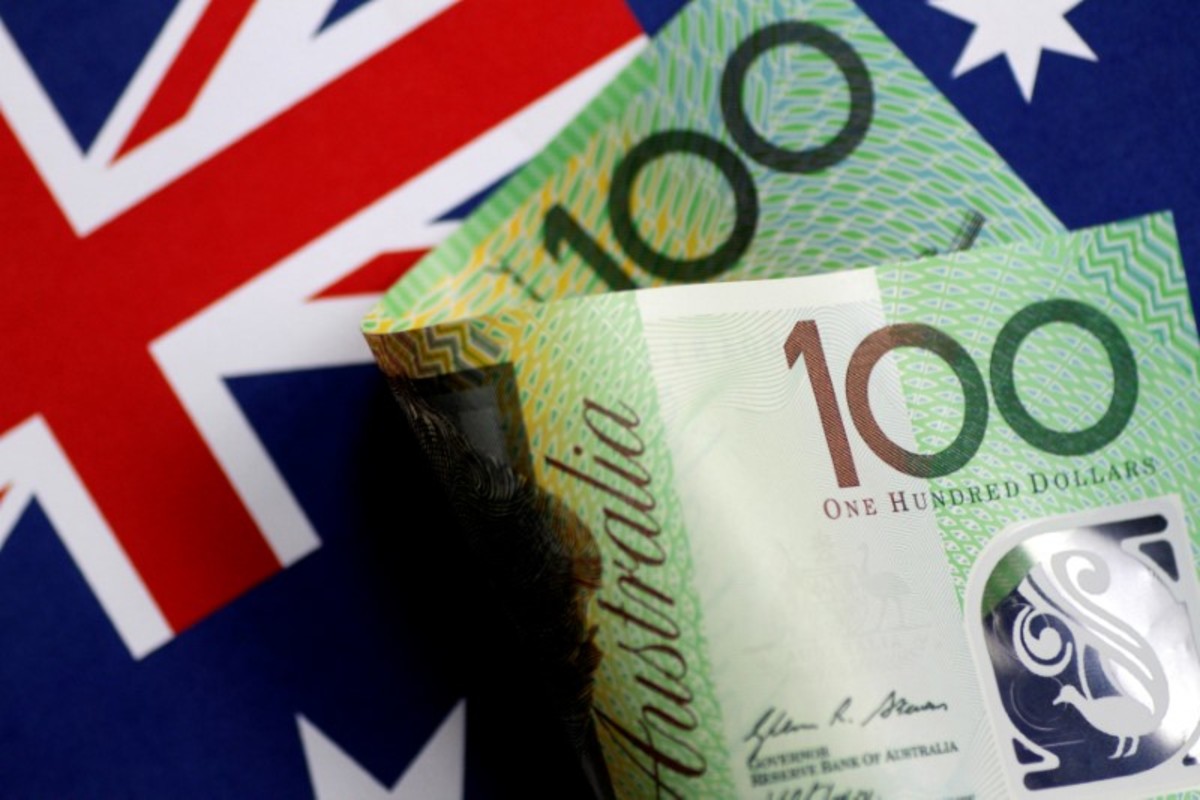
SYDNEY (Reuters) - The Australian dollar took a brief dip on Tuesday after data showed China's factories expanded at a slower pace in October, while the New Zealand dollar tripped after two rare days of gains.
The Australian dollar <AUD=D4>, often traded as a liquid proxy for China plays, was off 0.1 percent at $0.7678, edging closer to 4-month trough of $0.7622 touched last week.
China's official manufacturing Purchasing Managers' Index fell to 51.6 in October, from 52.4, while the services index eased to 54.3 from 55.4 in September.
China is Australia's top trading partner, taking much of its iron ore output, while the services sector accounts for over half of China's economy and is important to Beijing as it rebalances growth away from investment and exports.
The Aussie has underperformed in recent weeks largely on a resurgent greenback. It has fallen more than 4.5 percent since setting a near 2-1/2-year top of $0.8124 last month.
The Aussie is poised for its third straight month of losses in October, but some analysts see its woes coming to an end, at least in the short-term.
"We think the AUD has likely bottomed," ANZ analysts said in a note to clients. "Some consolidation in the USD, along with strong global growth and abundant macro liquidity should keep boosting sentiment and provide a lift to the AUD."
Hindering the Aussie has been a diverging rate outlook. The Reserve Bank of Australia (RBA) is considered likely to keep rates at record lows for many months yet, while the U.S. Federal Reserve is on a clear tightening path.
The premium offered by Australian two-year government debt <AU2YT=RR> over U.S. bonds has shrunk to the smallest since early 2001 at just under 26 basis points.
The New Zealand dollar <NZD=D4> has been under much the same pressure, and was last down 0.36 percent at $0.6850.
The kiwi has fallen in seven out of the last 10 sessions and is on track for its worst monthly showing since January 2016.
It touched its lowest since May last week at $0.6818, which was also its weakest for the year so far. A break there would take it to territory last trod in June 2016.
Foreign investors have been concerned the country's new left-leaning Labour Party government would take a hard line stance on immigration and foreign investment and shake up rules governing the Reserve Bank of New Zealand.
Local business also seemed uncertain with sentiment in an ANZ Bank survey dropping to a two-year low in October as firms grappled with the turbulent political outlook.
New Zealand government bonds <0#NZTSY=> gained with yields slipping 5 ticks at the long end and 2 ticks at the short end of the curve.
Australian government bond futures rose, with the three-year bond contract <YTTc1> up 3 ticks at 97.990. The 10-year contract <YTCc1> added 5 ticks to 97.2950.
(Reporting by Swati Pandey; Editing by Eric Meijer)