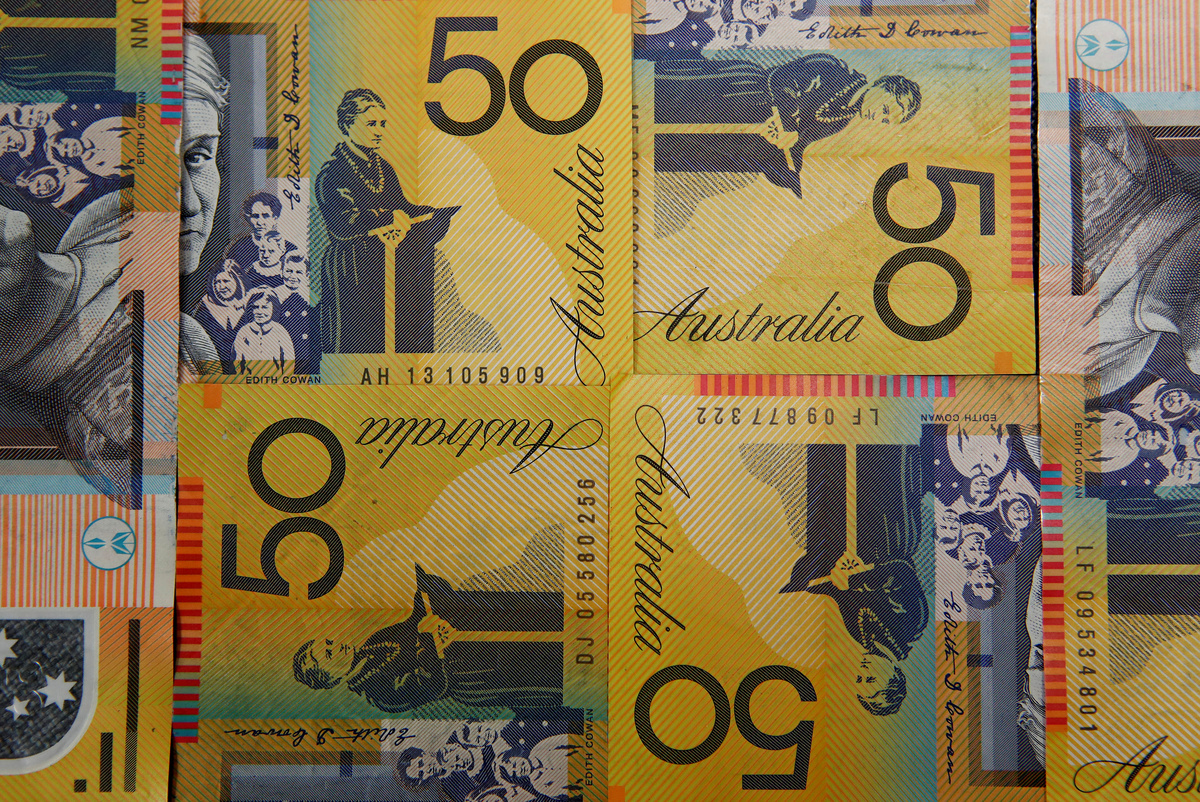
The Australian dollar bounced from a two-week trough on Wednesday as surprisingly strong retail sales data at home helped offset risk aversion globally and prompted a bout of short-covering.
The Aussie blipped up 0.4% to $0.6314 <AUD=D3>, having slipped 0.8% overnight to as low as %$0.6254. It briefly reached as high as $0.6354 but could sustain the rally.
The New Zealand dollar steadied at $0.5973 <NZD=D3>, after dropping 1.1% overnight to as deep as $0.5936.
Both had been under pressure as a drastic slide in oil prices sparked speculation that some investors, companies and countries might have to dump other assets to cover their losses.
The Aussie then got a timely lift when preliminary data showed Australian retail sales surged a record 8.2% in March as a coronavirus lockdown sparked panic buying of food and staples.
The scale of the increase was far beyond expectations and wrongfooted bears, though analysts were quick to emphasise that sales likely tumbled back in April as businesses were shut.
Indeed, Reserve Bank of Australia (RBA) Governor Philip Lowe on Tuesday warned economic output could shrink 10% in the first half of the year, easily the worst since the Great Depression.
Lowe said interest rates were likely to remain at a record low of 0.25% for year to come and reiterated the bank's commitment to buying as much bonds as necessary to keep three-year yields <AU3YT=RR> near the cash rate.
The RBA has actually been able to sharply scale back its bond buying as private demand for Australian debt has been more than strong enough to keep yields low.
A sale of A$1.5 billion in 2030 bonds on Wednesday drew bids worth A$6.4 billion, continuing a run of solid auctions.
"It has been our view throughout the volatility of recent weeks that there was little fundamental reason for bond yields to push significantly higher," wrote analysts at Westpac.
"We expect 10-year ACGB yields to trade below 1%, on average, for months to come," they added. "We see the AU-US 10-yr bond spread as consolidating around 20bps and would recommend fading any supply-led widening over coming months."
Yields on 10-year paper <AU10YT=RR> were trading at 0.84% on Wednesday, 27 basis points above comparable U.S. yields.
The three-year bond future <YTTc1> was half a tick firmer at 99.745, while the 10-year contract <YTCc1> rose 1 tick to 99.1800.
(Editing by Kim Coghill)