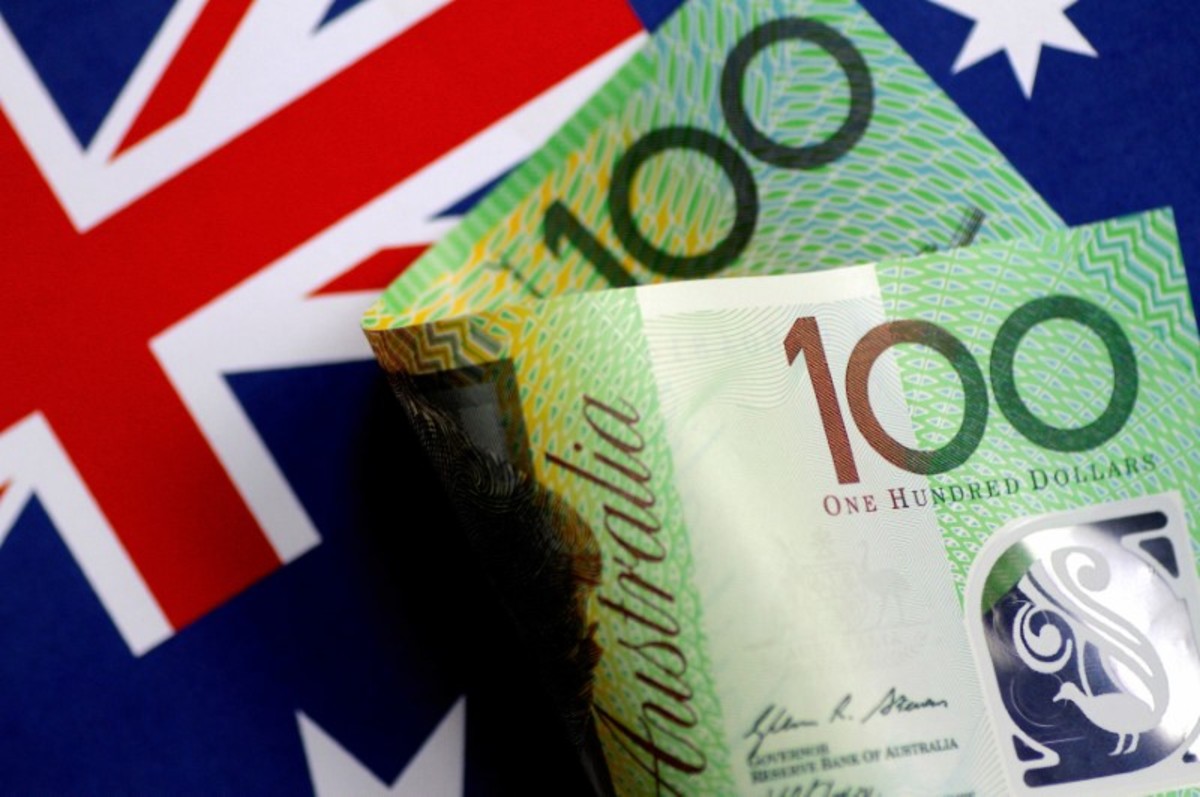
SYDNEY (Reuters) - The Australian dollar treaded water on Tuesday as the country's central bank held a policy meeting against the background of rising Sino-U.S. trade tensions and unease over global growth.
The Aussie dollar <AUD=D4> was idling at $0.7390, sandwiched between support at $0.7350 and resistance at $0.7440. Major chart levels at $0.7311 and $0.7484 have hemmed-in the currency for more than seven weeks now.
The kiwi dollar <NZD=D3> held near the floor of its recent range at $0.6734, not far from support in the $0.6710/20 zone.
The Reserve Bank of Australia (RBA) holds its monthly policy meeting on Tuesday and is considered certain to keep rates at 1.5 percent, marking a record two years without a change.
Attention will be on the RBA's post-meeting statement and any updates to its economic forecasts ahead of a quarterly outlook on monetary policy due on Friday.
Analysts assume it will stick with a prediction of economic growth of 3 percent, or a bit more, for this year and next but again emphasise that necessary progress on inflation and wages will take time.
Markets long ago priced out any chance of a hike in rates this year <0#YIB:> and price in only a 50-50 probability of a move by August, 2019.
"With the RBA firmly on hold, global factors are more likely to be the catalyst for a break of the $0.73-0.75 range which has held since early June," said Westpac senior currency strategist Sean Callow.
"In particular, we will be watching to see if the US-China trade war causes further damage to Australia's key commodity prices."
Copper, for instance, has fallen more than 15 percent since hitting a 4-1/2 year high in June.
Yet China's efforts to cut back on pollution have cut steel supply and raised prices, a boon for high-quality iron ore and coal, Australia's two biggest export earners.
Chinese iron ore futures surged nearly 7 percent to their strongest level since March on Monday, while prices for coking coal hit the highest in a year.
While sidelined on the U.S. dollar, the Aussie was faring better elsewhere.
The euro was down at A$1.5638 <EURAUD=> having touched a seven-week low on Monday at A$1.5604 in the wake of shockingly weak data on German factory orders.
Sterling slid to a two-month trough at A$1.7489 <AUDGBP=> amid concerns the UK could crash out of the European Union without first securing a much-needed trade deal.
British trade minister Liam Fox warned over the weekend the that the odds of Britain leaving the EU without a deal stood at 60-40.
Australian government bonds were little changed, with the three-year bond contract <YTTc1> up half a tick at 97.875. The 10-year contract <YTCc1> was a shade firmer at 97.3250.
New Zealand government bond yields <0#NZTSY=> were down around 2 basis points across the curve.
(Reporting by Wayne Cole; Editing by Eric Meijer)