Australia’s big banks should improve the protection of customers and taxpayers from the risk of bank failures by keeping more capital in reserve, according to the most wide-ranging inquiry into financial services undertaken since the late 1990s.
The Murray inquiry, commissioned by the Abbott government and released on Sunday, recommends strengthening policy settings including by setting Australian bank capital ratios to a rate which places them in the top quartile of internationally active banks.
“Australia should aim to have financial institutions with the strength to not only withstand plausible shocks but to continue to provide critical economic functions, such as credit and payment services, in the face of these shocks,” the report says.
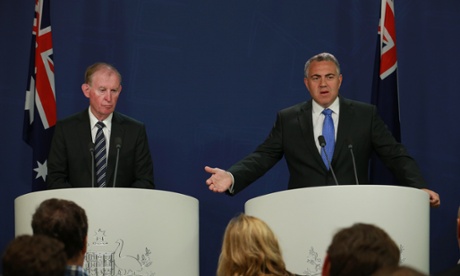
The big banks argue they are among the most well capitalised financial institutions in the world, but the chairman of the inquiry, former Commonwealth Bank chief David Murray, said bank balance sheets required further strengthening to ensure taxpayers didn’t carry the risks of any institutional failures.
Murray told reporters in Sydney on Sunday he believed the big banks, by warning preemptively that additional capitalisation requirements would force them to either raise interest rates or lower dividends, were exaggerating the impact of the proposed change.
The chairman of the inquiry said the recommendations in his report did not mean interest rates would have to rise, but he acknowledged they could impact bank returns.
Both Murray and the treasurer Joe Hockey said implementation of the key recommendation concerning increased capitalisation – in terms of the detail and timeframes – would be a matter for the banking regulator in consultation with the industry.
“From my perspective, I have long stated that it is vitally important that our banks be well capitalised, and they are,” the treasurer told reporters. “What the Murray inquiry is recommending is there be a further look at increasing those levels of capital and that’s something that needs to be dealt with by, appropriately, the regulator.”
The Murray inquiry also contained a number of other recommendations, including:
- setting clear policy objectives for Australia’s superannuation system;
- lowering bank interchange fees; and
- strengthening consumer protections, particularly in financial planning and advice – a sector which has been plagued by scandals.
“The current framework is not sufficient to deliver fair treatment to consumers,” the Murray report found. “The most significant problems relate to shortcomings in disclosure and financial advice, which means some consumers are sold financial products that are not suited to their needs and circumstances.”
The report recommended new “temporary product intervention power” for the corporate regulator, the Australian Securities and Investments Commission, to better protect consumers seeking financial planning advice.
The inquiry also flagged a number of politically sensitive issues around tax reform.
It pointed out that the GST was not levied on most financial services, and it noted that tax concessions in the superannuation system were not well targeted to achieve the aim of providing retirement incomes.
It also gave an explicit warning about the generous tax incentives for housing investments and warned that housing was “a potential source of systemic risk for the financial system and the economy”.
“The tax treatment of investor housing, in particular, tends to encourage leveraged and speculative investment. Since the Wallis Inquiry, higher housing debt has been accompanied by lenders having a greater exposure to mortgages,” the report said.
Hockey was asked whether the Murray report’s observations about tax would prompt the government to take the lead in arguing for a broadening of the base of the GST.
“No. This is the observation of an independent inquiry. They are perfectly entitled to do that,” Hockey said. “They make a number of observations about taxation change. I think this illustrates a fact there needs to be a broad consensus on Australia undertaking change to strengthen our economy and build a better future.”
The shadow treasurer, Chris Bowen, welcomed the release of the Murray report, and indicated the opposition would seek where possible to pursue reform on a bipartisan basis.
The lobby group representing the big banks, the Australian Bankers Association, endorsed some of the Murray recommendations, but made a veiled criticism of the enhanced capitalisation requirements.
“The question we, and the government, must ask on each of these recommendations is simply, does it help or hinder our future economic growth? A careful analysis of each recommendation on this basis is now needed,” said the ABA’s chief executive Steven Münchenberg on Sunday.
“We all saw the benefits of Australia having strong banks during the financial crisis – we now need to ensure our financial system remains strong, and is seen to be strong, to confront any challenges that lie ahead. This has to be assessed against the central role banking plays in supporting the economy and Australia’s current and future prosperity.”