Records broken, power crisis averted
Here’s the wrap of the day.
- Much of NSW, the ACT and QLD sweltered in the mid-30s for much of today ahead of similar extreme heatwave conditions forecast for the weekend
- Sydney Airport recorded its hottest February day with 42.9C at 2:24pm, exceeding the previous high of 42.6C set in 1980
- Observatory Hill in Sydney set a new record for the number of consecutive days above 35C; several parts of Sydney exceeded 40C, while Penrith recorded 44.5C
- Though the Australian Energy Market Operator warned of blackouts forced by a shortfall in electricity supply in NSW, ACT and SA, there was no significant loss of service. The small number of outages reported by Ausgrid this afternoon were attributed to a local network fault
- The Tomago aluminium smelter near Newcastle shut off its three potlines for a period late on Friday afternoon to reduce its electricity usage, as requested by the energy provider AGL and AEMO
- In Canberra, the Senate inquiry into the resilience of electricity infrastructure in a warming world debated the Australian energy network’s reliance on coal, while the federal and SA governments sparred over what was to blame for the loss of power to 90,000 homes in the state on Wednesday
- An out-of-control grass fire in Georges Plain, Bathurst, was contained by firefighters
- A statewide fire ban is in place over the weekend for NSW, many national parks have been closed and the Randwick races have been postponed due to the extreme weather conditions forecast
- Elswhere in Australia, Perth recorded its second-wettest day in history … and snow is forecast for some parts of Tasmania over the weekend
Thanks for following along with our coverage, and if you’re weathering the heatwave in Australia, take care this weekend.
Gold Coast beaches are expected to reopen on Saturday as a heatwave sweeps southern Queensland.
Dangerous swells forced the closure of more than a dozen beaches on Friday, delivering a blow to those wanting respite from the heat.
Beaches at Surfers Paradise, Staghorn Avenue, Elkhorn Avenue, South Narrowneck, Narrowneck, Breaker Street, Broadbeach and Miami remained closed late on Friday afternoon.
However Gold Coast City Council anticipates beaches from Burleigh to Rainbow will reopen on Saturday morning.
“Lifeguards and lifesavers will check the beaches north of this area in the morning prior to making a decision,” a council spokeswoman said.
However, anticipated tidal surges in the morning may delay the flags going up in some areas.
The mercury is expected to reach 34C on the Gold Coast on Saturday as heatwave conditions begin to grip southern Queensland.
Here’s a full report from AAP on the power cut to the Tomago aluminium smelter near Newcastle.
Energy provider AGL has cut power to an NSW aluminium smelter as the state tries to manage record demand for electricity.
The Australian Workers Union has warned the move could “batter” the smelter but AGL says the cut was required to ensure power was kept on in “schools, homes and other small businesses”.
The Tomago smelter uses 950 megawatts a day – about 12% of the state’s electricity – and is AGL’s largest single customer.
The smelter’s three pot line are being shut down sequentially for 75 minutes each from 3.45pm on Friday, Tomago Aluminium chief executive Matt Howell told AAP.
“Our concern is that this was done in the hottest part of the day when the market operator AEMO ... said they only needed us to curtail load for a maximum of three hours. That’s one hour per pot line.”
Workers have donned special suits and are labouring in 80C heat in the smelter on Friday evening to save the plant’s equipment.
AGL defended the move saying it had “certain contractual rights” to interrupt electricity supply at the smelter.
“If power to the smelter is not curtailed, schools, homes and other small businesses will suffer a loss of power at the peak periods of demand this (Friday) afternoon,” an AGL spokesman told AAP.
“This procedure has been implemented previously without adverse effect in similar circumstances to those that exist today.”
But Howell says it’s incorrect to say there’s been “no harm done” in the past.
The union argues workers will need to pull out all stops to save the plant’s equipment and “they may not be successful”.
An outage at the Portland smelter in Victoria in 2016 destroyed millions of dollars worth of equipment, AWU national secretary Daniel Walton said in a statement.
Australian summer.
So hot that the concrete melted my sneakers and gave me 2nd degree burns all over the soles of my feet! 🇦🇺☀👟🔥👣😩 #Australia #heatwave #summer
— Lost Auryn (@lost_auryn) February 10, 2017
My colleagues, Michael Slezak and Dave Fanner, have put together this video explainer outlining why there’s been the risk of power shortages today.
The temperature in Sydney approaching 6pm AEST is a still-sweltering 32.8C. It can expect a forecast high of 39C tomorrow.
Adelaide is at 39.8C, with a forecast high of 34C for Saturday.
Canberra is still at 40.2C with a “hot and mostly sunny” forecast of 41C ahead.
Brisbane is 29.1C now and can look forward to a high of 36C tomorrow.
AEMO downgrades forecast shortfall in NSW
Looks like there’s no need for load shedding.
Aust Energy Market Operator has downgraded forecast shortfall in NSW generation capacity, reducing potential need for any load shedding
— Ausgrid (@Ausgrid) February 10, 2017
Saturday’s Randwick races have been postponed due to the extreme weather forecast for Sydney. Racing NSW and the Australian Turf Club made the call out of concern for the welfare of horses and punters.
Racing NSW chief executive, Peter V’landys AM, said he had been in communication with the Bureau of Meteorology as to the likely conditions.
“Racing NSW and the ATC believed that animal welfare and the welfare of the participants should be the only consideration when making this decision.”
The meeting has been postponed to 13 February, with further details to come.
Power outages in Strathfield and Burwood – but not due to heat
Ten News is reporting that 11,000 homes in Strathfield and Burwood are without power. Ausgrid says it was due to fault on the local network, not load shedding as a result of excessive demand over heat, and that most customers have had services restored.
Power out to about 11,000 customers in parts of #Strathfield, #Burwood, after a fault on local network, not load shedding. Crews are on way pic.twitter.com/55zXSjUdgB
— Ausgrid (@Ausgrid) February 10, 2017
Power back to most customers in Strathfield & Burwood, crews working to reconnect 750 around Burwood Rd & Queen St, reports of wires down
— Ausgrid (@Ausgrid) February 10, 2017
About 900 customers at The Entrance North, NSW, are without power in an unrelated outage. Ausgrid crews are investigating what caused electricity to be lost, and it should be restored by 6:30pm.
This shows the rising demand in parts of NSW over the course of the day as recorded by Ausgrid.
Energy demand rising in parts of Sydney, C Coast & Hunter as temps soar - tracking on par with record peak day on Ausgrid network in 2011 pic.twitter.com/izVI0QiL4v
— Ausgrid (@Ausgrid) February 10, 2017
Questions have been raised over why two units at a major NSW power plant are not operational as the state faces a potential power crisis.
AGL Energy confirmed to AAP that two of the four units at its Liddell power station had been shut down due to leaks in boiler tubes, which can force outages without warning.
AGL expected one of the units to be up and running by late Saturday night but the second would not be functioning until late next week.
Liddell power station was purchased by AGL Energy from the NSW government in 2014. The AGL Macquarie network produces approximately 12% of the power for eastern Australia.
Labor leader Luke Foley demanded an explanation from the Berejiklian government earlier today.
“We’ve got the energy minister out there now on radio telling people to turn off their air conditioners, to turn up the temperature in their refrigerators, just to keep the lights on,” Foley told reporters. “What he hasn’t told us is that only two of the four units at the Liddell power station are operational.”
Energy minister Don Harwin said it was common for coal-fired power stations to have transient faults.
“This is the nature of a coal fired power stations,” he told reporters in Sydney. “Lidell is playing its part and its owner is playing its part in ensuring that we get through today in good shape.”
Updated
Records broken in Sydney
Hottest February day at #Sydney Airport today reaching 42.9C at 2:24pm, breaking previous record of 42.6C set on 21 Feb 1980. #heatwave
— BOM New South Wales (@BOM_NSW) February 10, 2017
Sydney (Observatory Hill) has recorded 10 days above 35C this summer, breaking the previous record (9 days) set in the summer of 1895-96.
— BOM New South Wales (@BOM_NSW) February 10, 2017
Penrith earlier recorded a temperature of 44.5C.
Enjoy a high of 21C in Tasmania on Saturday.
More reasons to migrate to Tasmania. #heatwave #doonatime pic.twitter.com/tWzINqOl8P
— Nicole Sommer (@NicSommer) February 10, 2017
Meanwhile, in Perth:
A major flood warning has been issued for Northam, east of the city, with people told to prepare to evacuate. Rapid and powerful flooding is expected in the Avon River.
Minor flooding is also predicted for the Perth metropolitan area, due to rising waters in the Murray and Swan River catchments as unusually heavy summer rain hits WA’s south.
At least the covers stayed on at Abbett Park @mgcclub pic.twitter.com/nI7jdMd6ff
— Justin Perks (@Perksy_73) February 10, 2017
The heat is affecting the air quality in Sydney with ozone leading to poor readings in east and north-west Sydney as well as the lower Hunter, central coast and Illawarra regions.
“Poor” denotes a score of between 100 and 149 on the air quality index. Parts of Sydney had recorded similar readings in early January.
Ozone is an irritant secondary pollutant formed by chemical reactions between atmospheric gases and nitrogen oxides from car-vehicle exhausts on sunny days. The problem is exacerbated by lack of wind.
Updated
National parks in NSW close over the weekend
Environment NSW has closed many national parks and reserves in Sydney, across the Hunter, central coast and Great Lakes regions, and the upper central west and north-west regions as a result of the elevated fire danger over the weekend.
The acting director of the metro branch of the National Parks and Wildlife Service, Deon Van Rensburg, said the closures were about safeguarding the public when the risk of fire was high.
“We apologise for any inconvenience but are sure most will agree it is the right thing to do in the face of such extreme heat and heightened bushfire risk.”
Some visitor areas would remain open. For updates and the latest information visit Environment NSW’s website, but at this stage the closures will affect these parks across the Hunter, central coast and Great Lakes region:
- Watagans national park
- Blue Gum Hill national park
- Karuah national park
- Wallaroo national park
- Karuah state conservation area
- Medowie state conservation area
- Karuah nature reserve
- Medowie nature reserve
- Wallingat national park
- Jilliby state conservation area
- Popran national park
Also affected were all parks across the upper central west and north-west areas, including:
- Warrumbungle national park
- Pilliga national park, Pilliga state conservation area and Pilliga nature reserve
- Mount Kaputar national park
- Beni state conservation area
- Goonoo state conservation area
Updated
Trunkey Rd has reopened following the grass fire on Wimbledon Rd in Bathurst.
Penrith at 44.5C as elsewhere in Sydney registers above 40C
Observations released by the Bureau of Meteorology just after 4pm have put Sydney airport at 39C, and 37.2C for Observatory Hill in Sydney.
Olympic Park, Badgerys Creek, Bankstown, Camden, Campbelltown, Canterbury, Holsworthy, Horsley Park, Lucas Heights, Mangrove Mountain, Richmond and Williamtown were all recording temperatures of above 40C.
Penrith recorded 44.5C.
Current temperatures around #NSW and #Canberra. More at https://t.co/2qM1QRn3xE. #heatwave #NSWweather #ACTweather pic.twitter.com/cF7Ay25yP5
— BOM New South Wales (@BOM_NSW) February 10, 2017
In the Hunter region, Cessnock airport had recorded 43.3C and Maitland airport 42.8C.
Mudgee, in the central tablelands, had just cracked 40C, as had Canberra in the southern tablelands and Gunnedah airport in the north-west slopes and plains.
A statewide fire ban is in place over the weekend.
Statewide total fire ban Sat/Sun. Broad areas Severe and Extreme fire danger. Catastrophic conds from Central West to Hunter Sunday. #NSWRFS pic.twitter.com/rWYDH0hXJS
— NSW RFS (@NSWRFS) February 10, 2017
Updated
Liberal Senator, Chris Back, has just pointed out in the Senate committee that Perth has experienced its coldest February maximum temperature and its wettest February day.
Back, a West Australian, also objected earlier today to references to the “national electricity market” and “national electricity grid” because it implied there was a giant cable across the Nullarbor Plain when WA is in fact not connected to the “east coast electricity market”.
So it seems the point of this intervention is to demonstrate he is a proud West Australian rather than suggesting we all hop on a flight to Perth to cool down.
Updated
Tomago smelter shuts down potlines
Further to the warning that Tomago aluminium smelter near Newcastle might have power cut to it this afternoon, the ABC Newcastle’s Giselle Wakatama has said it has been forced to shut down three potlines by energy provider AGL.
Tomago’s chief executive, Matt Howell, told ABC Newcastle that forcing the smelter to shut down power could cause catastrophic damage to equipment and was a disgrace. The Australian Workers Union has also resisted the decision.
Powering down: #Newcastle #Tomago Aluminium plant shuts down potlines to save NSW from #blackouts @1233newcastle @abcnewsSydney pic.twitter.com/lQwVCkTg2X
— Liz Farquhar (@lizfarquhar) February 10, 2017
. #Tomago aluminium says Australia is a country where lights should always be on. Says AGL's forced shutdown unacceptable. @1233newcastle
— Giselle Wakatama (@GiselleWak) February 10, 2017
. #Tomago aluminium boss outraged re AGL's forced shutdown 'Should not be forcing manufacturing to the wall bc we can't keep lights on'
— Giselle Wakatama (@GiselleWak) February 10, 2017
The NSW energy minister, Don Harwin, has thanked Tomago for doing its bit to reduce demand on electricity.
According to the Newcastle Herald, the smelter consumed 12% of the state’s energy and was asked to reduce its energy consumption this afternoon. AGL said in a statement that it would cut power to the plant if necessary, as agreed with AEMO.
AGL statement re Tomago pic.twitter.com/PGaBx0Gj6X
— Michael McGowan (@mmcgowan569) February 10, 2017
Updated
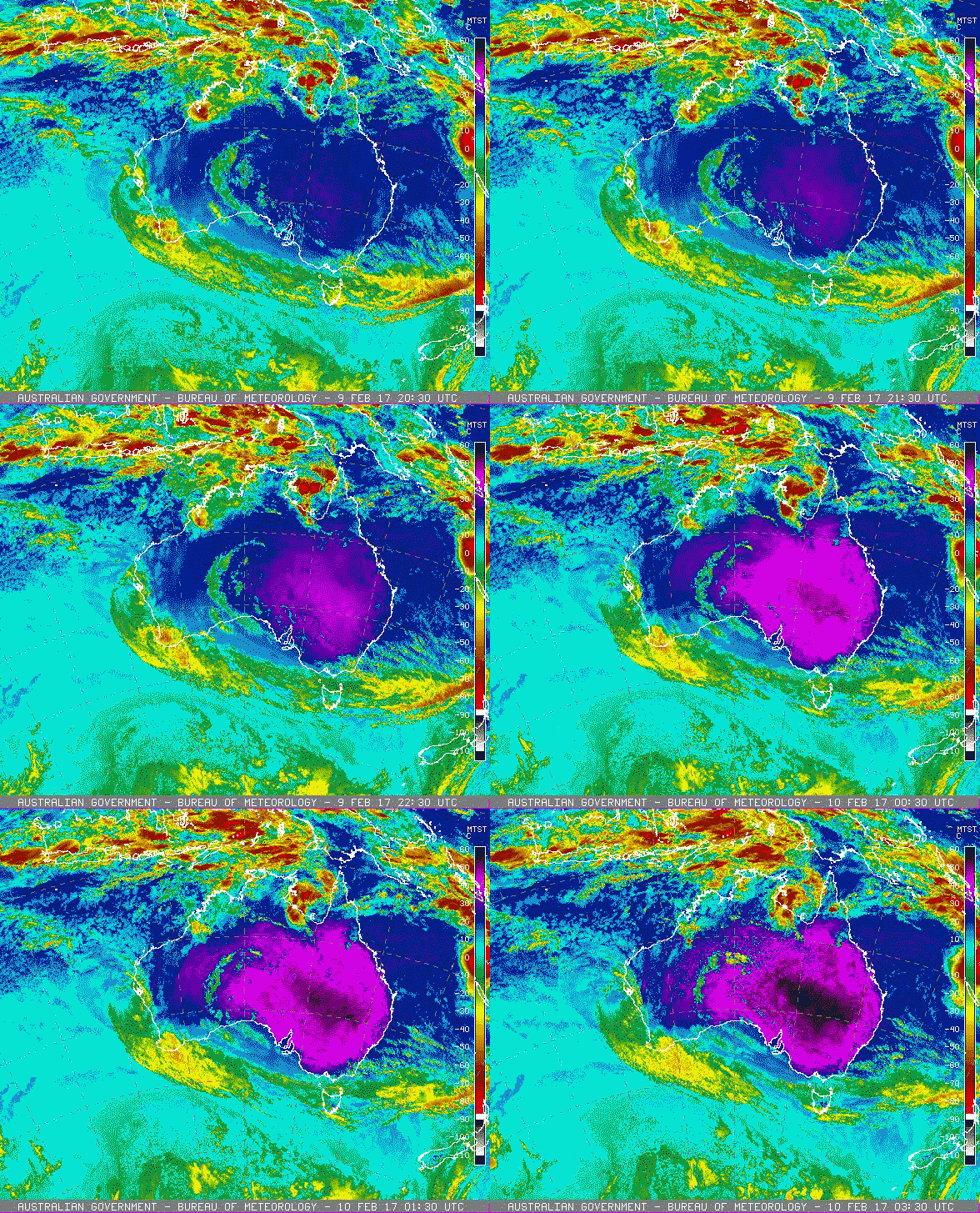
This graphic shows temperature change from satellite from 0630 to 1330 AEDT.
Mildura has hit 45C, and Swan Hill 42C in Wangaratta.
Sydney airport has recorded its hottest February day in more than 70 years: 43C.
Sydney Airport has hit 43C, the hottest February day on records going back over 70 years #heatwave
— Tristan Meyers (@TristanJMeyers) February 10, 2017
Updated
We’re nearing crunch time for electricity supply, with the Australian Energy Market Operator warning of potential shortfalls from 3.30pm AEDT. AEMO expects electricity demand in NSW to reach about 14,700 megawatts, the highest-ever level in the state. The real-time graphic showing electricity price and demand on its website is apparently not loading.
The Australian Workers Union has warned that the Tomago aluminium smelter near Newcastle could be “battered” if energy provider AGL cuts power for four hours this afternoon, as it threatened to do.
Workers would have to labour in 37C heat to save the plant’s equipment from destruction if that occurred, the AWU’s national secretary, Daniel Walton, said.
“Our information is that power could be cut this afternoon ... If that happens the results could be catastrophic,” he said. “Workers will have to pull out all stops in sweltering heat to save the plant’s equipment. They may not be successful.”
An outage at the Portland smelter in Victoria in 2016 destroyed millions of dollars worth of equipment, the union secretary said. AAP sought comment from AGL.
Updated
The Senate committee now has its star witness: the Australian Energy Market Operator’s executive general manager, David Swift. This is the body that intervened to “shed load”, ie order blackouts in South Australia when demand outstripped supply.
“We certainly weren’t asleep at the wheel,” Swift said of Wednesday’s blackout.
He explained AEMO’s forecast for energy demand was below what eventuated due to “the extremity of the day”.
“It was the highest day of demand ever in South Australia by quite a significant margin,” he said.
He said on Tuesday peak demand was 1,800MW. On the Wednesday it was over 3,000, which he called an “unprecedented rise and an unprecedented level of demand”.
By the time the gap in supply was clear, it was too late to order the second gas generator at Pelican Point.
The committee chair, Sarah Hanson-Young, wasn’t impressed: “My 10 year-old daughter knew it was going to be stinking hot on Wednesday.”
Updated
Heat check: 3pm AEDT
Canberra: 39.3C (forecast high: 41C)
Adelaide: 36.3C (39C)
Sydney: 36.2C (38C)
Brisbane: 32.3C (32C)
Darwin: 27.7C (30C)
And from Guardian Australia’s Mike Bowers’ dashboard in Liverpool, Sydney, 40 minutes ago ...
from @mpbowers' dashboard in Liverpool, Sydney #heatwave pic.twitter.com/xoCXjchxUG
— Elle Hunt (@mlle_elle) February 10, 2017
Queensland contributes power to help other states
Queensland will be “chiming in” with 1,000 megawatts of excess power generation to help other states, the state’s energy minister, Mark Bailey, has said.
That amount, which is what the Australian Energy Market Operator has asked for, is the maximum that can be sent via the power interconnector to New South Wales, Bailey said.
Bailey, a staunch renewable energy advocate bent on trying to lift that sector’s share of state generation to 50% by 2030, noted: “We’re expecting Queensland power to be chiming in through the interconnector to our bigger NSW neighbours to meet their power needs today.”
On most days the Queensland network produces 8,000 MW, with an excess reserve capacity of 2,000 MW.
“This is a classic case of the interconnector [being] a valuable piece of technology, because quite frankly, without Queensland power today, NSW would be in absolute dire straits,” Bailey said.
He criticised the federal government for its attacks on renewable energy.
“The NSW crisis today, where they’ve got a lack of reserve… this is in a state with one of the lowest levels of large-scale renewables in the country,” Bailey said.
“That’s something [the federal government] can’t explain because it doesn’t fit in with their ideological position.”
The ABC has a handy state-by-state guide to when the most unpleasant bit of the heatwave will end.
In summary: on Sunday in SA, on Sunday and Monday in NSW, and Tuesday in Queensland (although later in the north).
In the ACT it’ll cool to “only” 32C on Sunday and be more bearable on Monday.
A 2014 study by researchers from Macquarie University on the number of heat-associated deaths found there were significantly more heat-associated deaths in the early 1900s, but that there has also been a recent increase in the 2000s:
Here’s the same chart, but showing total deaths rather than a rate of population:
Fire crews “are gaining the upper hand” on that blaze in Georges Plains, Bathurst.
WATCH & ACT: Wimbledon Rd, Georges Plains. #NSWRFS crews are gaining the upper hand. Residents to monitor conditions. pic.twitter.com/MsZB7KikLW
— NSW RFS (@NSWRFS) February 10, 2017
... and snow forecast in Tasmania
With much of mainland Australia bracing for heatwave conditions, residents in some parts of Tasmania have quite a different weekend ahead.
The forecast for Mt Wellington in Hobart warns of snow above 900m on Sunday and above 1,000m on Monday. The forecast high for each day is 6C and 7C.
Snow was also forecast above 1,000m in Lake St Clair in the state’s central plateau, and above 900m in Liawenee.
Hobart, at least, has a reasonably warm – if wet – weekend ahead, with a forecast high of 22C for Saturday and 17C for Sunday with showers developing.
Updated
Second-wettest day in Perth ...
As NSW, the ACT and South Australia brace for possible heatwave-related power cuts, nearly 10,000 properties in Perth have been left without electricity for another reason.
Heavy rain in WA’s south-west has caused flash flooding, cutting power to 9,000 properties. Perth has come close to having its wettest day, with more than 114mm of rain in the 24 hours to Friday morning – slightly shy of the record 120.6mm that fell on 9 February 1992.
The unseasonal weather also resulted in the city reaching only 17.4C on Thursday, making it Perth’s coldest February day.
A Western Power spokesman there 2,900 homes were still without electricity on Friday morning.
The Bureau of Meteorology duty forecaster, Catherine Schelfhout, said there would be risks of flooding in the upper Swan River in coming days.
“This weather is pretty unusual.”
Updated
The Greens have given their two cents on the South Australian blackout at a press conference in Canberra.
The leader, Richard Di Natale, said there was spare capacity that wasn’t used, referring to the second Port Pelican gas generator. He said the blackout was therefore like turning on your fan/refrigerator when it wasn’t plugged in.
Di Natale called Malcolm Turnbull a “climate Judas” because the government is considering supporting “clean coal” technology, which he said amounted to selling out the planet to keep the Liberal leadership.
Sarah Hanson-Young, who is chairing the Senate committee into electricity infrastructure, said the solutions to blackouts were investment in storage solutions, and new rules for the market operator so they could be ordered to bring supply online to keep the lights on.
She questioned why the energy minister, Josh Frydenberg, hadn’t done that, and said the treasurer, Scott Morrison, bringing a lump of coal to question time on Thursday was “a stunt”.
The #heatwave sun beating down right now cld be landing on solar plants, powering our fans & air conditioners. But our gov just wants coal.
— Adam Bandt (@AdamBandt) February 10, 2017
Updated
Three students have been hospitalised north of Brisbane after suffering from heat-related problems.
Paramedics treated 16 teenagers at The Lakes College about 10am AEST, and two girls and one boy were taken to hospital as a precaution.
Two students transported to hospital suffering heat related illness at The Lakes College North Lakes. @9NewsBrisbane pic.twitter.com/537xNndOql
— Tessa Hardy (@TessaHardy9) February 10, 2017
In South Australia, 39 have been admitted to hospital with heat-related illnesses in the past two days, according to SA Health.
People in heatwave conditions have been advised to avoid strenuous physical activity in the heat of the day and to drink plenty of water.
Signs of heat-related illness may include nausea, vomiting, faintness and dizziness, loss of appetite, weakness and headaches.
Canberra residents are being reminded to reduce their electricity use as the temperature rises to 40C in the national capital.
They’ve been told to limit air conditioning by not going below 26 degrees and turning off all unnecessary lighting, the emergency services agency says.
Using dishwashers, dryers and vacuum cleaners should also be avoided to limit non-essential electricity use especially during the afternoon peak period.
“The ACT has been advised due to the potential for record high electricity demand across NSW because of the extreme heat conditions there may be minor supply shortfalls across the network,” the ESA warned on Friday.
The temperature in Canberra hit 37.7C at 1pm, according to the Bureau of Meteorology.
A total fire ban is in place for the ACT on Friday and Saturday.
Last chance to charge your phones ...
The chart below, from the Australian Energy Market Operator, is for New South Wales but the situation is similar for Queensland.
Shit's about to get real in the electricity market #blackout #heatwave pic.twitter.com/Rn1GwI7PxJ
— Luke Marshall (@lukasmarshall) February 10, 2017
Greenpeace is calling on the Turnbull government to give up its addiction to coal, which it says is making heatwaves more extreme and leaving many Australians without electricity.
Climate and clean energy campaigner Nikola Casule said: “The best way to guard against blackouts is to invest across the grid in renewable energy and storage, which provides affordable, reliable power without adding more fuel to the fire of global warming.
“The treasurer’s antics waving around coal in the parliament yesterday won’t do anything to help Australians suffering through unbearable heat and worrying about blackouts today.”
Casule is referring there to Scott Morrison bringing a sizeable chunk of coal into question time on Thursday for show and tell with Labor: “This is coal, don’t be afraid.”
Barnaby Joyce juggled with it.
Guardian Australia’s Katharine Murphy wrote of the episode:
What a bunch of clowns, hamming it up when real people are suffering blackouts in South Australia, when the country is sweltering through a summer that feels ominous and oppressive – that heat that just won’t let up, almost as if those pesky climate scientists might be on to something.
Updated
Trunkey Rd in Georges Plains, Bathurst, is closed in both directions between Wimbledon Rd and Rockley Rd due to that grass fire. The advice from NSW RFS is to avoid the area.
WATCH & ACT: Wimbledon Rd, Georges Plains. Crews working to hold the fire at Trunkey Rd. #NSWRFS pic.twitter.com/04KWF4BJvm
— NSW RFS (@NSWRFS) February 10, 2017
GEORGES PLAINS: Trunkey Rd is closed in both directions btn Wimbledon Rd & Rockley Rd due to a grass fire. Avoid the area. pic.twitter.com/L6zwIUKkWK
— Live Traffic NSW (@LiveTrafficNSW) February 10, 2017
WATCH & ACT: Wimbledon Rd, Georges Plains. Fire moving in a SE direction towards Trunkey Rd. Firefighters assisted by aircraft. #NSWRFS pic.twitter.com/Sf1cWIKXPk
— NSW RFS (@NSWRFS) February 10, 2017
The status of the fire remains at “watch and act”.
Updated
Nem-Watch and RenewEconomy have produced a live widget that displays how much electricity in each state is being generated, and from what source.
When blackouts occurred in SA, it appeared politically expedient for some to blame the high proportion of renewables used in that state.
But looking at the widget below, it’s clear that explanation wouldn’t work for NSW, where the majority of electricity is from coal.
The body that runs the national electricity market is still warning of possible blackouts in NSW this afternoon.
The highest risk is now between 3.30pm and 5.30pm.
The Australian Energy Market Operator calls this “load shedding”. In order to protect the infrastructure, the load on the system is reduced by ordering blackouts.
The aim of load shedding is to minimise impact on any one group of energy users, by rolling the blackouts around different areas.
But if the demand and supply changes rapidly, that is not always possible.
The market operator – Aemo – has been begging energy generators to bid into the electricity market, but they appear to not have had enough of a response.
They have now turned to asking consumers – you – to use less electricity. In a media release today, they said: “If consumers can safely reduce their electricity consumption during periods of high demand, this can ease the supply/demand balance and can mitigate the need for load shedding.”
Heat check: 1pm AEDT
-
Canberra 37.7C
-
Adelaide 37.3C
-
Sydney 35.5C
-
Brisbane 32.8C
The fire in Georges Plains is an out of control glass fire on Wimbledon Road. NSW RFS has put its status at “watch and act”, reflecting a “heightened level of threat” – one step above “advice”, indicating that a fire has started but there is no immediate danger, and below an “emergency warning”, the highest level of alert possible.
Updated
Here’s chopper footage of that fire on Wimbledon Rd, Georges Plains.
“Isolated properties are in the area.”
WATCH AND ACT: Wimbledon Rd, Georges Plains. #NSWRFS crews on scene fighting a fast moving grass fire. Isolated properties are in the area. pic.twitter.com/pQ6CQTMUie
— NSW RFS (@NSWRFS) February 10, 2017
Grass fire in Bathurst
A few minutes ago the Rural Fire Service reported a “fast-moving grass fire” in the Georges Plains region of Bathurst. I’ll see what more I can find about this.
#NSWRFS crews on scene at a fast moving grass fire at Wimbledon Rd, Georges Plains (Bathurst LGA).
— NSW RFS (@NSWRFS) February 10, 2017
The NSW RFS warned of dangerous fire conditions across much of NSW yesterday, with commissioner Shane Fitzsimmons pointing to the potentially deadly combination of extremely high temperatures and wind.
Severe and extreme fire dangers were expected in widespread areas, and there was the potential for catastrophic fire danger in the Hunter region on Sunday.
If you see an unattended fire, you’re reminded to call 000.
Updated
In Port Stephens, in the Hunter region of NSW, beach patrol hours have been extended for the weekend.
Heatwave update Port Stephens public swimming pools will be open until 8pm Sat/Sun. Plus our beaches patrolled extended hours, on demand.
— PortStephensCouncil (@PSCouncil) February 9, 2017
Near Hay, in the western Riverina region, Fairfax’s Daisy Huntly has taken a temperature of 52.6C in a shearing shed – and nearing 47C outside.
According to Bom, that’s the max forecast for the day.
It's 52C in the shearing shed near #HayNSW. Outside heading to 47. Start early, finish early. https://t.co/nIFhqrQ7GR #heatwave #riverina pic.twitter.com/RLbr8rNM2N
— Daisy Huntly (@DaisyHuntly) February 10, 2017
Labor MP Tony Burke:
We must have the world's only govt saying the answer to extreme heat & climate change is fewer renewables and more coal.#auspol #heatwave
— Tony Burke (@Tony_Burke) February 10, 2017
It’s not on the market yet, but scientists have invented a material that’s cheap to produce, lightweight, and can cool a surface against the heat of the sun without using energy.
AFP reported on Thursday that a study published in the journal Science found a glass-polymer hybrid material, only slightly thicker than aluminium foil, could be “transformative” in radiative cooling technology.
Uses for the product could include keeping buildings and other objects cool, as well as extending the life of solar panels.
In field tests the material showed a cooling power roughly equivalent to the electricity generated using solar cells for a similar area, and could cool continuously both day and night.
“Just 10 to 20 square metres of this material on the rooftop could nicely cool down a single-family house in summer,” said co-author Gang Tan, an associate professor in the University of Wyoming’s department of civil and architectural engineering.
Researchers say the material is lightweight, easy to fit to curved surfaces, and fairly simple to mass produce.
Updated
As heat rises, more electricity is needed to be used by appliances around the state, especially by air-conditioners that need to work harder to keep offices and homes cool.
On Thursday the Australian Energy Market Operator sent out several increasingly dire warnings about the likely shortfall of electricity supply. The first said there would be a 19MW deficit in NSW about 3pm.
As it does in these situations, it asked the market to respond. In other words, it asked generators to get ready to fire up their turbines and bid into the electricity market. But that request seemed to go unheeded.
Throughout the afternoon on Thursday the forecast deficit when from 19MW to over 250MW, to as much as 419MW at the last update a little after 5pm yesterday.
To put that in context, that’s about as much energy as the total a large gas power plant can produce, and about a third of the maximum capacity of a coal power plant. It’s a lot of energy.
The crazy thing is that the demand for electricity is forecast to be significantly less than the full capacity of the electricity generators in the state.
Even if you exclude all the wind and solar, the state has about 15,500MW. And that’s not even including the electricity that can be imported from Queensland.
So why there’s a shortage is not totally clear. And why electricity generators aren’t offering to bid into the market, even though wholesale electricity prices are going to be very high, is rather confounding.
Whatever the case is, with NSW having relatively little renewable energy capacity, the desperate rush from the coal lobby and the Coalition to blame renewables will be a little hard to maintain.
Updated
Heat check – and possible new records
It’s a little after noon AEDT and here’s how the heatwave-affected cities are shaping up.
-
Canberra 36.3C (forecast high: 41C)
- Adelaide 34.8C (39)
-
Sydney 31.9C (38)
- Brisbane 29.6C (32)
Meanwhile, a climate and health expert at the Australian National University’s climate change institute has warned that extreme high temperatures across NSW and the ACT could set temperature records.
Dr Liz Hanna, president of the Climate and Health Alliance, says the extreme heat in these regions could set records for the number of consecutive days above 35C. It is rare for Sydney to record three days in a row of 35C. There have been only four occasions in history, the most recent in early January 1994.
"There's potential for this #heatwave to break the #Canberra #heat record," @_LizHanna #climate #weather @ANUFennerSchool @ANUmedia @BOM_au pic.twitter.com/4wpuTdTBSm
— Adrienne Francis (@AdrienneFranci1) February 10, 2017
Four consecutive days in January 1960 topped 39C; two of them were above 41C.
Penrith and Richmond, in Sydney’s western suburbs, have not had three consecutive days above 42C in 22 years and 64 years respectively – but that could change this weekend.
As of 5 February, the northern NSW town of Moree had endured more than a month of days at or above 35C, more than double the number of consecutive days the previous record set in 1981.
The Bureau of Meteorology has forecast two days of 41C in Canberra, close to the record for the city’s hottest day, set at 42.2C in 1968.
Updated
Don't fight the sweat today. EMBRACE IT. 😎 #heatwave pic.twitter.com/s0IMFyge9q
— triplejHack (@triplejHack) February 9, 2017
Even Australia’s native fauna, evolved over centuries to cope with its extreme weather conditions, struggle in summer.
Wires, the animal welfare agency, has published tips on how you can help. They’re also the people to contact if you come across an animal in distress.
The #heatwave will cause problems for wildlife. Learn how to identify wildlife suffering from heat stress https://t.co/r0P1eDYKIV pic.twitter.com/B0TgFe9Tmh
— WIRES (@WIRES_NSW) February 9, 2017
Updated
In a statement published this morning, the Australian Energy Market Operator has warned of “tight” electricity supply conditions for NSW and the ACT. It says it’s as simple as people using more electricity – on air-conditioning and fans – because of the hot weather.
It says shortfalls could be possible during the afternoon peak from about 1530 AEDT to 1730, “which may trigger the need for localised load shedding to rebalance the power system” to protect the network from damage, meaning households would be deliberately disconnected.
It says it will aim for “rotational load shedding” to reduce the burden on its network but minimise the impact on any one group of customers.
The question – particularly in SA where 90,000 households were without power – is whether something can be done, or we’ve just got to put up with shortfalls in future. Remember, all the signs point to even hotter summers to come. (I’m not happy about it either.)
Updated
While we’re on the subject of energy, construction on the Silverton windfarm in western NSW is finally set to begin, after the sale of the project from AGL to its Powering Australian Renewables Fund.
The deal will see AGL pay just $65 a megawatt hour for the first five years of the windfarm’s operation, effectively undercutting current prices for coal-generated electricity.
“It’s a very low price, which demonstrates the amazing innovation and cost curve that renewable energy is on,” says Alicia Webb, director of large-scale energy at the Clean Energy Council, the clean energy industry’s peak body.
Updated
Evidence of the carnage my colleague Naaman Zhou reported on this morning.
Fan stocks are running low. Good luck #TamworthNSW #heatwave pic.twitter.com/DO4DDHMoro
— Jacob McArthur (@jlmcarthur4) February 10, 2017
With #heatwave trending all morning, Twitter is expressing its distress the only way it knows how: in gifs.
#Australia 🇦🇺 #heatwave ☀️ #StaySafe #straya pic.twitter.com/gSI9bVb3T3
— Kylie (@Kylie_Lovers23) February 9, 2017
Obligatory #heatwave Tweet pic.twitter.com/0HCwElwDTv
— Maria Catanzariti (@mariac) February 9, 2017
Me now that the #heatwave is back: pic.twitter.com/IVGllVfLqP
— She's On The Money (@ShesOnTheMoney) February 9, 2017
#heatwave pic.twitter.com/O6x2Ixl7cb
— Peter V (@wesmantooth4774) February 9, 2017
How I'll be spending my Sunday #heatwave #noaircon pic.twitter.com/zSouhWAcDS
— Brooke Power (@brooke_power) February 9, 2017
Hello Sydney 🔥🤒👎🏻#Heatwave #Melting #hurryupwinter pic.twitter.com/hyyJUgzTFF
— Scotty (@ScottCragg) February 9, 2017
TGIF?? #heatwave #sydney #why pic.twitter.com/d3FSG14j9t
— Chanel Basha (@sensachanel_) February 9, 2017
Some energy providers are giving customers advance notice of planned power outages – this one for eight hours on 1 March, nearly three weeks away.
Work has turned up the thermostat. @essentialenergy just sent me this. Time to nationalise power generation & distribution.#auspol #heatwave pic.twitter.com/gjiqrhAUoO
— J__A (@P_B_Wee) February 10, 2017
The Senate committee in Canberra is inquiring into the resilience of electricity infrastructure, in part because everyone is sticking their air con on owing to global warming.
While One Nation’s Malcolm Roberts has spent most of the morning trying to get witnesses to say that you can’t power an aluminium smelter off solar energy, the Greens’ Sarah Hanson Young wants witnesses to bite back on the federal government’s tendency to blame power outages on renewables.
In relation to South Australia’s outages in recent days because of the heatwave John Bradley, the chief executive of Energy Networks Australia, said the “rush to blame after an operational event that occurred a few days ago is part of the problem”.
“There are clearly issues with extreme weather events since last year contributing to outages. But the lessons of individual operational events need to be worked through in a clear way rather than engage in a rush to judgment.”
He didn’t pin the all blame on the federal government, because all governments, state and federal, are responsible for aspects of energy policy.
Updated
The RSPCA has renewed its warning not to leave dogs in hot cars, with multiple such fatalities already this summer. Police are investigating the deaths of four dogs this week in Gulgong, NSW, after being left in the back of a ute.
“It’s apparent some people are just not getting the message that a parked car is no place for a dog. It can be lethal, as we see all too often,” said the RSPCA’s NSW chief inspector, David O’Shannessy.
The RSPCA’s “Just Six Minutes” campaign refers to the length of time it takes a dog to die in a hot vehicle. Owners of dogs that die from being left in a car can be fined $22,000 or sentenced to two years’ prison.
Anne Fawcett, a veterinarian at Sydney Animal Hospitals Inner West, has shared her tips for caring for animals in extreme heat.
This French bulldog, pictured in Sydney’s Central Park just before 10am, has figured it out for himself.
It's nearly 30 degrees at 9:40am in Sydney and this dog is just sitting in a park fountain pic.twitter.com/Ay4sBf2wRt
— Elle Hunt (@mlle_elle) February 9, 2017
Updated
Though not all classrooms in Australia are air-conditioned, it seems there is no heatwave-related equivalent of a “snow day” granting pupils a day off. (In New Zealand, there are sometimes “earthquake days”.)
The ABC has education departments’ policies by state and it seems only in extreme circumstances will the heat force school closures. In Victoria, “extreme weather conditions” may just mean a shorter lunch break (though dismissal time is “adjusted accordingly”).
Just how bad is it going to get? The word for the weekend
We’re not far off the forecast highs for the day, with Canberra at 35.3C, Sydney at 33.7C, Adelaide at 32.9C and Brisbane at 30.1C. (Melbourne is at a very comfortable 20.7C, and Perth, where there are flooding warnings, is just below 15.9C.)
The Bureau of Meteorology has warned of severe to extreme heatwave conditions for southern Queensland and northern NSW for “several days”, with widespread temperatures in the low to mid-40s. Queensland also has high humidity to contend with.
At the weekend, the severe heatwave will contract to eastern NSW with localised extreme patches through the northern coastal areas. SA and Victoria will experience easing conditions.
The #heatwave situation for Friday, Saturday and Sunday from @BOM_au https://t.co/C4H9ruVN7g pic.twitter.com/N7UJ9QTKHu
— Elle Hunt (@mlle_elle) February 10, 2017
Heading into Monday, “extreme” conditions will give way to those that are just “severe”, with a low-intensity heatwave moving across central and southern parts of Queensland.
By Tuesday, even NSW residents can look forward to some relief. These graphics show three-day forecasts for the situation.
Updated
In South Australia, flying foxes are reportedly dropping dead as a result of the extreme heat. The ABC reports that bats do not cope well in hot weather and that a Natural Resources SA ecologist expects the number of fatalities to rise.
Below is an image of a dead bat being bagged. SA residents are advised not to touch the animals themselves as they may be diseased.
Flying foxes dropping dead in South Australia's #heatwave https://t.co/5mAHsPeDKw pic.twitter.com/ZiL2ASED2J
— ABC News (@abcnews) February 9, 2017
Updated
If you’d like to see how One Nation’s Malcolm Roberts is engaging with the Senate inquiry into the resilience of electricity infrastructure in a warming world, the Adelaide Advertiser has his exchange with a scientist over “empirical evidence” that human activity has affected global temperatures.
Updated
A majority of Kmart, Target, Big W, Bunnings Warehouse and the Good Guys stores were claiming to have completely sold out of portable fans owing to extreme demand, with Target staff in Sydney telling the Guardian that “as soon as a pallet hits the floor, it’s gone within a couple of hours”.
“Every second customer wants a fan. I feel bad for them, because as soon as we get any, they’re gone.”
A Big W store in Sydney’s west said it had sold out a month ago, and had no new stock on the way. A store manager added that all retailers in the local area were sold out.
Maddie McCarthy, a student from Wollongong, has spent the past two days on the hunt, after her box fan “wasn’t cutting the mustard”. She was told by a number of major retailers that fans were effectively sold out in the Illawarra region. “I never heard anything about when they’d be back in stock.”
Calls to stores in Woollongong confirmed they were sold out, with store managers unable to remember the last time they were in stock. In Sydney Target staff said they occasionally received new shipments overnight but could not be sure. The Sydney Morning Herald reported that a Kmart in Bondi Junction was only expecting more stock “next summer”.
A spokesperson for The Good Guys said its stores were seeing “incredible demand in NSW as a result of the current heatwave”.
“As fast as we can get stock in, they are flying out the door. We have been bringing more stock into our stores to try and keep customers satisfied but we expect that this weekend’s heatwave will see an almost unprecedented level of demand.”
Residents in search of relief have taken to venting online, with one Reddit user complaining:
“Kmarts Ashfield, Burwood, Broadway have all run out of pedestal fans and are not getting any more in because they are now stocking up on winter items (would you believe?)”
Updated
Tens of thousands of South Australian homes were deliberately blacked out on Wednesday evening as a result of a heatwave. SA Power Networks initially put the number of affected households at 44,000, but later confirmed to the Adelaide Advertiser that it was as high as 90,000.
The front page of today’s Tiser suggests that SA residents might be a bit fed up.
Today's @theTiser front page #newsADL #Adelaide #SAParli #FrontPagesToday pic.twitter.com/Qx0vxr8PdN
— Greg Barila (@GregBarila) February 9, 2017
The Australian Energy Market Operator ordered a second generator for Port Adelaide’s Pelican Point to provide support on Thursday afternoon, and called for backup for NW on Friday and Saturday.
The SA premier, Jay Weatherill, is blaming the national electricity market for the failure, stating that the Aemo could not be trusted to deliver reliably. But the prime minister, Malcolm Turnbull, has criticised the state government for opening itself up to risk with its renewable energy policy.
The Advertiser has reported on the blame game here. A Senate inquiry under way in Canberra today will hear about how the national grid can cope with spiking demand and renewable generation – Guardian Australia’s press gallery team will be reporting back on that later on.
Updated
Meanwhile, on the other side of the continent, very different records are being broken in Western Australia. It’s the second-wettest day for Perth in recorded history, and could break the record for the coldest February morning.
Oops! Nice Beemer trapped in flood waters in Osborne Park this morning. @9NewsPerth pic.twitter.com/Olt92GMNhv
— Scott Cunningham (@cunninghamscott) February 9, 2017
Updated
NSW is bracing for catastrophic weather, with emergency services on standby and authorities pleading with the community to be vigilant.
The heatwave across the state, centred around the Hunter, will gradually worsen from Friday through to Sunday.
“The catastrophic conditions is something that has not occurred in NSW since 2013,” the police and emergency services minister, Troy Grant, said in a press conference this morning.
There is severe fire danger forecast for the ACT, and Grant said emergency services would be on high alert across the weekend. He encouraged people to postpone plans to visit national parks or areas where there was a fire risk, and suggested that “local infrastructure” such as “shopping centres [and] movie theatres” would offer respite from the heat”.
The press conference can be viewed in its entirety on NSW police’s Facebook page.
Updated
Good morning,
It’s a day of extreme heat in many parts of Australia, with temperatures forecast to hit the mid-40s in parts of New South Wales, Victoria and Queensland. In NSW, police and health authorities, bracing for three days of 40-plus temperatures, have triggered their “heatwave action plan”.
On top of expeceted hospital admissions, there is a high chance of bushfires and potential power cuts. A heatwave cut electricity to 44,000 households in South Australia on Wednesday, prompting questions about Australia’s energy security as we continue what is likely to be our hottest summer ever.
I will be blogging today from the air-conditioned comfort of Guardian Australia’s office in Sydney, where the mercury had already hit 30.6C just after 10am. Tell me if it’s hot enough for you in the comments or on Twitter.
Updated